The Effects of Economic Growth and Recent Trends (HSC SSCE Economics): Revision Notes
📚Revision Notes
The Effects of Economic Growth and Recent Trends
Economic growth has traditionally been viewed as the most important economic policy goal. This is because achieving higher GDP makes it easier to meet other economic and social objectives. However, rapid growth can also create challenges that policymakers must manage carefully.
The effects of economic growth
Economic growth produces both positive and negative effects across the economy. Understanding these impacts helps explain why governments aim for sustainable rather than maximum growth rates.
Living standards
When the economy grows faster, real GDP per capita increases. This means real wages tend to rise, giving households more disposable income to spend on goods and services. Higher material living standards are the primary reason countries pursue economic growth.
Note
Australia's recent experience shows that growth alone does not guarantee rapid improvements. In the five years before the COVID-19 pandemic, real GDP averaged just 1.1% annually, compared to 2.1% in the 1990s. This slower growth meant Australian living standards improved more gradually than in previous decades.
Employment
Economic growth creates new job opportunities. When an economy sustains strong growth, everyone willing and able to work should find employment. Growth also transforms the types of jobs available, creating positions requiring higher skills that boost productivity and generate higher incomes.
Important
Australia's experience after COVID-19 demonstrates this connection. Strong economic recovery following the 2020 recession drove unemployment below 4% for the first time since the 1970s, showing how growth directly supports job creation.
Inflation
Higher economic growth can trigger price increases and larger wage demands, pushing inflation upward. This problem becomes particularly acute when the economy operates near full capacity and aggregate supply cannot keep pace with aggregate demand growth. Inflation often emerges as an unwanted side effect of rapid expansion.
Important
The Balancing Act of Sustainable Growth
Policymakers therefore aim for the sustainable rate of economic growth – a pace that generates employment and maintains external balance while keeping inflation within the target range of 2–3%. This balancing act represents a major challenge for macroeconomic policy.
External stability
Growing economies typically experience rising disposable incomes, which increase consumption of imported goods. Unless export growth matches import growth, the balance of goods and services deteriorates and the current account deficit widens.
Excessive current account deficits can undermine confidence in an economy. This creates a balance of payments constraint where policymakers may deliberately slow growth to improve external stability.
Note
The "Speed Limit" Concept
The balance of payments can effectively become a "speed limit" on how fast the economy can expand. Just as a car cannot safely exceed certain speeds on different roads, an economy cannot grow faster than its external balance allows without risking instability.
Income distribution
Economists traditionally assume economic growth raises living standards for everyone. However, growth benefits often flow disproportionately to higher-income earners, highly skilled workers, and capital owners rather than spreading evenly through wage increases for low-skilled workers or lower prices for low-income households.
Important
Growth Does Not Guarantee Equality
When growth benefits are not widely shared, inequality rises. While absolute poverty should fall as the economy expands, relative poverty may increase if income distribution becomes more unequal. This means some groups can be left behind even during periods of strong overall growth.
Environmental impacts
Pursuing economic growth without regard for environmental consequences can lead to pollution, depletion of non-renewable resources, and the catastrophic effects of climate change. Recent decades have seen stronger focus on ecologically sustainable development – protecting the environment while maintaining economic growth.
Environmental protection can actually support long-term growth. For example, a 2023 McKinsey consulting group report estimated that transitioning to net zero carbon emissions could boost Australia's GDP by $75 billion annually through to 2035, demonstrating that environmental and economic goals can align.
Note
The McKinsey finding challenges the traditional assumption that environmental protection necessarily limits economic growth. Instead, it suggests that strategic environmental investment can create new economic opportunities and enhance long-term prosperity.
Recent trends in economic growth
Understanding the business cycle
Economic activity is never completely stable. Market economies like Australia's experience ups and downs of the business cycle – fluctuations in the general level of economic activity caused by changes in aggregate supply and demand.
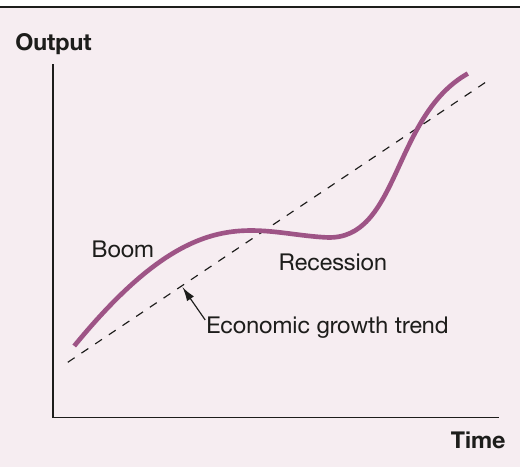
The diagram above shows a typical growth pattern. While real GDP trends upward over time, the pattern is uneven. Periods of stronger growth (booms) alternate with slowdowns and sometimes recessions.
Important
Defining a Recession
A recession occurs when there is a decline in economic activity, defined as two consecutive quarters (six months) of negative economic growth. This technical definition helps economists and policymakers identify when the economy has moved beyond a temporary slowdown into a more serious downturn.
Australia's remarkable growth record
Australia's economic growth over recent decades has been relatively stable compared to previous business cycles and other economies. The country achieved a record-breaking 28 years of continuous economic growth from 1991–92 to 2019–20, averaging 2.9% annual GDP growth throughout this period.
This performance placed Australia among the highest average GDP growth rates in OECD countries. However, real GDP per capita averaged only 1.6% over the same period – close to the OECD average.
Note
Why Total GDP Growth Differs from Per Capita Growth
This difference reflects Australia's high population growth, which allows high total GDP growth alongside average per capita growth. When population grows rapidly, total economic output can increase substantially even if the economic benefit per person grows more modestly.
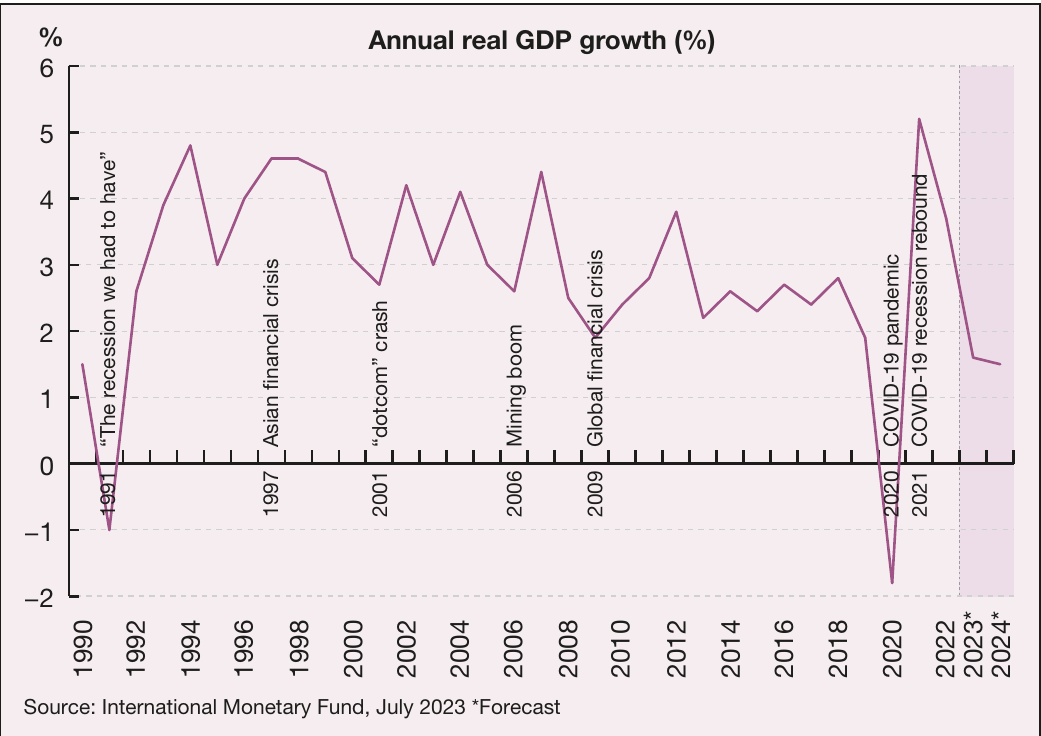
In 2020, Australia experienced its first recession since 1991, with contractions of 0.2% and 6.7% in the March and June quarters respectively due to the COVID-19 pandemic. The economy then staged an equally sharp recovery, with growth levelling out to pre-pandemic rates.
Eight factors influencing Australia's business cycle
Australia has mostly benefited from global economic trends alongside successful policy management:
Global economic conditions have been mostly favourable for Australia in recent decades. Strong demand for resource exports underpinned a mining investment boom and subsequent surge in export revenues. This increased national income and helped the economy rebound quickly from external shocks like COVID-19 in 2020 and the global financial crisis in 2008. However, supply chain disruptions and Russia's 2022 invasion of Ukraine triggered global inflation that has impacted Australian growth.
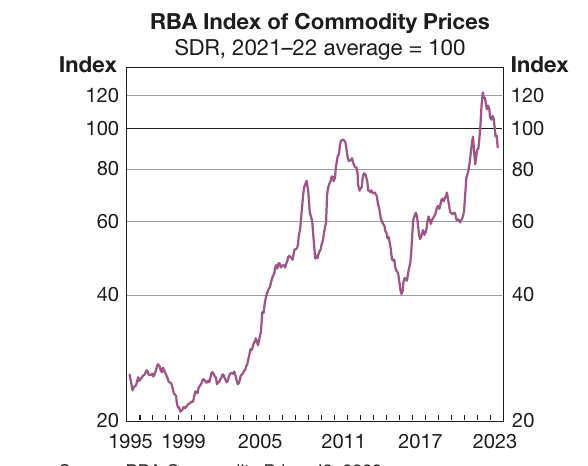
Terms of trade booms occurred from 2005–2011 and 2017–2022, driven by large increases in prices for commodity exports (specifically iron ore, coal and natural gas). Export revenues grew substantially, improving the balance on goods and services and leading to consecutive current account surpluses that addressed longstanding balance of payments concerns.
Note
Achieving the Sustainable Growth Rate
Sustainable macroeconomic policy has largely maintained appropriate growth rates over three decades. The Australian Treasury estimates the long-term sustainable rate of economic growth at around 2.5% of GDP. In the three decades to 2020, growth remained between 2–4% for 22 out of 30 years, demonstrating effective management.
Pre-emptive monetary policy by the Reserve Bank of Australia has supported growth during downturns. When interest rates are adjusted in anticipation of changes in growth and inflation, this is called pre-emptive monetary policy. For example, the RBA reduced the cash rate three times in 2019 to 0.75%, then to a record low 0.10% during the pandemic.
Important
The Challenge of Monetary Policy Balance
The Reserve Bank aims to maintain low inflation and sustainable growth, though this balancing act faces criticism. In 2022–23, the RBA was criticized both for raising rates too slowly as inflation grew, and for raising them too far, contributing to sharper growth slowdown. This illustrates the difficulty of achieving the perfect policy balance.
Counter-cyclical fiscal policy has successfully stabilized growth during downturns. The Government's response to COVID-19 in 2020 represented the largest fiscal policy intervention in Australian economic history, helping ensure a smaller downturn than other countries and quick recovery.
High population growth has been sustained through immigration since the mid-20th century, making Australia one of the fastest-growing advanced economies. However, COVID-19 forced international border closure for the first time since World War II, with negative net overseas migration in 2020–21. This contributed to labour shortages constraining growth in 2022–23, prompting a temporary lift in annual migration to 200,000 and comprehensive program review.
Asset price increases in real estate and shares since the early 2000s increased household wealth, encouraging greater borrowing and consumption. This wealth effect tends to increase economic growth. While higher housing prices constrain homebuyer spending power, the overall wealth effect supports expansion.
Note
The Productivity Growth Challenge
Productivity growth slowdown has contributed to lower recent growth rates following record 1990s growth. The Productivity Commission's 2022 inquiry reported labour productivity growth averaged 1.1% annually in the 2010s, compared to 1.3% in the 2000s and over 2% in the 1990s. Other advanced economies have experienced similar slowdowns.
The unending resources boom
The most significant economic development during Australia's long growth cycle was the mining boom. Reserve Bank Governor Glenn Stevens described it as the greatest expansionary shock to the Australian economy in over 50 years.
Strong growth in China and other emerging economies created soaring demand for natural resources like coal, gas and iron ore. This led to sharp price increases and the largest improvement in Australia's terms of trade for 150 years.
Note
Why Commodity Prices Soared
The spike in global resource prices was especially large because of prolonged low investment in mining worldwide. Global supply was price inelastic – mining companies could not increase output quickly in response to higher demand, so prices soared. Average prices for Australia's commodity exports tripled between 2003 and the cycle peak.
This sparked the largest sustained terms of trade improvement on record. Although the terms of trade dipped during the 2009 global financial crisis, it quickly rebounded to reach a 140-year high in 2011. The Reserve Bank noted in 2011 that the boom had added 15% to Australia's nominal GDP, equivalent to over $190 billion annually. This exceeded the impact of the information and communication technology revolution on national income.
While foreign-owned mining companies sent some profits overseas, Australian taxpayers benefited through higher company tax receipts that allowed personal income tax reductions.
Important
Long-term Impact of the Resources Boom
A decade and a half after the boom began, income per person was around 20% higher than the mid-2000s, and average real wealth per person had risen 40%. Commodity export prices remained resilient even after many economists declared the resources boom ended in 2012.
Global recessions typically trigger commodity price downturns, but after COVID-19, prices for iron ore, copper, nickel, lithium and coal surged, partly due to supply chain disruptions. In 2021–22, both iron ore and coal prices exceeded the 2011 mining boom record, again driving Australian growth. The mining boom that began in 2003 continues in many respects into the 2020s.
Note
Future Resources and the Energy Transition
While fossil fuel demand will decline as economies transition to net zero emissions, resources including lithium and cobalt – critical inputs for clean energy technologies – will likely continue supporting Australian economic growth. The shift from one type of commodity to another may sustain Australia's resources sector advantage.
Australia's GDP performance
Note
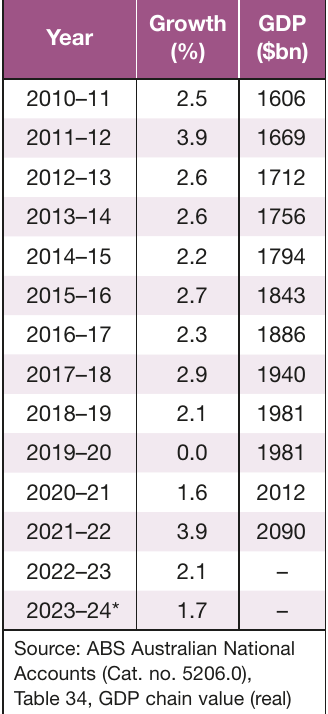
The table shows Australia's annual growth rates and GDP values from 2010–11 to 2023–24. Notable features include zero growth in 2019–20 during the COVID-19 pandemic, strong rebounds in 2011–12 and 2021–22 (both 3.9%), and GDP increasing from $1,606 billion to $2,090 billion over the period.
The "three Ps" and future outlook
According to the Australian Treasury, "the three Ps" – productivity, participation and population – are key to Australia's long-term economic growth. Sustaining long-term productivity growth, high workforce participation levels, and continued population growth from natural increase and immigration will help Australia achieve the highest possible sustainable growth rate.
Important
Challenges for Future Growth
However, Australia's 2023 Intergenerational Report highlighted ongoing concerns for each indicator. It projected average annual growth falling from 3.1% in the past four decades to 2.2% real GDP in the next four decades.
Key concerns include:
- Low labour productivity growth due to slowing educational attainment growth
- Workforce participation expected to decline as the population ages
- Population growth rates fallen due to the COVID-19 migration slowdown and lower overall fertility rates
Remember!
Summary
Key Takeaways: Economic Growth and Recent Trends
- Economic growth produces both positive effects (higher living standards, job creation) and negative effects (inflation pressures, environmental damage, potential inequality)
- The sustainable rate of economic growth (around 2.5% for Australia) balances employment growth and external stability while keeping inflation within the 2–3% target range
- Australia achieved 28 consecutive years of growth (1991–2020), averaging 2.9% annual GDP growth, before the COVID-19 recession
- The resources boom driven by Chinese demand for commodities has been the most significant factor in Australia's recent growth, continuing into the 2020s
- The "three Ps" – productivity, participation and population – are critical for sustaining long-term growth, but all three face challenges in coming decades
- Effective pre-emptive monetary policy and counter-cyclical fiscal policy have helped Australia navigate global economic shocks more successfully than many other advanced economies