The Causes of Unemployment (HSC SSCE Economics): Revision Notes
📚Revision Notes
The Causes of Unemployment
Economists have different views on what causes unemployment and how governments should address it. Understanding these causes is essential for developing effective policies to reduce unemployment and achieve full employment in the Australian economy.
Overview of unemployment causes
There are multiple potential explanations for why unemployment exists in an economy. These causes can be broadly categorised into demand-side factors (related to the level of economic activity) and supply-side factors (related to the characteristics and flexibility of the labour market itself).
Note
Key causes of unemployment include insufficient economic growth, poorly designed macroeconomic policies, structural changes in the economy, rapid technological advancement, inadequate worker training, excessive labour costs, and inflexibility in the labour market. Each of these factors can contribute to unemployment in different ways, and often multiple causes operate simultaneously.
The level of economic growth
Labour demand is a derived demand, meaning that employers only hire workers because there is demand for the goods and services those workers produce. When aggregate demand in the economy falls, this typically leads to a reduction in the demand for labour and a rise in unemployment.
A decline in aggregate demand can occur for several reasons:
- An economic downturn that reduces domestic consumption and investment spending by households and businesses
- Contractionary macroeconomic policies implemented by government and the Reserve Bank to control inflation
- Reduced demand for Australian exports due to a global recession, slower growth in major trading partner economies, or declining competitiveness of Australian products
Important
The relationship between economic growth and unemployment follows a clear pattern:
- When economic growth falls below approximately 2% per year, unemployment tends to rise
- When growth exceeds 3% per year, unemployment typically falls
- When growth sits in the 2-3% range, unemployment levels tend to remain relatively stable
This pattern was clearly demonstrated during the period from 2003 to 2008, when strong economic growth saw unemployment fall from around 7% to 4%. More recently, the sharp economic contraction at the start of the COVID-19 pandemic in March 2020 caused an immediate surge in unemployment, while subsequent economic recovery led to unemployment falling below 4% by 2022-23.
Note
Reserve Bank research suggests that changes in economic activity take approximately two years to have their peak impact on the unemployment rate. This lag means that policies designed to reduce unemployment through economic growth may not show their full effects immediately.
Changes in economic growth primarily affect cyclical unemployment, which is the component of unemployment that rises and falls with the business cycle.
The stance of macroeconomic policies
Government fiscal policy and Reserve Bank monetary policy significantly influence cyclical unemployment through their impact on the business cycle and aggregate demand.
Expansionary policies aim to stimulate economic growth and job creation by increasing aggregate demand. This can be achieved through:
- Lower interest rates that encourage borrowing and spending
- Increased government spending on goods, services and infrastructure
- Tax cuts that increase disposable income
Contractionary policies aim to reduce inflation by dampening aggregate demand, though this may increase unemployment in the short term. These policies include:
- Higher interest rates that discourage borrowing and spending
- Reduced government spending
- Tax increases that reduce disposable income
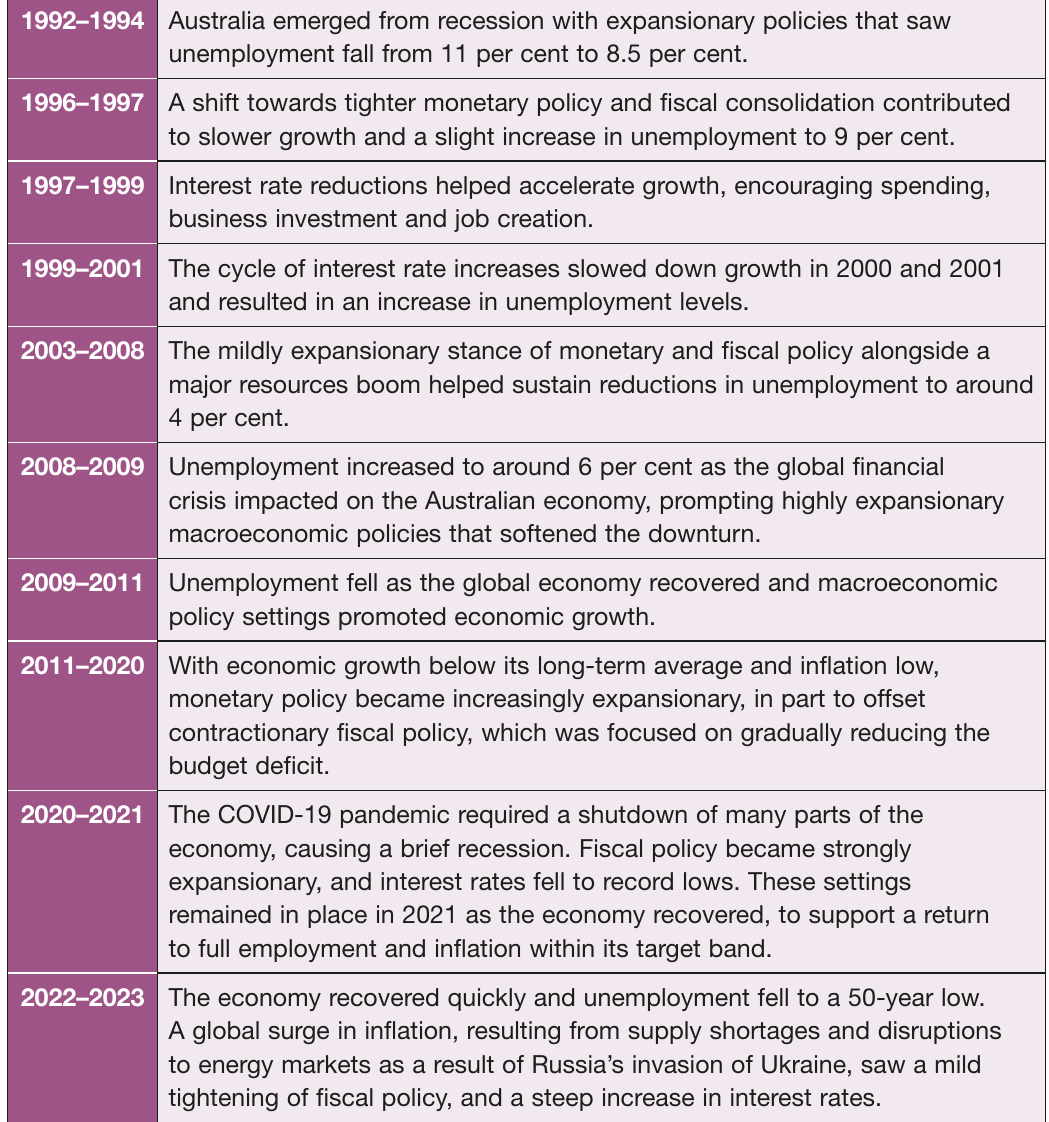
The table below shows how different policy stances have affected Australian unemployment over three decades:
Example
Policy Impact Example: The COVID-19 Response
During 2020-21, the COVID-19 pandemic necessitated highly expansionary policies, with fiscal policy providing substantial support payments and interest rates falling to record lows. These policies supported economic recovery and helped unemployment fall to historically low levels by 2022.
However, when inflation surged globally in 2022, the Reserve Bank implemented 11 consecutive interest rate rises from May 2022 onwards, representing a shift toward contractionary monetary policy despite the risk of slightly higher unemployment.
Constraints on economic growth
Over the longer term, unemployment is influenced by an economy's ability to sustain economic growth. If there are significant constraints preventing growth, the economy will struggle to create sufficient jobs to reduce unemployment.
Historically, the main constraints on Australian economic growth have been inflation and external balance concerns (the current account deficit). In recent years, concerns about these constraints had diminished. However, a surge in inflation during 2022-23 demonstrated that these constraints can re-emerge. This inflation surge, caused partly by global supply chain disruptions and energy market disruptions following Russia's invasion of Ukraine, necessitated interest rate increases that slowed economic growth.
Note
Economists disagree about whether inflationary pressures are likely to be sustained or temporary, which affects their views on appropriate policy responses and the likely path of unemployment.
Rising participation rates
An increase in the labour force participation rate can cause a temporary rise in the unemployment rate, even during periods of economic recovery. This seemingly counterintuitive relationship occurs because more people who were previously not actively seeking work begin looking for jobs.
Important
Understanding the Participation Paradox
During economic recoveries, discouraged jobseekers observe improving employment opportunities and decide to re-enter the labour market. Unless these returning workers find jobs immediately, they are classified as unemployed, which increases the measured unemployment rate.
This phenomenon helps explain why unemployment may decline slowly during an economic recovery, even when both economic growth and employment growth are strong. The entry of additional jobseekers into the labour market partially offsets the reduction in unemployment that would otherwise occur from job creation.
Structural change
Structural change in the economy creates significant short-term costs, particularly job losses in less efficient industries and sectors undergoing major transformation. Globalisation has accelerated this process, as domestic businesses become more integrated into global supply chains and some jobs are moved offshore.
Note
Research on job losses in OECD countries shows that automation accounts for approximately twice as many job losses as trade and globalisation. This suggests that technological factors, rather than international competition alone, are the primary driver of structural unemployment in developed economies.
Recent decades have seen major structural shifts in the Australian labour market. The services sector now employs more than three-quarters of Australian workers, while manufacturing employment has fallen from 13.8% of total employment in 1991 to 6.5% in 2023. Agriculture, forestry and fishing employment has declined from 6% to 2.2% over the same period.
Growth industries include:
- Health care and social assistance (now employing around 2.1 million Australians)
- Professional services (around 1 million workers)
- Construction (around 1 million workers)
- Education (around 1 million workers)
- Hospitality (around 1 million workers)
The expansion of health care employment reflects Australia's ageing population and is expected to continue, as many of these jobs are difficult to automate.
One emerging structural shift is the increase in remote working and reduction in face-to-face contact jobs, a trend accelerated by the COVID-19 pandemic.
Technological change
Rapid technological advancement can cause unemployment, particularly in the short term. The pace of labour market change is expected to accelerate during the 2020s as automation driven by artificial intelligence transforms jobs and creates new categories of employment.
The Productivity Commission's 2023 Productivity Inquiry report highlighted the potential for AI to drive future productivity growth in Australia. Research firm Forrester estimates that Australia could experience up to 1.5 million job losses by 2030 due to AI and automation. However, these losses are likely to be offset by the creation of new jobs that utilise AI technologies.
Note
The Job Creation-Destruction Balance
The World Economic Forum's 2023 Future of Jobs report predicts a 35% increase in demand for data analysts and information security analysts by 2027, creating a combined 2.6 million jobs globally. The report notes that 60% of current professions did not exist in 1940, suggesting that AI-driven change will create entirely new categories of work rather than simply eliminating existing jobs.
The fastest-growing roles are expected to be:
- Technology-related positions (such as AI and machine learning specialists)
- Sustainability-related roles (such as renewable energy engineers)
The fastest-declining roles are clerical and administrative positions, including bank tellers and postal service clerks.
Productivity
Labour productivity significantly affects employer decisions about hiring and employment levels. Productivity changes have different short-term and long-term effects on unemployment.
Important
Short-term vs Long-term Effects of Productivity
In the short term: Higher productivity growth tends to slow employment growth or increase unemployment, because fewer workers are needed to produce each unit of output. Businesses can produce the same amount with fewer employees, reducing the demand for labour.
In the long term: Higher productivity growth contributes to stronger economic growth, which leads to lower unemployment rates. An economy with higher productivity is more competitive internationally and can sustain faster growth, ultimately creating more jobs.
Conversely, lower productivity growth may reduce unemployment in the short term (as more workers are needed per unit of output) but increase unemployment in the longer term. An economy with lower productivity growth will be less competitive and slower-growing, limiting job creation over time. Additionally, employers may respond to low productivity by substituting capital equipment for labour, further reducing employment.
Inadequate levels of training and investment
Structural unemployment arises from a mismatch between the skills of unemployed workers and the skills required for available job vacancies. This mismatch suggests problems with the education and training system.
During the 2000s, significant skills shortages emerged across many parts of the Australian economy, affecting tradespeople, health professionals, and construction workers. At the peak of the pre-global financial crisis boom in 2007-08, 85% of all occupations experienced skill shortages. By 2023, this had reduced to 19 occupations on Australia's skill shortage list.
Note
Persistent shortages continue for technicians and trade workers, including arborists, carpenters, stonemasons, bakers, pastry cooks, plumbers, and air conditioning mechanics. The existence of significant skill shortages alongside substantial unemployment indicates gaps in Australia's education and training provision.
Inadequate training levels also make Australia more reliant on skilled migration to fill job vacancies, rather than developing skills within the domestic workforce.
Increased labour costs
Rising labour costs (wages) can contribute to higher unemployment, though in recent years economists have been more concerned about low wage growth than excessive wage increases. The excessive wage growth that contributed to inflation during the 1970s and early 1980s is not currently a major concern.
Several circumstances could lead to increased labour costs causing higher unemployment:
Labour shortages in skilled occupations may lead employers to compete for limited workers, driving up wages generally and potentially creating wage inflation that overheats the economy.
A wages breakout can occur when nominal wages rise too quickly, outstripping both inflation and productivity increases. This reduces business profits, potentially causing businesses to substitute capital for labour or reduce output, effectively leading to workers pricing themselves out of jobs.
Substantial increases in award wages by the Fair Work Commission (the government agency regulating Australian workplaces, setting minimum wages, approving workplace agreements, and resolving some industrial disputes) could make it too expensive for some employers to maintain their current workforce. While such increases improve living standards for lower-paid workers, they may reduce employment if businesses cannot absorb the additional costs.
Rising labour on-costs can also increase total employment costs. These on-costs include:
- Payroll tax
- Superannuation contributions
- Sick leave
- Holiday pay
- Workers' compensation insurance
Since government policy decisions primarily determine these costs, changes in regulation can significantly affect the demand for labour.
Inflexibility in the labour market
Labour market inflexibility may contribute to higher labour costs and unemployment. Some economists argue that Australia's relatively high minimum wage rates make it less attractive for employers to hire less-skilled workers, contributing to higher unemployment. They suggest that labour market deregulation might reduce minimum wages and unemployment levels.
Note
A 2019 Institute of Public Affairs study titled "Expanding Economic Opportunity: An International Comparison of Australia's Labour Market Regulation" attributed Australia's underemployment levels to labour market regulation. The study ranked Australia 105th out of 140 nations for wage determination flexibility and 110th for hiring and firing flexibility.
However, OECD studies typically characterise the Australian labour market as relatively flexible compared to other developed economies. These studies emphasise the need for improvements in skills and training to reduce underemployment, rather than focusing primarily on labour market rules and regulations.
This debate about labour market flexibility is explored in greater detail in other policy discussions about employment regulation and industrial relations reforms.
Summary
Key Points to Remember:
-
Economic growth is crucial: Unemployment rises when growth falls below 2% and falls when growth exceeds 3%, with a two-year lag between economic changes and their peak impact on unemployment.
-
Multiple causes interact: Unemployment results from a combination of factors including insufficient demand, technological change, structural shifts, inadequate training, and labour market characteristics.
-
Policy matters: Expansionary macroeconomic policies reduce cyclical unemployment by increasing aggregate demand, while contractionary policies may increase unemployment in the short term to control inflation.
-
Structural change is ongoing: Australia's shift from goods production to services employment has been dramatic, with health care now the largest employer and manufacturing employment halving since 1991.
-
Technology creates and destroys jobs: While AI and automation may cause up to 1.5 million job losses by 2030, new technology-related jobs are expected to offset these losses, requiring workers to develop new skills.