The Impacts of Unemployment (HSC SSCE Economics): Revision Notes
📚Revision Notes
The Impacts of Unemployment
High unemployment creates serious negative effects across three main areas: the economy, individuals, and society as a whole. This is why reducing unemployment is a key goal of economic management in Australia.
Economic costs
Opportunity cost
When people are unemployed, the economy's resources are not being used to their full capacity. This means the economy operates below its production possibility frontier.
Note
The production possibility frontier represents the maximum possible output an economy can produce when all resources are fully employed. Operating below this frontier indicates productive inefficiency and lost economic potential.
The main consequences are:
- Total output falls below its potential level because unemployed workers are not contributing to production
- Lower output leads to reduced household incomes and spending
- Businesses face lower sales and profits
- Business investment, production and economic growth all decline
Lower living standards
Unemployment directly reduces living standards in two ways:
For the unemployed:
- They must rely on welfare payments, which provide much lower incomes than paid work
- Their consumption and quality of life decrease significantly
For those in work:
- They must pay higher taxes to fund income support for the unemployed
- This reduces their disposable income
Additionally, high unemployment means less production of both consumer goods and capital goods, lowering overall living standards across the economy.
Decline in labour market skills for the long-term unemployed
Extended periods of unemployment lead to serious skill deterioration. Workers who remain unemployed for long periods:
- Lose their existing labour market skills
- Lose confidence and workplace experience
- Become less employable, or even unemployable
Important
This process is called hysteresis - where unemployment in the current period causes unemployment to persist in future periods as people lose their skills, job contacts and motivation to work.
Hysteresis can transform cyclical (short-term) unemployment into structural (long-term) unemployment, creating lasting damage to the labour force.
New labour force entrants such as school leavers and university graduates also struggle to develop skills if they cannot find jobs soon after finishing their education.
Costs to the government
High unemployment significantly impacts the federal Budget through both revenue and expenditure:
Revenue effects:
- Lower household incomes mean less tax revenue collected
Expenditure effects:
- Increased transfer payments (unemployment benefits) to the unemployed
- Higher spending on training programs and labour market programs
This combination of falling revenue and rising expenditure causes the budget outcome to deteriorate.
Lower wage growth
Basic supply and demand theory suggests that excess labour supply (high unemployment) should reduce wages. However, wages rarely fall in practice due to "downward stickiness" - wages are set through formal enterprise agreements or industrial awards and don't easily decrease.
Instead, high unemployment typically leads to slower wage growth over time rather than actual wage reductions.
Note
Interestingly, Australia has experienced a long period where wage growth has been below expectations despite relatively low unemployment. This suggests other factors are also at play, such as changes in bargaining power, labour market conditions, and structural shifts in the economy (discussed in detail in Chapter 17).
Social costs
Increased inequality
Unemployment disproportionately affects certain groups, particularly:
- Lower-income earners
- Young people
- Unskilled workers
When these groups lose employment income, they become relatively worse off compared to higher-income earners. This contributes to both poverty and greater inequality in income distribution.
Note
Research Finding: In June 2022, almost one in five Australian families was a "jobless family" - meaning no-one aged over 15 years in the family had a job.
Recent research by the Smith Family has highlighted the "intergenerational" dimension of inequality and poverty. Disadvantage is passed from one generation to the next, creating a "poverty trap" where children from jobless families struggle to break the cycle.
Other social costs
Unemployment is strongly associated with serious personal and social problems, especially among those experiencing long-term unemployment:
- Severe financial hardship and poverty
- Increased levels of debt
- Homelessness and housing problems
- Family tensions and breakdown
- Loss of work skills
- Increased social isolation
- Increased levels of crime
- Erosion of confidence and self-esteem
- Poor health, mental health conditions and a higher risk of suicide
Important
Economic burden of social problems:
These social problems impose economic costs on the entire community. More public resources must be directed toward:
- Health services
- Welfare services
- Social workers
- Police services
- Correctional centres
This spending diverts resources away from other community needs and wants.
Beyond direct costs, increased unemployment and inequality can create broader social tensions and backlash against globalisation, as seen in many countries following the 2008 global financial crisis.
Unemployment for particular groups
Unemployment impacts different groups in society very unevenly. Some groups face far higher unemployment rates than the general population.
Youth unemployment
Young people aged 15-19 face the most severe unemployment challenges. Their unemployment rate is up to three times higher than the general population.
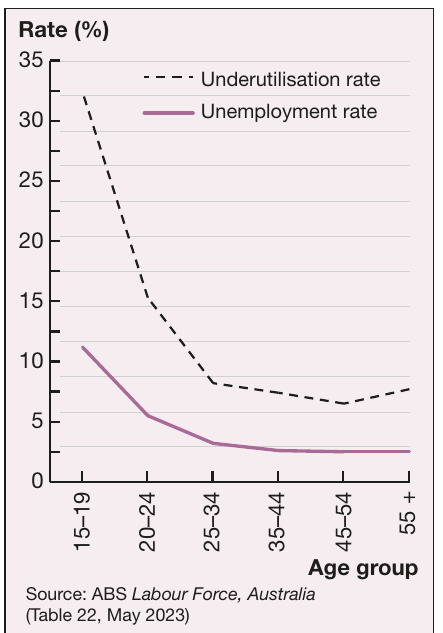
The graph above shows that both unemployment and underutilisation rates decline sharply with age. For 15-19 year olds in the labour force, the underutilisation rate was 33.8% in June 2023, compared to a national average of around 10%.
Why youth unemployment is higher:
Young workers were particularly affected by the COVID-19 recession because they:
- Have above-average levels of casual and part-time employment
- Are concentrated in hard-hit sectors like hospitality and accommodation
Note
Statistical Impact: An Australia Institute report in 2022 found that individuals aged 15-24 make up just 14% of the workforce but experienced 55% of job losses during COVID-19 lockdowns.
Longer-term causes include:
- Lack of work experience, education and training
- Educational experiences that don't provide workplace-ready skills
- Remote learning during COVID-19 proved harder for disadvantaged students
Employers typically seek workers with education, training and experience, which young people lack.
Education response:
These challenges help explain why four in five Australian students now complete high school, compared to just one in three in the 1980s. With most jobs requiring post-secondary school skills, the education system must better manage the transition from school into further education, training or apprenticeships.
Indigenous Australians
Aboriginal and Torres Strait Islander Australians face relatively high unemployment rates, especially in regional and remote areas.
Note
The Australian Government's "Closing the Gap" report in 2020 found:
- Employment among Indigenous Australians is approximately two-thirds the level of non-Indigenous Australians
- 49.1% of Indigenous Australians are employed
- Around 75% of non-Indigenous Australians are employed
However, there is almost no difference in employment rates among Indigenous Australians with higher levels of education. This suggests that education and skills are critical to closing the gap.
Important
Prejudicial attitudes towards Indigenous Australians in parts of regional Australia are often cited as a contributing factor to their higher unemployment rates. This represents a form of discrimination that creates unequal employment opportunities in the labour market.
Age-related unemployment
Both young and older workers face particular challenges:
Young workers (15-19):
- Highest unemployment and underutilisation rates (as discussed above)
- Least likely to experience long-term unemployment (according to Reserve Bank analysis in 2020)
Older workers:
- Have greater difficulty finding new work once they lose a job
- Most likely to be out of work for extended periods
- Face significant age discrimination
Important
Evidence of Age Discrimination: An Australian Human Rights Commission report in 2021 found evidence of substantial age discrimination toward older workers. Almost half of human resources and business leaders surveyed said their organisation would be reluctant to hire workers over a particular age.
Regional variations
Unemployment rates vary significantly across different regions, though the gap between city and regional unemployment has diminished in recent years.
Example
Regional Variation Example: New South Wales (2022-23)
Greater Sydney (labour force: 3 million):
- Average: 3.4%
- Range: 2.1% (Sutherland) to 5.2% (South-West)
Rest of NSW (labour force: 1.5 million):
- Average: 3.0%
- Range: 1.8% (Riverina) to 4.3% (mid North Coast)
People born outside of Australia
Migrants experience different unemployment patterns depending on how long they've been in Australia:
Recent migrants (first 5 years):
- 6.0% unemployment for those from main English-speaking countries
- 5.9% for those from other countries
- These rates are higher than the 3.4% for Australian-born workers
- Higher rates reflect adjustment challenges including language differences
Established migrants (10+ years):
- Have lower unemployment rates than locally born population
- No significant difference between those from English-speaking and non-English-speaking countries
Skills underutilisation:
Note
CEDA analysis in 2021 found that nearly a quarter of permanent skilled migrants were over-qualified for their current job. They struggled to find better positions because they:
- Lacked sufficient Australian work experience
- Didn't have access to local networks
Discrimination and unequal opportunities
Higher unemployment rates for some groups may indicate persistent discrimination and unequal employment opportunities in the labour market.
Important
Examples of labour market discrimination:
- Prejudicial attitudes toward Indigenous Australians in parts of regional Australia
- Age discrimination against older workers
- Barriers faced by recent migrants despite qualifications
These forms of discrimination create unequal access to employment opportunities and contribute to higher unemployment rates among affected groups.
Summary
Key Points to Remember:
-
Economic costs: Unemployment means the economy operates below its production possibility frontier, reducing total output, living standards, and government revenue while increasing government expenditure
-
Hysteresis: Long-term unemployment causes workers to lose skills, confidence and employability, turning cyclical unemployment into structural unemployment
-
Social costs: Unemployment increases inequality and is associated with serious problems including poverty, homelessness, family breakdown, crime, and mental health issues
-
Youth unemployment: Young people aged 15-19 face unemployment rates up to three times higher than the general population, with underutilisation rates over 30%
-
Disadvantaged groups: Indigenous Australians, older workers, recent migrants, and people in certain regions all face higher unemployment rates, sometimes due to discrimination and unequal opportunities