The Main Types of Unemployment (HSC SSCE Economics): Revision Notes
📚Revision Notes
The Main Types of Unemployment
Understanding the different types of unemployment is essential for developing effective government policies to reduce joblessness. Each type has distinct causes and requires different policy responses. This note examines the seven main classifications of unemployment in the Australian economy.
Structural unemployment
Structural unemployment arises when fundamental changes occur within the economy. These changes may result from technological advances or shifts in consumer demand for goods and services. When industries decline, workers often find that their existing skills no longer match the requirements of emerging industries and new job opportunities.
This type of unemployment is particularly challenging because it involves a mismatch between workers' skills and employer needs. For example, manufacturing workers whose jobs are replaced by automation may struggle to transition into growing service industries without retraining.
Important
Most of Australia's long-term unemployment is attributed to structural factors, making it one of the most significant unemployment challenges facing the economy.
Cyclical unemployment
Cyclical unemployment is directly linked to the ups and downs of the economic cycle. During economic downturns and recessions, aggregate demand falls, leading to reduced business activity and fewer employment opportunities. Conversely, during periods of strong economic growth, cyclical unemployment typically decreases as businesses expand and hire more workers.
Example
Real-World Example: COVID-19 Pandemic Impact
The COVID-19 pandemic provides a clear demonstration of cyclical unemployment in action:
Initial Impact (2020):
- The pandemic triggered a short recession
- Cyclical unemployment became the major contributor to rising unemployment rates
- Economic activity contracted sharply due to lockdowns and restrictions
Result: Many workers lost their jobs temporarily or permanently due to reduced demand for goods and services.
Frictional unemployment
Frictional unemployment represents workers who are between jobs. These individuals have left one position but have not yet commenced another. This type of unemployment is a natural and inevitable feature of a dynamic labour market where workers seek better opportunities and employers search for suitable candidates.
The job matching process takes time. Workers invest effort in finding suitable positions that match their skills and preferences, while employers carefully screen candidates.
Note
In a typical year in Australia, approximately one in ten workers change jobs. This figure fell to a record low of one in twelve during the COVID-19 pandemic in 2021, as economic uncertainty made workers more cautious about changing employers.
Improving the efficiency of job matching services can help reduce frictional unemployment. Job and skills databases enable faster connections between unemployed workers and available positions. Following the pandemic, there was evidence of "the Great Resignation" – a surge in workers changing jobs that occurred in the United States and, to a lesser extent, in Australia.
Seasonal unemployment
Seasonal unemployment occurs at predictable and regular times throughout the year due to the seasonal nature of certain types of work. This pattern repeats annually and can be anticipated.
Common examples include:
- Summer jobs (e.g. selling ice cream at beach kiosks)
- Christmas retail work (e.g. department store Santa Claus positions)
- The influx of school, university and TAFE graduates entering the labour market between December and March
Note
Because these fluctuations are predictable, the Australian Bureau of Statistics publishes seasonally adjusted unemployment statistics. These adjusted figures account for regular seasonal variations, providing a clearer picture of underlying unemployment trends.
Hidden unemployment
Hidden unemployment refers to people who would like to work but are not captured in official unemployment statistics. These individuals do not meet the ABS definition of unemployment because they are not actively seeking work, even though they are willing and able to work.
People may stop actively seeking employment for various reasons, including repeated rejection, family responsibilities, short-term illness, or study commitments. These individuals are known as discouraged jobseekers. For instance, a tour guide who lost their job during the COVID-19 pandemic might have decided not to seek alternative employment until international tourism resumed.
The presence of hidden unemployment appears in statistics as a decline in the labour force participation rate when these individuals cease job searching. However, they do not appear in unemployment figures.
Note
Scale of Hidden Unemployment in Australia:
While difficult to measure precisely, the Australian Council of Social Service estimates there are approximately 1.3 million hidden unemployed people in Australia. The ABS calculated in 2023 that 1.3 million Australians wanted to work but were not actively seeking employment and were therefore not officially counted in the labour market.
Underemployment
Underemployment describes workers who are employed for fewer than 35 hours per week but would prefer to work additional hours. These individuals are classified as employed rather than unemployed, yet they represent a significant and growing dimension of Australia's labour market challenges.
Since 2014, the ABS has published monthly estimates of underemployment levels.
Note
Underemployment Statistics (June 2023):
- 935,000 Australians were underemployed
- This represents 6.4% of the workforce
- Australia has more underemployed workers than unemployed workers, highlighting the scale of this issue
The long-term increase in underemployment reflects faster growth in part-time and casual employment compared to full-time positions in recent years.
Important
Underemployment particularly affects young workers. In 2022–23, the underemployment rate for people aged 15 to 24 averaged 14.3%, significantly higher than for any other age group.
Long-term unemployment
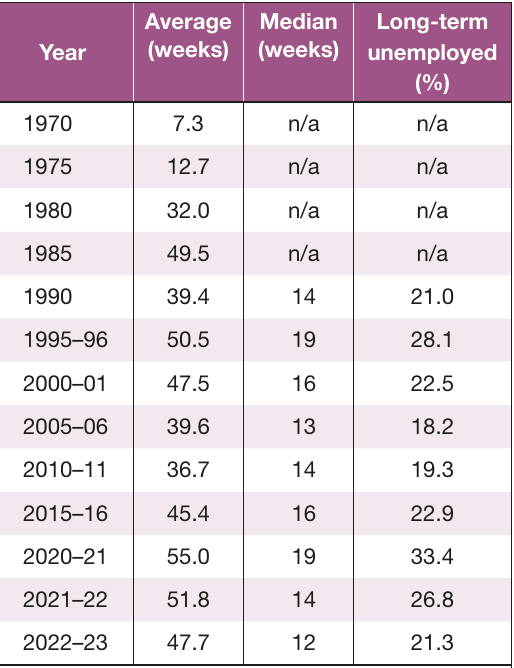
Long-term unemployment refers to individuals who have been without work for 12 months or longer. This form of unemployment typically results from structural factors and poses particularly stubborn policy challenges.
When a large pool of long-term unemployed exists, it becomes very difficult to reduce. While strong economic growth can prevent the pool from growing, growth alone is insufficient to solve the problem. Long-term unemployment often becomes permanent unemployment because individuals who remain jobless for extended periods find it increasingly difficult to secure employment, even when the economy improves.
Important
Why Long-Term Unemployment Persists:
Several factors explain why long-term unemployment becomes self-perpetuating:
- Skills advantage for recently unemployed: Recently unemployed workers are reabsorbed into the workforce more quickly, particularly if they possess up-to-date skills that attract employers
- Skills mismatch: Long-term unemployed workers typically suffer from structural unemployment and lack the skills currently demanded in the labour market
- Confidence erosion: Extended unemployment erodes confidence, as persistent rejection in job applications becomes discouraging
- Loss of labour market contact: Unemployed individuals lose contact with the working world and miss out on learning about new skills and labour market developments, further reducing their employability
- Employer perception: Employers often view long periods of unemployment unfavourably when assessing candidates
Example
Success Story: Australia's COVID-19 Policy Response
Australia's comprehensive policy response to the COVID-19 recession proved effective in preventing labour market "scarring" – the lasting damage caused by prolonged unemployment.
Timeline of Long-Term Unemployment:
April 2020 (Pre-pandemic low):
- 134,000 long-term unemployed
March 2021 (Peak):
- 259,000 long-term unemployed (26-year high)
- This represented a doubling from the pre-pandemic level
Mid-2023 (Recovery):
- 100,000 long-term unemployed
- Below pre-pandemic level
Outcome: This demonstrates the success of Australia's policy interventions in preventing lasting labour market damage.
Hard-core unemployment
Hard-core unemployment represents the most severe form of joblessness. It refers to individuals who have been unemployed for so long that employers consider them effectively unemployable due to their personal circumstances.
Circumstances that may render someone unemployable include:
- Mental illness
- Physical disability
- Drug abuse
- Anti-social behaviour
Note
When someone is assessed as unable to undertake work, even on a part-time basis, they are placed on a disability support pension. Individuals receiving the disability support pension are not counted in official unemployment statistics, as they are not considered part of the labour force.
Summary
Key Points to Remember:
-
Seven types of unemployment exist: structural, cyclical, frictional, seasonal, hidden, underemployment, long-term, and hard-core
-
Structural unemployment results from economic changes (technology, demand shifts) causing skills mismatches; it accounts for most long-term unemployment in Australia
-
Cyclical unemployment rises during recessions and falls during growth periods; it was the main driver of unemployment increases during COVID-19
-
Hidden unemployment and underemployment represent significant labour market issues not fully captured in headline unemployment statistics; approximately 1.3 million Australians experience hidden unemployment, while underemployment (6.4% of the workforce) exceeds total unemployment
-
Long-term unemployment (12+ months without work) becomes self-perpetuating as workers lose skills, confidence and labour market connections; Australia successfully prevented labour market scarring following COVID-19 through effective policy responses