An Overview of the Effectiveness of Economic Management (HSC SSCE Economics): Revision Notes
📚Revision Notes
An Overview of the Effectiveness of Economic Management
Assessing economic policy effectiveness
Evaluating how well economic policies work requires measuring their outcomes against the goals they were designed to achieve. Policymakers must recognise that objectives shift over time, priorities change, and sometimes different goals conflict with each other.
Since the early 1990s, Australia has assigned clear roles to different types of economic policies. Macroeconomic policies aim to achieve the maximum sustainable rate of economic growth while minimising business cycle fluctuations. These policies are also known as demand management or counter-cyclical policies because they work to smooth out economic ups and downs.
Note
The distinction between macroeconomic and microeconomic policies is fundamental to understanding Australia's economic management framework. Macroeconomic policies focus on short to medium-term stabilisation, while microeconomic policies target long-term structural improvements.
The six key objectives used to evaluate policy effectiveness are:
- Economic growth and wellbeing
- Full employment
- Low inflation
- External balance
- Equitable distribution of income and wealth
- Environmental sustainability
Treasury estimates suggest Australia's long-term potential growth rate has been revised down to 2.5% as of 2023. However, when the economy has spare capacity (such as during recovery from recession), it can sustain higher growth rates in the short to medium term.
Microeconomic policies work differently to macroeconomic policies. Their goal is to boost productivity and competitiveness, which lifts the sustainable rate of economic growth over the longer term.
Australia's comparative economic position
Australia ranks highly on international measures of living standards and economic development. The country holds fifth position globally on the Human Development Index, demonstrating strong performance across health, education and income indicators.
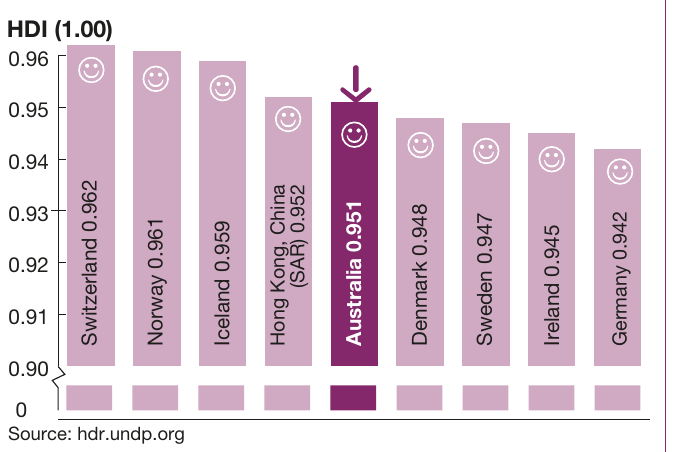
In terms of wealth, Australians ranked first in the world by median adult wealth in 2022, with US$273,900 per adult according to Credit Suisse's Global Wealth Report. However, not all indicators show improvement. Australia's ranking on the Legatum Institute's global Prosperity Index fell from 12th to 15th between 2013 and 2023. This index measures countries across multiple dimensions including economic growth, education, health, governance, human rights and environmental standards.
Note
The Human Development Index (HDI) provides a more comprehensive measure of economic development than GDP alone, incorporating life expectancy, education levels, and income per capita to assess overall wellbeing.
Economic growth outcomes
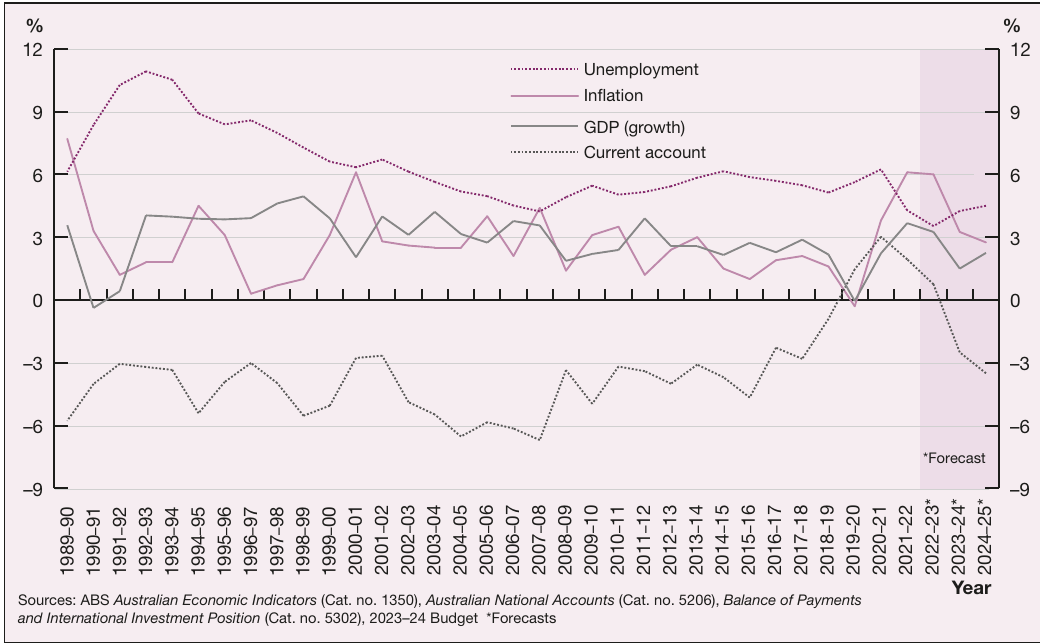
Australia achieved a remarkable economic milestone by sustaining the longest unbroken run of economic growth on record anywhere in the world, spanning from 1991 to 2019. During this period, the economy averaged 2.9% annual growth, significantly stronger than the 2.1% average for OECD economies.
Important
This 28-year period of continuous growth was unprecedented in modern economic history. The key to this success was avoiding the boom-bust cycle that had characterised earlier periods and affected most other developed economies.
This sustained growth resulted from avoiding major business cycle fluctuations. The economy did not experience the boom-bust pattern where rapid growth triggers high inflation, requiring contractionary policies like sharp interest rate rises that could trigger recession. Several factors underpinned this stability including high population growth, strong terms of trade that boosted export revenue, and high workforce participation rates.
However, growth slowed considerably in the second half of the 2010s. Growth fell to just 2%, barely above the OECD average and representing Australia's slowest per capita growth rate in 60 years. Following the COVID-19 recession, Australia recovered quickly, but the long-term sustainable growth rate had fallen to 2.5%, reflecting weak productivity growth and limited new sources of growth or investment.
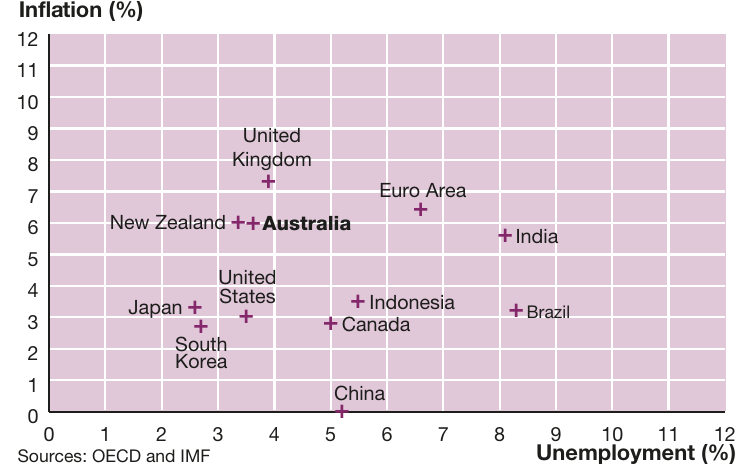
Australia has also benefited from favourable external conditions compared to most other economies. The country's rich natural resources allowed it to capitalise on rising global commodity prices and China's rapid industrialisation. Terms of trade rose dramatically in the 2000s to almost double their average during the previous quarter century. They surged again as the global economy emerged from COVID-19 and after Russia's invasion of Ukraine pushed energy prices higher.
Note
Terms of trade measure the ratio of export prices to import prices. When Australia's terms of trade improve, it means the country can buy more imports for each unit of exports sold, effectively increasing national income without producing more goods and services.
Strong population growth (among the highest in the OECD) has also supported growth, with a skilled migration program that increases the economy's productive capacity.
Inflation performance
Australia's inflation record since the early 1990s has been outstanding, despite the global surge in 2022. After averaging 10% during the 1970s and 8% during the 1980s, inflation has averaged around 2.5% since the introduction of inflation targeting in the early 1990s.
Several factors contributed to this success:
- Clear and transparent monetary policy framework
- Lower tariff barriers increasing competitive pressure
- Increased competition across many industry sectors
- Price reductions from new technologies and cheaper imports
- Moderate wage outcomes
- Strong productivity growth in the 1990s
Note
The introduction of inflation targeting in the early 1990s gave the Reserve Bank a clear mandate to maintain inflation between 2-3% over the medium term. This transparency helped anchor inflation expectations, making it easier to control actual inflation.
Even during the mining boom, which created cost pressures and capacity constraints, Australia successfully controlled inflationary pressures. Following the post-COVID-19 inflation surge, Australia has brought inflation down more quickly than many other countries.
Labour market outcomes
Australia's labour market has generally achieved full employment in recent years. The unemployment rate reached approximately 3.5% in 2023, its lowest level in 50 years. Treasury forecasts suggested unemployment would rise to 4.5%, but this remained below pre-pandemic levels above 5%.
Labour market strength is also reflected in lower underemployment. After growing to above 9% in the 2010s, underemployment fell to just above 6% in 2023. This means fewer workers are seeking additional hours than in the previous decade.
Note
Underemployment measures workers who have jobs but want to work more hours. It's an important indicator alongside unemployment because it captures "hidden" slack in the labour market that may not be visible in unemployment figures alone.
External balance improvements
Favourable external conditions have helped Australia reduce its large external imbalances. The structural improvement in the current account and net foreign liabilities resulted from three major developments:
- China's emergence as Australia's largest export market
- A remarkable improvement in Australia's terms of trade
- A long period of record-low global interest rates
In the decade to 2020, the current account deficit averaged around 2.3% of GDP, compared with an average of 4% in the previous three decades. Australia even recorded current account surpluses from 2019-2023, reflecting strong export prices, reduced overseas travel during COVID-19, lower global interest rates and surging energy prices following Russia's invasion of Ukraine.
Important
Remaining Vulnerabilities
Despite these improvements, Australia still has high foreign liabilities and remains vulnerable to external shocks, particularly given its reliance on commodity exports and China as its dominant export market. However, the fact that most external debt is denominated in Australian dollars reduces risk exposure.
Environmental sustainability challenges
While Australia has managed short and medium-term economic risks well, its greatest long-term vulnerability may come from climate change impacts. Australia's ecological vulnerability has been demonstrated by recent natural disasters, including:
- The "Black Summer" bushfires (2019-20) that burned 186,000 km² of bushland
- Major floods in Queensland and northern NSW in 2022
Agriculture, tourism and regional economies face particular vulnerability to these impacts.
Important
Australia's Climate Challenge
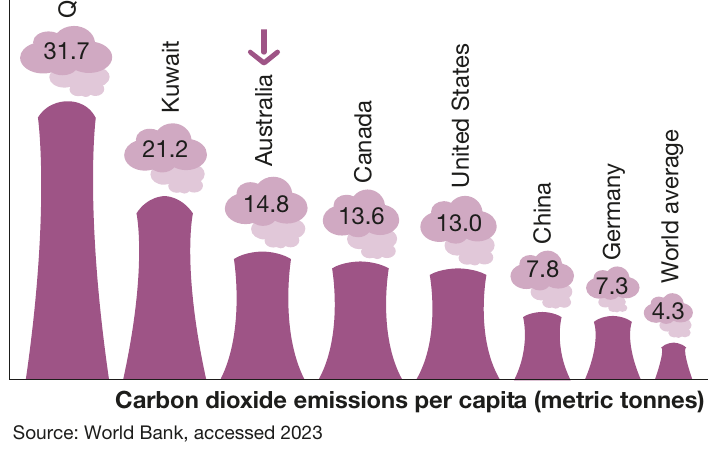
Australia has one of the world's highest per capita emissions of greenhouse gases. The country relies heavily on carbon-intensive fossil fuels for both energy generation and export income. Progress in reducing emissions has been slower than in other economies.
Political disagreements over climate policy responses and frequent policy changes have created policy uncertainty for the past 15 years, complicating Australia's pathway to reducing emissions. Despite commitments to achieving net zero emissions by 2050, Australia faces ongoing challenges in the decarbonisation process, particularly in shifting from coal-dominated electricity generation to renewable energy sources.
Australia also has a poor record in:
- Preserving biodiversity
- Protecting natural environments
- Managing scarce water resources
- Preventing overuse of agricultural land
Income and wealth distribution concerns
Despite unprecedented sustained growth and falling unemployment, Australia has experienced rising inequality in income and wealth distribution. Like other advanced economies, Australia has seen middle-level jobs shrink while earnings at the top end grow and lower-paid service industry jobs expand. Rising property prices have widened the wealth inequality gap.
Important
Growing Inequality Trends
A 2018 Productivity Commission report found that overall inequality has increased over the past three decades, with the fastest growth in income and wealth occurring among the highest earners. A 2021 report highlighted disparities between young and older people, exacerbated by high housing costs.
The impact of rising inequality has been intensified by declining wage growth. Since 2015, wage growth in Australia has been below the OECD average, following a long period when Australians enjoyed some of the highest real wage growth in the world. This combination of slow wage growth and rising inequality means some Australians feel left behind by globalisation and technological change.
Specific groups face disproportionate social disadvantage, including Indigenous Australians and people excluded from the labour market.
Improved policy coordination
Australia's economic outcomes indicate improved effectiveness of economic policies since the 1990s. Governments have better managed conflicts between economic objectives and generally avoided sacrificing one macroeconomic goal for another. This has been helped by reduced economic volatility, allowing governments to strike a balance between growth, inflation, unemployment and external balance goals.
Note
Contrast with Earlier Decades
This contrasts sharply with economic management in the 1970s and 1980s, which was characterised by constant tensions over whether to prioritise low inflation or reduced unemployment. Both remained high during those two decades, creating difficult policy trade-offs.
Summary
Key Points to Remember:
- Australia achieved the world's longest unbroken growth run (1991-2019) but growth has slowed in recent years to around 2.5% sustainable rate
- Inflation has averaged 2.5% since the early 1990s, a dramatic improvement from 10% in the 1970s and 8% in the 1980s
- Australia has achieved full employment with unemployment at 3.5% in 2023, the lowest in 50 years
- The current account has improved from 4% deficit (1990-2010 average) to 2.3% deficit (2010-2020 average), even recording surpluses 2019-2023
- Environmental sustainability is Australia's greatest long-term vulnerability, with high per capita emissions and increasing climate-related natural disasters
- Rising income and wealth inequality represents a growing concern despite strong overall economic performance