Evaluating the Effectiveness of Specific Policies (HSC SSCE Economics): Revision Notes
📚Revision Notes
Evaluating the Effectiveness of Specific Policies
Introduction
Evaluating the effectiveness of economic policies requires examining individual policies and determining whether they have achieved their goals. This can be challenging because it is often difficult to isolate the specific effects of one policy from another. However, a systematic approach can help assess policy effectiveness.
Note
The challenge of evaluating policy effectiveness stems from the interconnected nature of economic policies and the many external factors that influence economic outcomes. Economists must carefully distinguish between what happens because of a policy and what would have happened anyway.
Framework for evaluating economic policies
When assessing whether a policy has been effective, economists use six key criteria:
1. Specific objectives of the policy
To evaluate effectiveness, you must first identify what the policy was trying to achieve. For example, the Reserve Bank of Australia aims to keep inflation within a target range of 2 to 3 per cent over the medium term. If inflation stays within this range, monetary policy can be considered successful for that objective. However, if the target had been zero inflation, the same outcomes would indicate failure.
Without clearly defined objectives, measuring policy effectiveness becomes more difficult. Governments typically set specific targets for economic growth and inflation but often only have general aims for unemployment reduction.
2. Whether the policy was implemented effectively
Not all policies are implemented as originally planned. Changes may occur if:
- A government is voted out of office
- Political priorities shift
- Political constraints prevent full implementation
3. Economic outcomes and comparison with objectives
This step involves reviewing actual economic outcomes and comparing them with policy objectives. The challenge is that governments do not always set specific, measurable targets, making it harder to determine success or failure.
4. Time lags
Important
Time lags affect how quickly policies take effect. This must be considered when evaluating whether a policy has achieved its objectives within an expected timeframe. A policy that appears ineffective in the short term may actually be working, but its effects have not yet fully materialized.
5. Other factors that may have affected outcomes
Economic policy operates alongside many other influences on the economy. Economists use the Latin phrase "ceteris paribus" (meaning "with everything else being the same") when discussing policy effectiveness. However, in reality, other factors constantly change.
Example
Example: Australia's Carbon Tax and Emissions
Australia's per capita greenhouse gas emissions fell after the carbon tax was abandoned in 2014. However, this was not due to the policy change but rather to other factors including:
- Closure of large-scale manufacturing
- Higher energy prices reducing demand
- Increased residential solar power uptake
This demonstrates how economic outcomes can be influenced by factors completely separate from the policy being evaluated.
Factors that can influence economic outcomes include:
- Changes in global economic conditions or major trading partner economies
- Overseas interest rate movements
- Sharp currency value movements
- Developments affecting future expectations (e.g., industry crises, regional conflicts)
- Commodity price changes and terms of trade fluctuations
- Natural environment developments (droughts, floods, natural disasters, pandemics)
- Industrial disputes
- New technologies or consumer preference shifts
- Changes in investor and consumer confidence
6. Side effects and unintended consequences
Even when a policy achieves its main objective, it may create problems elsewhere in the economy. This highlights the trade-offs between policy objectives due to conflicting economic goals.
Trade-offs in economic policy
Economic policies often involve difficult trade-offs because achieving one objective may work against another:
Inflation versus unemployment
A short-term trade-off exists between reducing inflation and reducing unemployment. When inflation exceeds the Reserve Bank's target band, raising interest rates to reduce inflation typically leads to slower economic activity and increased cyclical unemployment.
The Reserve Bank operates independently from government to prevent political considerations from constraining monetary policy. This independence became important in 2023 when RBA Governor Michele Bullock stated that unemployment would need to rise to return inflation to target:
The unemployment rate is expected to rise to 4.5 per cent by late 2024... Our goal is to return the labour market (and the market for goods and services) back to a level more consistent with full employment... We think this can be achieved if employment and the economy more generally grow at a below-trend pace for a while. This would help to bring demand and supply into better balance and give us the greatest chance of securing sustainable full employment into the future.
— Michele Bullock, Deputy RBA Governor, Speech to Ai Group, 20 June 2023
Economic activity versus public health
During the COVID-19 pandemic, Australian governments faced difficult trade-offs between maintaining economic activity and managing public health risks. Lockdowns and border closures cost the economy tens of billions of dollars, but governments assessed that not taking these measures would have resulted in even worse outcomes.
Housing affordability versus economic growth
Some economists have argued for greater controls on lending for housing to address concerns about excessive housing price growth and household debt levels. However, such measures would reduce economic activity and household incomes.
Budget deficit reduction versus economic growth
When economies have high public debt levels, governments must balance reducing budget deficits against the risk that contractionary fiscal policy could trigger recession. Australia has not faced this constraint recently due to lower debt levels than other advanced economies, but several European economies struggle with this trade-off.
Economic growth versus income equality
Economists historically accepted a trade-off between achieving higher economic growth and increased income and wealth inequality. Boom periods (such as Australia's resources boom) often generate income distributed very unevenly.
Note
Organisations such as the OECD and IMF now emphasise "inclusive growth". They argue that policies promoting greater income equality can boost economic growth because increasing lower-income earners' incomes will boost consumption. This suggests the trade-off between equality and growth may not be as clear-cut as previously thought.
Climate action versus short-term economic impacts
Australia legislated a commitment to reduce carbon emissions to "net zero" by 2050 in 2022. Delivering this requires structural economic changes over the next quarter century, creating trade-offs between:
- Long-term greenhouse gas emission reduction goals
- Short-term impacts including higher energy prices, slower growth, and potential job losses in carbon-intensive industries and regions
The past two decades saw frequent changes to climate and energy policies, with proposals often rejected in Parliament, creating policy uncertainty that hindered effective implementation.
Economic management in Australia: past, present and future
Macroeconomic management
Macroeconomic management has largely proved effective in achieving short- to medium-term goals since the early 1990s. Australia sustained economic growth alongside low inflation and relatively low unemployment. When COVID-19 forced the economy into recession in 2020, Australia was in its 29th consecutive year of growth—a world record. The economy recovered quickly, with unemployment falling to its lowest level in almost half a century.
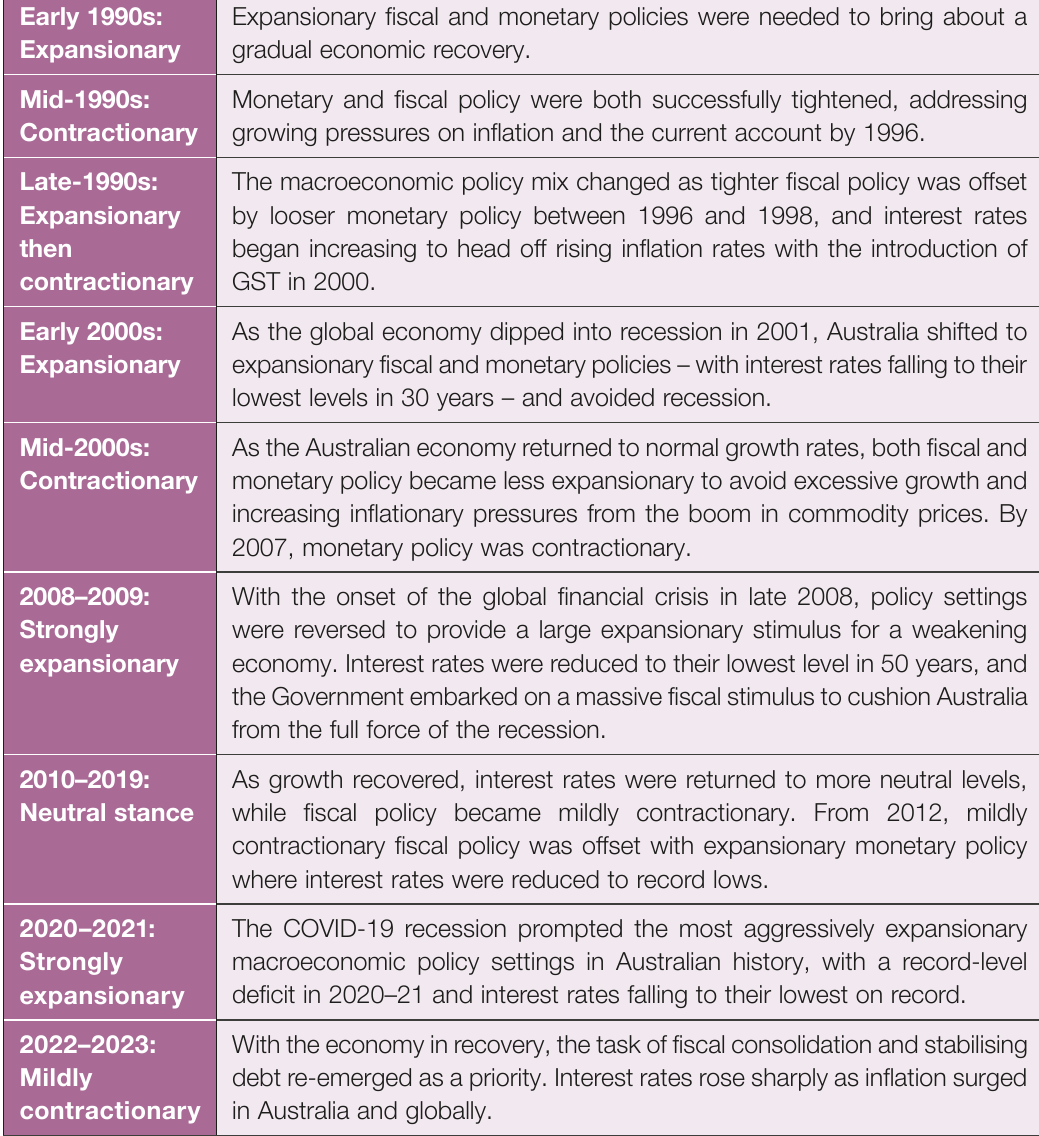
The timeline shows how Australian policy stances have shifted between expansionary, contractionary, and neutral positions in response to changing economic conditions.
Monetary policy: effectiveness and limitations
Monetary policy has worked well since the early 1990s in managing the growth cycle and achieving price stability. The inflation target has largely been met (except for occasional periods outside the target, as occurred recently), and Australia has maintained stable economic growth.
Flexible inflation targeting, and the RBA's actions within this framework, have been successful overall. The RBA has played a particularly critical role during crises, where it has acted decisively and effectively to support the economy and protect against severe outcomes... Flexible inflation targeting remains the best operational framework for monetary policy to pursue the dual mandate of price stability and full employment.
— Commonwealth of Australia, An RBA Fit for the Future: Review of the Reserve Bank of Australia, March 2023
Effectiveness relies on policy coordination
Important
Monetary policy's main limitation is that it rarely works effectively on its own—it needs support from similar fiscal policy settings. It becomes ineffective when working in the opposite direction to fiscal policy. For example, in 2008 when inflation reached 5 per cent, interest rates had to increase further to counter the inflationary effect of income tax cuts.
More effective for contractionary than expansionary policy
The past three decades have shown monetary policy is more effective for implementing contractionary policy than expansionary policy. During major economic downturns or extended periods of below-trend growth, low interest rates alone cannot sufficiently stimulate economic activity and reduce unemployment.
In response to the COVID-19 recession in 2020, central banks used unconventional monetary policy measures after reducing interest rates to near zero:
- Purchasing government debt from the private sector (asset purchase programs)
- Providing low-cost credit to the banking sector
- Introducing yield targets for government bonds
Note
These unconventional approaches demonstrate that conventional monetary policy can be ineffective in low interest rate and low inflation environments. Nevertheless, low interest rates can support expansionary fiscal policy in boosting growth because fiscal policy directly impacts aggregate demand, while monetary policy relies on households and businesses responding to interest rate incentives.
Demand management limitations
As a demand management policy, monetary policy can influence aggregate demand but cannot address structural (supply-side) problems. During the 2022 inflation surge, the Reserve Bank highlighted that inflationary pressures came from supply-side and overseas factors:
- Supply chain disruptions from the pandemic recovery
- Labour shortages
- Food and energy price increases from Russia's invasion of Ukraine
Higher interest rates can reduce demand pressures but do not fix supply-side problems. Some economists therefore considered the steep interest rate increases during 2022-2023 excessive.
Monetary policy also struggles with conflicting goals, particularly regarding its impact on demand and asset prices. Before the pandemic, the Reserve Bank noted tension between raising interest rates to curb potentially dangerous housing price bubbles and wanting to encourage stronger economic growth. Monetary policy is a blunt instrument with limited effectiveness when policymakers want to support growth in one sector while restraining it in another.
Cannot address structural problems
Important
Monetary policy cannot successfully address structural issues such as:
- Low productivity growth
- Transitioning to a less carbon-intensive economy
- Improving external balance
Even though monetary policy aims to achieve low inflation, it can do little to address inflationary pressures other than those driven by consumer and business demand. Raising interest rates to address other inflation sources (such as a falling currency) attempts to solve the problem by attacking something other than its real cause.
During periods of sustained economic growth, monetary policy faces additional strain as the tool of last resort if wages grow too quickly. Without an incomes policy to control wage increases directly, tighter monetary policy becomes the most effective tool to limit inflation and wage rises. Recently, the RBA has warned that wages growth must be accompanied by productivity improvements to ensure wages do not contribute to inflation.
Fiscal policy: effectiveness and limitations
Fiscal policy is the most effective tool for stimulating the economy and creating jobs during downturns, but less effective at slowing the economy when it overheats. Australia's fiscal responses to the COVID-19 recession (2020) and global financial crisis (2008) both successfully strengthened aggregate demand before deep recession set in.
In 2009, Australia avoided recession altogether. In 2021, although recession could not be avoided, the economy staged a quick recovery. Fiscal policy proved effective in both cases through packages centred on supporting household incomes while also including:
- Investment incentives
- Wage subsidies (in 2020)
- Industry rescue packages
- Infrastructure investment
Limitations and long-term concerns
Like monetary policy, fiscal policy has limitations:
- Expansionary fiscal policy increases budget deficits and public debt levels
- In a growing economy, it can draw savings away from private investment
- Sustained higher budget deficits over the longer term can contribute to:
- Higher long-term interest rates
- Lower national savings
- Increased current account deficit
Note
One longer-term concern about public debt increases from the COVID-19 recession is that repayment could take decades, and higher interest rates in future could make these debt levels a heavier budget burden.
Microeconomic management
Australia's extensive microeconomic reforms since the 1980s are generally regarded as successful. Microeconomic policy has enabled the economy to avoid boom/bust cycles and sustain growth with improved living standards and reduced unemployment. The Australian economy has become more internationally competitive, with contained inflationary pressures. Australia's economy is generally regarded as one of the world's more open and successful economies, despite geographic isolation from major global economic centres.
Criticisms and the need for ongoing reform
Some economists criticise the lack of ongoing microeconomic reform in the past two decades. Compared with the rapid pace of reform in the 1990s (including national competition policy, enterprise bargaining, major industry deregulation, accelerated tariff cuts, and GST introduction), microeconomic reform has moved slowly recently.
To some extent, this is inevitable since many 1990s reforms involved once-off structural changes that cannot be repeated. Nevertheless, the OECD and economic agencies (Treasury, Productivity Commission) argue more needs to be done to accelerate reform.
The Productivity Commission's 5-Year Productivity Inquiry (2023) outlined 71 specific policy recommendations, many involving microeconomic reforms:
- Increasing workplace agreement flexibility
- Streamlining planning and zoning laws
- Charging vehicles for road use
- Removing anti-competitive pharmacy regulations
- Reforming the tax system
Australia's economic recovery from the pandemic has been world leading, however to ensure Australians continue to enjoy higher living standards, we need to continue to focus on the task of lifting productivity...Given the scale and nature of the economic shock caused by the COVID-19 pandemic, it is expected to have an enduring impact on Australia's productivity challenge. The acceleration in the uptake of technology by business and individuals has stimulated growth in remote work, online commerce, businesses' digital presence and innovative delivery of public services like health and education...In this environment, Australia needs policy settings that foster a flexible and dynamic economy, that is able to adapt in the face of economic challenges and opportunities. Policy settings should encourage the economy to adapt to the growing importance of digital technologies, including through developing a skilled labour force. They must also be forward looking and support an environment that promotes economic dynamism, entrepreneurship and appropriate risk-taking, and innovation and technological adoption.
— Productivity Commission, 5-year Productivity Inquiry: Advancing Prosperity, 2023
Structural weaknesses requiring attention
Despite Australia's relatively successful economic performance, critics argue the economy has structural weaknesses:
- Over-reliance on resources exports to China and other developing economies
- Labour productivity growth slowed to the lowest rate in over 60 years in the decade to 2020
- Significant numbers of working-age Australians remain unemployed, underemployed, or outside the labour force
- Lack of clear, consistent climate change policy has led to expensive and often ineffective measures
- Australia's competitiveness ranking has slipped (from 4th in 2004 to 19th in 2023)
- Significant looming challenges include climate change, ageing population, declining workforce participation, and risk of sustained Chinese slowdown
Important
These factors underline the need for continued microeconomic reform, economic diversification, and investments in education, early childhood programs, and infrastructure to support future productivity growth.
Broader measures of policy effectiveness
In the longer term, the success or failure of Australia's policy mix will be measured by capacity to:
- Restore and sustain growth, employment and living standards
- Prepare for disruptive effects of climate change and water shortages
- Distribute economic growth rewards more equitably
- Achieve a sustainable external accounts position
The Government acknowledged the need for broader effectiveness measures in 2023 with its "Measuring What Matters" statement, adopting 50 indicators to measure progress across themes of a healthy, secure, sustainable, cohesive and prosperous Australia.
Note
Economic policy effectiveness cannot ultimately be judged by economic outcomes alone. Economic policies affect the kind of society we live in and how we lead our lives. Critical questions confront economic policymakers in the 2020s:
- Does GDP increase result in increased wellbeing and happiness?
- Should wellbeing measures play a greater role in policymaking?
- Do we have a responsibility to future generations to act more urgently on carbon emissions and resource consumption?
- Is it fair that family background determines life opportunities?
- Is it fair that Australians enjoy good living standards while many in developing countries suffer from preventable diseases?
These questions go beyond technical economic issues to our values as a nation and what we consider important in life.
Remember!
Summary
Key Points to Remember:
- Evaluating policy effectiveness requires examining six criteria: objectives, implementation, outcomes, time lags, other factors, and side effects
- Ceteris paribus ("all else being equal") is difficult to achieve in practice—many factors beyond policy influence economic outcomes
- Trade-offs exist between policy objectives: reducing inflation may increase unemployment; climate action may slow short-term growth
- Monetary policy has been effective since the 1990s at achieving inflation targets but is more effective for contractionary than expansionary policy and cannot address supply-side problems
- Fiscal policy is most effective for stimulating the economy during downturns but creates long-term debt concerns
- Microeconomic reforms since the 1980s have been successful, but Australia needs continued reform to address structural weaknesses and maintain competitiveness
- Policy coordination is essential—monetary and fiscal policy work best when aligned rather than working against each other