Limitations of Economic Policy (HSC SSCE Economics): Revision Notes
📚Revision Notes
Limitations of Economic Policy
Economic policies do not always achieve their intended goals. Several factors can reduce the effectiveness of government policies, creating barriers to successful economic management. Understanding these limitations helps explain why governments cannot always deliver the economic outcomes they promise.
Three key limitations
Note
Economic policy effectiveness is constrained by three fundamental factors that shape what governments can and cannot achieve:
- Time lags – delays between policy decisions and their effects
- Political constraints – democratic pressures and institutional barriers
- Global influences – international factors beyond government control
Understanding these limitations is essential for evaluating why economic policies sometimes fail to deliver their intended outcomes.
Time lags
What are time lags?
Economic policies face two types of delays that affect their effectiveness and timing:
Implementation time lags occur when it takes time for governments to change or introduce new policies. The government must go through decision-making processes before a policy can begin.
Impact time lags occur when policies need time to affect the economy after implementation. Even once a policy starts, its economic effects take time to materialise.
Important
The combination of implementation and impact lags means that by the time a policy fully affects the economy, economic conditions may have already changed, potentially making the policy response inappropriate for current circumstances.
Comparison across policy types
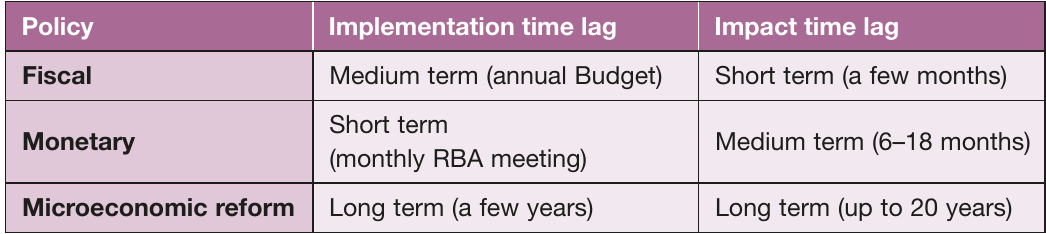
Different policies experience varying time lags, with significant implications for their effectiveness in managing the economy:
Monetary policy
- Implementation: Short term (monthly RBA meetings from 2024)
- Impact: Medium term (6–18 months, recently extended to up to 24 months)
- The RBA holds eight scheduled meetings per year
- Decisions are announced at 2:30pm on the second meeting day
- Effects on the cash rate are immediate, but broader economic impacts take longer
- The impact time lag has lengthened because more households now have fixed-rate mortgages (from around 20% to 40% during COVID-19)
- For some households, interest rate increases in 2023 may not affect them until 2025
Note
The shift toward fixed-rate mortgages during the COVID-19 pandemic has fundamentally changed how monetary policy works in Australia. This means the RBA's interest rate decisions now take longer to flow through to household budgets, reducing the immediate effectiveness of monetary policy adjustments.
Fiscal policy
- Implementation: Medium term (annual Budget process)
- Impact: Short term (a few months)
- Major changes occur annually with the Budget in May
- The budget development process begins early in the year and runs for several months
- Changes must pass through budget committee meetings and government department scrutiny
- Legislation can take additional months to pass through Parliament
- Once implemented, fiscal changes quickly affect income levels, prices and economic conditions
- Tax reductions immediately influence household incomes
- Increased government spending rapidly impacts economic activity
- During downturns, fiscal policy becomes most important due to its quick impact
Example
Rapid Fiscal Policy Responses to Economic Crises
Fiscal policy's short impact time lag makes it particularly valuable during economic emergencies:
- COVID-19 pandemic (2020): The Australian Government rapidly implemented JobKeeper payments, business support measures, and household stimulus payments to cushion the economic shock
- Global financial crisis (2008–09): The Government deployed stimulus packages including cash payments to households and infrastructure spending to prevent recession
These responses demonstrate how fiscal policy can deliver immediate economic support when quick action is needed, despite its longer implementation time.
Microeconomic reform
- Implementation: Long term (several years)
- Impact: Long term (up to 20 years)
- Complex planning and policymaking processes cause delays
- Often requires cooperation from state governments as well as Commonwealth
- Examples requiring state agreement: national energy policy, schools funding reform, consumer protection laws, national disability insurance scheme
- Negotiating with multiple states takes considerable time due to different interests
- Benefits of structural change take years to become apparent as resources reallocate
- Full effects flow through to costs, profits, export growth and productivity gradually
- Difficult to measure impact when several reforms happen simultaneously
Note
Microeconomic reforms face a dual time lag challenge. Not only does it take years to implement these complex structural changes, but the economic benefits may not be fully realised for decades. This makes it politically difficult to pursue such reforms, as the government implementing them often won't be in power to claim credit for the positive outcomes.
Why time lags matter
The challenge for policymakers is matching the right policy to the economic situation. Monetary policy can be implemented quickly but takes time to work. Fiscal policy takes longer to implement but works faster.
Important
The Pre-emptive Challenge
The Reserve Bank must make pre-emptive adjustments based on expected inflation 12–18 months ahead, not current conditions. This means monetary policy decisions are essentially educated predictions about future economic conditions, making them inherently uncertain and subject to error.
Political constraints
The democratic context
Economic policymaking occurs within a democratic system where governments must balance economic objectives with political realities. Several political factors constrain policy effectiveness and limit what governments can achieve, even when economists agree on the optimal policy approach.
Public opinion and electoral pressures
Governments must consider public views when developing policies. They face difficult trade-offs between:
- Election commitments they promised voters
- Economic conditions requiring different responses
- Policies supported by their own political party
- Potential opposition from specific groups
Note
Election Cycle Effects
Governments typically implement longer-term, less popular policies in the first year of their three-year term. Before elections, they become reluctant to make unpopular decisions and face pressure for short-term popular measures that may lack long-term economic benefits.
This creates a predictable policy cycle where difficult but necessary reforms are concentrated early in the electoral term, while politically attractive but potentially economically suboptimal policies increase as elections approach.
Example
The Morrison Government's Fiscal Promises
The Morrison Government was elected in 2019 promising budget surpluses but delivered the largest deficits in Australian history due to COVID-19.
This example illustrates how external economic shocks can force governments to abandon election commitments, demonstrating the tension between political promises and economic reality.
The barrier of unpopular reforms
According to a 2021 Grattan Institute report, unpopularity has become the largest obstacle to economic reform in Australia over the past decade. Governments now rarely implement unpopular reforms to achieve long-term goals.
Historical examples of unpopular reforms:
- 2012: Gillard Government's carbon tax
- 2000: Howard Government's Goods and Services Tax (GST)
Important
Reducing Political Pressure Through Independent Agencies
To minimise political constraints, governments delegate certain decisions to independent bodies:
- Reserve Bank: interest rate decisions
- Fair Work Commission: national minimum wage and award wage increases
- Independent authorities: pricing in regulated sectors (postal services, electricity)
These agencies can make economically sound decisions without short-term political pressure, insulating important economic decisions from electoral cycles and partisan politics.
Parliamentary constraints: the Senate
Many economic policies require legislation to pass through Parliament. This creates potential barriers, especially in the Senate, which acts as a house of review with significant power to block or modify legislation.
The bicameral system:
- Legislation must pass both the House of Representatives (Lower House) and Senate (Upper House)
- Governments rarely hold Senate majorities
- Compromises with Opposition or minor parties become necessary
Example
2022 Election Parliamentary Mathematics
The Albanese Labor Government won with:
- 77 of 151 House of Representatives seats (majority of just one)
- Only 26 of 76 Senate seats
To pass legislation, the Government needs either:
- Support from the Opposition (Liberal/National Coalition, 32 seats), or
- Support from the Greens (12 seats) plus one of six other Senators (2 Lambie Network, 2 One Nation, 1 United Australia Party, 1 Independent)
This fragmented Senate composition means the Government must negotiate and compromise on almost every piece of legislation, potentially watering down policy effectiveness.
Example
Case Study – Housing Australia Future Fund
Despite passing most election commitments, the Government could not secure Senate majority for its social housing plan. Some senators opposed it for going too far, others for not going far enough. Combined opposition blocked the legislation.
This demonstrates how a divided Senate can prevent even central election promises from becoming policy, illustrating the significant constraint that parliamentary arithmetic places on government policy implementation.
Federalism and state government cooperation
Australia's federal system creates another layer of political constraint. The Commonwealth and state governments share responsibility for major economic areas:
- Energy policy
- Education system
- Health care
- Aged care
- Business regulation
- Infrastructure (roads)
Implementation challenges:
To implement major changes, the Commonwealth often needs cooperation from some or all states. Negotiations take considerable time due to different state interests, political compositions, and priorities.
Note
Financial Incentives for Reform
The Commonwealth's greater revenue-raising capacity allows it to offer financial incentives for reform progress. This creates a mechanism where the federal government can encourage state cooperation through funding arrangements.
Example
Housing Reform Incentives (2023)
In August 2023, the Albanese Government provided $3 billion to states/territories and $500 million to local governments in return for planning reforms to help build 1.2 million new homes over five years.
This approach demonstrates how financial incentives can overcome federalism barriers, though it also shows the significant cost of achieving cooperation in Australia's federal system.
Constitutional challenges:
When Commonwealth and states cannot agree, the Commonwealth may try to impose changes. This can lead to lengthy High Court constitutional challenges. Generally, the High Court has favoured expansive Commonwealth powers over states in recent decades, but states retain significant constitutional powers.
Example
Industrial Relations Constitutional Challenge (2006)
The Commonwealth won a major constitutional case where states challenged its takeover of industrial relations powers. This demonstrated the expanding reach of Commonwealth powers, though such challenges create uncertainty and delay policy implementation for years.
Special interest groups
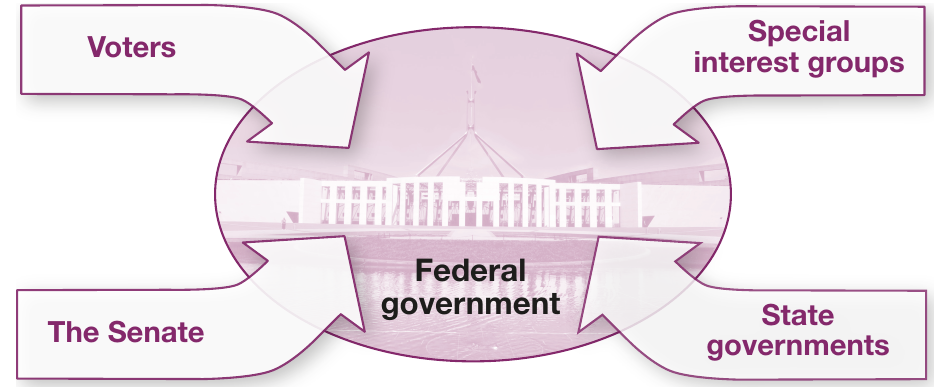
Interest groups play important roles in policy development, representing different sectors of the economy and society:
Business groups:
- Significant influence on both major political parties, especially Coalition parties
- Large businesses employ lobbyists due to potential financial impacts of policy decisions
Unions:
- Close relationship with Labor Party
- Influence labour market and social welfare policies
Note
Climate and Energy Policy Debates
Interest groups are particularly active where fossil fuel interests dispute with environmental and climate organisations. This creates intense lobbying pressure from both sides, making it difficult for governments to develop coherent long-term energy and climate policies.
Recent policy debates influenced by interest groups:
- Windfall profits tax on oil and gas industry
- Increased royalties tax on Queensland's resources sector
- Australia's carbon emissions reduction targets
- New coal mine approvals
Important
Interest group influence can distort policy decisions away from optimal economic outcomes, as governments balance competing pressures from well-resourced lobby groups rather than focusing purely on evidence-based policy making.
Global influences
As Australia becomes more integrated globally, international factors increasingly constrain domestic economic policy. Globalisation works at multiple levels to limit policy options, reducing the autonomy of national governments to pursue independent economic strategies.
Global financial markets
Governments prioritise maintaining confidence of international investors and global financial markets. This has become critical following enormous volatility from the global financial crisis and pandemic.
Note
Policies Supported by Financial Markets
Global financial markets generally favour a specific policy formula that governments feel pressured to follow:
- Reduced government spending and budget deficits
- Low corporate and capital gains taxes
- Reduced trade barriers and openness to foreign investment
- Financial sector deregulation, including removal of restrictions on international financial flows
- Economy-wide deregulation to increase competition
- Privatisation of government-owned businesses
- Labour market deregulation and better-targeted social welfare
- Trade agreements giving overseas businesses power to take legal action against governments if policies undermine investment profitability
These preferences create a narrowing of policy options as governments seek to maintain market confidence.
Consequences of alternative policies:
Governments face constraints when adopting policies differing from the generally accepted formula. Critics argue global financial markets restrict policy options, while others argue markets effectively discipline poor policy decisions.
Example
US Credit Rating Downgrade (2023)
Ratings agency Fitch removed the US Government's triple A credit rating in 2023, citing political instability and Congressional disputes that nearly led to government debt default.
This demonstrates how global financial markets can punish governments for perceived policy failures, even in the world's largest economy, showing the power of international market confidence in shaping policy choices.
Impact on monetary policy
Interest rate linkages:
Global financial flows and overseas interest rates directly influence monetary policy conduct. If rates rise overseas, Australia's returns become relatively less attractive to foreign investors. This may cause:
- Outflow of funds
- Currency depreciation
- Added inflation
- Undermined confidence
To prevent this, governments often adjust interest rates responding to changes in other economies, limiting their ability to set monetary policy based purely on domestic conditions.
Example
Global Interest Rate Synchronisation (2022)
In 2022, Australian interest rate increases mirrored rising global rates as inflationary pressures rose worldwide.
This illustrates how Australia's monetary policy is constrained by global trends, with the RBA forced to consider international rate movements alongside domestic economic conditions.
Important
Banking Sector Effects
Market interest rates in Australia are directly affected by overseas rate changes because Australian banks rely on overseas borrowing to fund their loan portfolios. This means global interest rate movements flow through to Australian borrowing costs regardless of RBA decisions, further limiting monetary policy independence.
International business cycle
The global business cycle restricts policymaking scope within individual countries. It is difficult for a country to significantly increase growth if the global economy is in downturn.
Note
Mechanism of Global Business Cycle Constraint
Faster domestic growth during global slowdown causes:
- Increased imports (as domestic spending rises)
- Weakened export growth (as foreign demand falls)
- Substantial current account deficit increase
This can force governments to slow the economy through tighter fiscal and monetary policy, risking more severe recession. This explains why industrialised countries generally keep growth aligned with international and regional business cycles.
International organisations
World Trade Organization (WTO):
- Influences individual trade policies through enforcement powers
- Has forced Australian Government to change export assistance policies and quarantine regulations
Example
WTO Salmon Import Dispute
Australia was forced to abandon its ban on fresh salmon imports from Canada after losing a WTO dispute. This demonstrates how international organisations can override domestic policy decisions, even on issues related to biosecurity and quarantine.
UN Climate Change Conferences:
International pressure influences domestic policy, such as pressure on Australia to strengthen climate commitments ahead of the 2021 Glasgow conference.
Group of Seven (G7) and G20:
These groups significantly influence the global economy and domestic macroeconomic policies of smaller countries like Australia. Growing economic integration through these forums means individual countries have less policy autonomy.
Important
International organisations create both opportunities for cooperation and constraints on sovereignty. While they enable coordinated responses to global challenges, they also limit what individual governments can do independently, particularly in areas like trade policy, environmental regulation, and financial sector oversight.
Remember!
Summary
Key Points to Remember:
-
Time lags limit policy effectiveness: Implementation and impact delays vary across policy types. Monetary policy acts quickly but takes 6–24 months to impact the economy. Fiscal policy takes longer to implement but works faster. Microeconomic reforms require years for both implementation and impact.
-
Political constraints restrict policy choices: Democratic pressures, Senate composition, state government cooperation and special interest groups all limit what policies governments can implement. Unpopularity has become the largest barrier to economic reform in recent decades.
-
Global integration reduces policy autonomy: Financial markets, international business cycles and international organisations increasingly constrain domestic policy options. Governments must maintain international investor confidence and align policies with global economic conditions.
-
Policy timing affects outcomes: Understanding time lags helps explain why policies don't always work as intended. The RBA must make pre-emptive decisions based on future expectations, while governments face electoral cycles that discourage long-term reforms before elections.
-
Independent agencies reduce political pressure: Delegating decisions to bodies like the RBA and Fair Work Commission allows economically sound decisions without short-term political interference.