Labour Market Policies (HSC SSCE Economics): Revision Notes
📚Revision Notes
Australia's Wage Determination System
Overview of the wage determination framework
The Fair Work Act 2009 establishes the framework for determining wages and working conditions in Australia. This national system covers approximately 70% of the Australian workforce. The remaining 30% consists of independent contractors, business owners, and state public sector employees.
Note
The wage determination system operates as a comprehensive framework that balances formal protections with workplace flexibility. Understanding how these different components interact is essential for comprehending Australia's approach to employment regulation.
The wage determination system is divided into two main categories:
Formal system:
- Awards only (23.0% of workforce)
- Collective agreements (35.1% of workforce)
Informal system:
- Common law contracts or individual arrangements (37.8% of workforce)
- Working business owners (4.1% of workforce)
All employment arrangements sit on a foundation of guaranteed minimum standards, with awards providing an additional layer of protection for many workers.
The diagram above illustrates how different types of employment arrangements relate to each other. Modern awards form a central pillar of the system, building upon the National Employment Standards. Workers covered by collective agreements can negotiate trade-offs of award conditions, but these must pass the "better off overall" test to ensure workers benefit from any changes.
National employment standards
The National Employment Standards (NES) provide a baseline of legally guaranteed employment conditions that apply to all employees under the Fair Work Act. These fundamental protections cannot be removed or reduced by any agreement.
Key provisions of the NES
Maximum working hours: Full-time employees cannot be required to work more than 38 ordinary hours per week, plus reasonable additional hours. This protects workers from excessive working hours while allowing some flexibility for business needs.
Flexible working arrangements: Certain groups of workers have the right to request changes to their working arrangements. This includes parents, carers, workers over 55 years of age, and people living with a disability. Requests may include changes to working hours, job sharing arrangements, or working from home. Employers can only refuse these requests on reasonable business grounds.
Note
The right to request flexible working arrangements recognizes that employees have diverse needs beyond their workplace obligations. While employers can refuse requests, they must have legitimate business reasons for doing so, creating a balanced approach that considers both worker wellbeing and operational requirements.
Leave entitlements: Employees are entitled to multiple forms of leave:
- Paid annual leave
- Paid sick leave
- Paid compassionate leave
- Public holidays
- Unpaid parental leave
- Unpaid community service leave
- Unpaid long service leave
Casual conversion: Casual employees who have worked for the same employer for more than 12 months must be offered the option to convert to permanent full-time or part-time employment. This provision does not apply to small businesses.
Important
Significant Expansion in 2023
In 2023, the Albanese Government expanded the NES to include provisions relating to superannuation (the Superannuation Guarantee and protection from underpayments) and up to 10 days of paid leave for victims of domestic violence. These changes represented the most significant updates to the NES since the Fair Work Act came into operation.
Minimum wages
The national minimum wage serves as a safety net for employees who are not covered by an award. The Fair Work Commission conducts an Annual Wage Review each year to determine both the national minimum wage and award wage rates, with changes taking effect from 1 July.
Factors considered in wage decisions
When determining minimum wages, the Fair Work Commission Expert Panel must balance both economic and social objectives. The panel considers:
- Performance of the national economy
- Macroeconomic impact of wage increases
- Effects on business costs and hiring decisions
- Cost of living pressures facing households
- Labour market conditions
- Impact on different groups of workers (such as the gender pay gap)
Note
The Fair Work Commission's approach to wage setting reflects a careful balancing act between protecting workers' living standards and maintaining economic stability. This multi-factor assessment ensures wage decisions consider both immediate worker needs and broader economic consequences.
Recent wage increases
In June 2023, the Fair Work Commission announced a two-tiered wage increase in response to inflation reaching 7.8% in the March quarter of 2023. This decision reflected concerns about the erosion of real wages and household financial stress, while also acknowledging the robustness of the labour market.
Example
Worked Example: 2023 Wage Increase
The Fair Work Commission implemented different increases for different groups:
Tier 1 - National minimum wage:
- Previous rate: $21.38 per hour
- Increase: 8.6%
- New rate: $23.23 per hour (or $882.80 per week)
- Weekly increase: $21.38 × 38 hours = $812.44 → $882.80
- Total weekly increase: $70.36
Tier 2 - Other award pay rates:
- Increase: 5.75%
- Guaranteed minimum: $40 per week increase
- This ensured even the lowest-paid award workers received a meaningful pay rise
This represented the highest minimum wage increase since Australia's centralised wage system was established in the early 1980s. The slightly higher increase for the minimum wage compared to other awards aimed to provide disproportionate benefits to the lowest-paid workers, including addressing gender pay gaps.
Awards
Awards establish minimum wages and working conditions for employees based on their industry or occupation. They provide a safety net that ensures workers receive at least a baseline level of pay and entitlements. Many employers pay above award rates, but awards set the legal minimum.
Modern awards
Under the Fair Work Act, Australia's award system underwent significant restructuring. The system was streamlined from approximately 4,300 awards to just 123 modern awards. This simplification aimed to make the system easier for employers and employees to understand and apply.
Example
Worked Example: Retail Sector Simplification
The Fair Work Act replaced:
- Before: 41 federal and state awards
- Total pages: 2,082 pages
- After: 2 awards
- Total pages: 76 pages
Reduction calculation:
- Page reduction: reduction
- Award reduction: reduction
This demonstrates the substantial reduction in complexity achieved through the modern awards system.
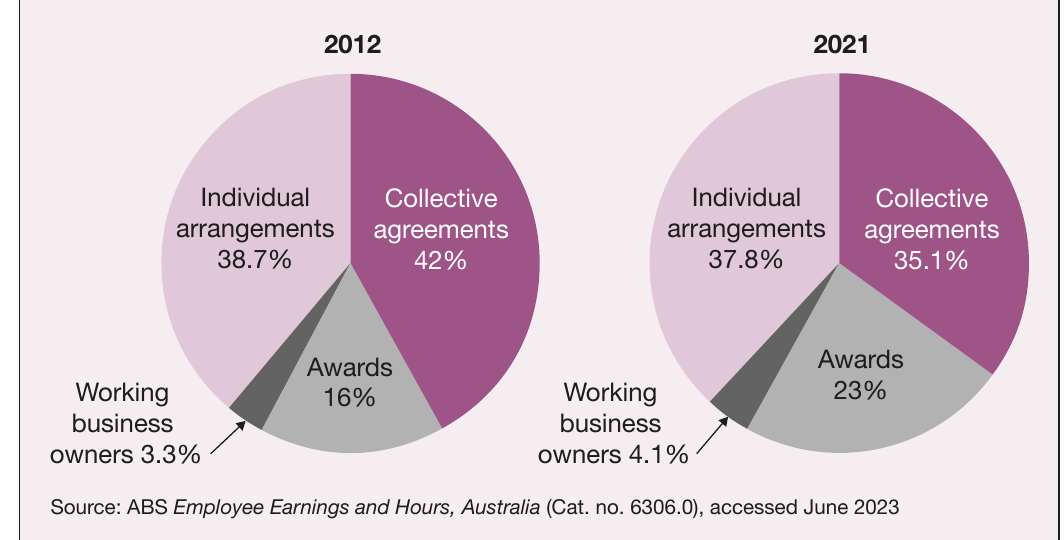
The charts above show changes in wage-setting arrangements between 2012 and 2021. The proportion of employees covered by awards increased from 16% to 23% over this period, while collective agreements decreased from 42% to 35.1%. This trend reflects the fact that modern awards are often simpler for employers to use than negotiating enterprise or individual agreements.
Note
Research suggests that approximately one in five non-award employees work under "over-award" arrangements, where awards form the basis of individual or collective agreements with additional benefits added. This means around 40% of employees are on award-based arrangements in total.
Provisions in modern awards
Modern awards extend the protections of the National Employment Standards with provisions tailored to specific industries, occupations, or enterprises. These may include:
- Types of employment arrangements
- When work is performed (including shift work)
- Overtime and penalty rates
- Annualised wage or salary arrangements
- Various allowances
- Leave-related matters beyond the NES
- Superannuation contributions
- Procedures for consultation, representation, and dispute settlement
Individual flexibility agreements
Modern awards and enterprise agreements must include a clause allowing for individual flexibility agreements (IFAs). This mechanism enables an individual employee and employer to vary certain terms of an award to meet their specific needs without negotiating a separate formal agreement.
IFAs can only vary specific terms such as:
- When work is performed
- Overtime rates
- Penalty rates
- Leave loading
Important
Important Safeguards for IFAs
IFAs include critical protections to prevent exploitation:
- They must leave the employee better off overall compared to the award
- They can only be made after employment has commenced
- They cannot be offered as a condition of employment
Research by the Fair Work Commission in 2021 found that IFA usage is very low overall, though it temporarily increased during the COVID-19 pandemic. These agreements balance the need for flexibility with protection against employers reducing pay and conditions.
Enterprise agreements
Enterprise agreements represent the most common form of wage determination within the formal system. These are collective workplace agreements negotiated between an employer (or group of employers) and employees, usually with union representation.
Right to bargain
The Fair Work Act introduced a right for employees to engage in enterprise bargaining with employers. If a majority of employees vote in favour of seeking a collective agreement, employers can be required to engage in bargaining discussions. This ensures workers have a genuine opportunity to negotiate their pay and conditions collectively.
Coverage and trends
Approximately 35% of employees in the national system are covered by enterprise agreements, which has declined from 42% in 2012. Despite this decline, Australia's coverage rate of 35% remains above the OECD average of 32%.
Note
Only 12.5% of Australian workers are union members, yet unions typically negotiate enterprise agreements on behalf of all employees in a workplace, not just union members. This means collective agreements usually benefit a much broader group of workers than just those who belong to unions.
Requirements for enterprise agreements
All enterprise agreements must meet several key requirements:
National Employment Standards compliance: Agreements must comply with the NES and cannot remove or reduce any NES entitlements.
Award minimum rates: Pay rates in enterprise agreements cannot fall below the equivalent award rates. Awards provide the minimum floor for wages.
Important
Better Off Overall Test (BOOT)
This is the most important requirement for enterprise agreements. The BOOT requires that employees must be made better off overall under the agreement compared to the applicable award. The Fair Work Commission administers this test to ensure agreements genuinely benefit workers.
The BOOT also applies to any individual flexibility agreement negotiated as part of an enterprise agreement, providing an additional layer of protection.
Content of enterprise agreements
Enterprise agreements typically cover all workers up to management level in a workplace. They commonly address:
- Wage increases (both immediate and future increases)
- Loadings for additional work hours or unsociable hours
- Productivity improvements and efficiency measures
- Industry-specific working conditions
- Dispute resolution procedures
Wage increases under collective agreements have moderated in recent years, declining from an average of around 4% (from 1991 to 2015) to 2.7% between 2015 and 2022.
Note
Recent Reforms
Changes that came into effect from 2023 have made it easier for employees to negotiate multi-employer enterprise agreements, especially in sectors with historically low levels of collective bargaining. These changes also granted the Fair Work Commission greater powers to arbitrate outcomes where disputes have become "intractable" (meaning there is no realistic prospect of reaching an agreement through negotiation).
Common law contracts and high-income earners
Individual arrangements cover almost 40% of workers in the federal system, making them a significant component of Australia's wage determination framework.
Common law contracts
Common law contracts represent the most common form of individual arrangement, particularly widespread in small businesses. These contracts often set out employment terms in just one or two pages, making them simpler than formal enterprise agreements.
Key characteristics:
- Negotiated individually, not collectively
- Cannot trade off or reduce award entitlements including pay (except for high-income earners)
- Enforced through ordinary law courts rather than workplace tribunals
- Not considered part of the formal industrial relations system
Employment contracts for high-income earners
High-income earners represent an exception to the general rule that individual contracts cannot bypass awards. Under the Fair Work Act, modern awards do not apply where an employee earns more than a specified threshold ($167,500 in 2023-24).
Note
High-income earners are only covered by the National Employment Standards rather than award entitlements. This reflects the policy view that the award system was designed to provide a safety net for lower-income workers with less bargaining power and protection.
Historical context: Australian Workplace Agreements
From 1997 to 2009, a system of individual contracts called Australian Workplace Agreements (AWAs) operated in Australia. The Fair Work Act abolished AWAs following criticism that they were unfair.
Important
Why AWAs Were Abolished
The concerns with AWAs included:
- Employers have significantly greater bargaining power than individual employees
- AWAs were often imposed on employees without genuine negotiation
- In some cases, employers used AWAs to remove entitlements employees previously enjoyed under collective agreements and awards, such as penalty and overtime rates
This history explains why current individual contracts (except for high-income earners) cannot bypass the award system and must comply with industrial regulations.
Employees versus independent contractors
One of the major contemporary challenges for Australia's labour market policies is distinguishing between employees and independent contractors, particularly in the gig economy.
The gig economy challenge
The "sharing economy" or "gig economy" involves digital platforms connecting customers directly with individual workers who provide services such as:
- Fast-food delivery
- Transport services (ride-sharing)
- General household assistance
A report commissioned by the Victorian Government estimated in 2020 that more than one million Australians had gig economy jobs across over 100 digital platforms.
The classification problem: Gig economy businesses typically classify their workers as independent contractors rather than employees, excluding them from Fair Work Act coverage. However, these businesses often treat workers like employees in practice by:
- Providing materials needed for the job
- Setting fixed rates of pay per item or service
- Controlling many aspects of how work is performed
This classification as contractors rather than employees significantly lowers business costs by avoiding normal employee entitlements and award wages.
Distinguishing employees from contractors
The Fair Work Commission uses several factors to distinguish employees from independent contractors:
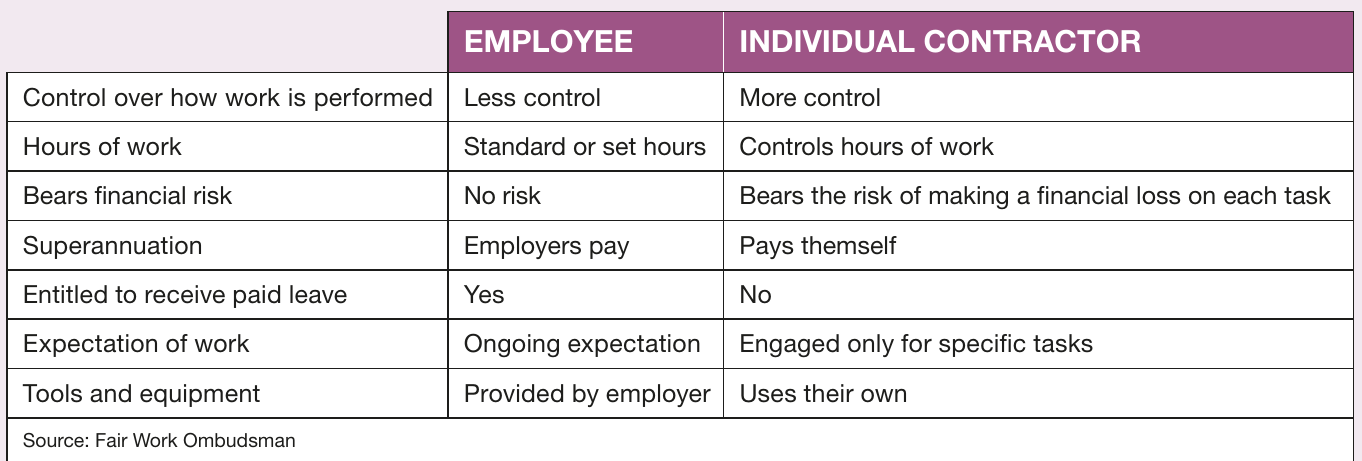
The table above outlines the key differences between employees and individual contractors across seven important dimensions.
Legal developments
During the 2010s, the Fair Work Commission made several rulings using a "multi-factor test" that considered the key factors of an individual's day-to-day work. However, a landmark High Court decision in 2022 ruled that a written contract ultimately determines whether an individual is an employee or contractor, regardless of the practical reality of the working relationship.
Example
Case Study 1: Deliveroo Driver (2020)
Following the High Court ruling, the Fair Work Commission found that a Deliveroo driver was not protected from unfair dismissal because he was classified as a contractor under the terms of his contract.
Key facts:
- Classification: Independent contractor
- Issue: Lost work after company's algorithm determined he was too slow
- Outcome: No protection from unfair dismissal as a contractor
- Impact: Highlighted the vulnerability of gig workers under contractor classification
Example
Case Study 2: Hungry Panda Rider (2022)
In contrast, a NSW court ruled that a Hungry Panda delivery rider who died in a road accident while making a delivery was actually an employee.
Key facts:
- Classification: Employee (determined by court)
- Situation: Death during delivery
- Outcome: Family entitled to $830,000 workers' compensation payout
- Significance: Demonstrated inconsistency in how similar workers are classified
These contradictory outcomes highlighted the confusion and inconsistency in the system.
Recent reforms
To address this confusion, the Albanese Government introduced the Fair Work Legislation Amendment (Closing Loopholes) Bill in September 2023.
Important
Key Reforms for Gig Workers
This legislation aims to:
- Give the Fair Work Commission formal powers to establish minimum standards for gig workers
- Preserve the flexibility of digital platforms
- Address loopholes relating to "permanent casuals" and labour hire arrangements
The Fair Work Commission would be empowered to create minimum standards for gig workers who are not employees where three conditions are met:
- Individuals are on low pay compared to employees
- They have low bargaining power
- They have limited control over their work
As Workplace Relations Minister Tony Burke argued when introducing the Bill: "it's got to be possible to have 21st-century technology without having 19th-century working conditions".
Summary
Key Points to Remember:
-
Australia's wage system has two parts: The formal system (awards and collective agreements) and the informal system (individual contracts and business owners) both sit on a foundation of National Employment Standards.
-
Awards provide industry-specific minimums: Modern awards set minimum wages and conditions for specific industries or occupations, with the system streamlined to 123 awards covering around 23% of workers.
-
Enterprise agreements require the BOOT: All collective agreements must pass the "better off overall test" to ensure employees benefit compared to the relevant award.
-
Individual contracts cannot reduce award entitlements: Except for high-income earners (over $167,500), individual contracts must comply with award provisions and cannot trade off conditions.
-
The gig economy presents new challenges: Distinguishing employees from contractors remains contentious, with recent reforms aimed at establishing minimum standards for platform workers while preserving flexibility.