Evaluating Labour Market Outcomes in Australia (HSC SSCE Economics): Revision Notes
📚Revision Notes
Evaluating Labour Market Outcomes in Australia
Overview of Australia's labour market system
Australia operates a hybrid wage determination system that balances market and non-market forces. The system emphasises market-based mechanisms through enterprise bargaining, where wages and conditions are negotiated at the workplace level between employers and employees. At the same time, it retains non-market institutions such as the Fair Work Commission, which sets minimum standards and resolves disputes.
Note
This hybrid approach combines the flexibility of market forces with institutional protections for workers. It allows wages to respond to specific conditions in different industries while ensuring a safety net of minimum wages and conditions.
This approach combines the flexibility of market forces with institutional protections for workers. Enterprise bargaining allows wages to respond to specific conditions in different industries and workplaces, while the Fair Work Commission ensures a safety net of minimum wages and conditions.
Key performance areas
Wages growth and inflation
A critical goal of the wage determination system is to achieve a balance between low, stable inflation and real income growth for workers. Real wages represent the purchasing power of wages after accounting for inflation, while nominal wages are the dollar amounts without inflation adjustments.
Example
Understanding Real vs Nominal Wages
If your nominal wage increases by 3% but inflation is 5%, your real wage change is:
This means your purchasing power has actually decreased by 2%, even though your dollar wage increased.
The decentralised system has successfully maintained low inflation over recent decades. However, this has come at the cost of weak real wage growth. The flexibility of enterprise bargaining has allowed larger wage increases in specific sectors experiencing strong demand without triggering widespread wage increases across the economy.
During the late 2010s, wage growth became so weak that the former Reserve Bank Governor, Philip Lowe, advocated for higher wage growth to boost consumer spending and strengthen economic growth. The relationship between wages and economic activity demonstrates how subdued wage growth can actually hinder economic performance.
Important
The Inflationary Wage Spiral Risk
In 2022, concerns about inflation returned following a global inflation surge. Policymakers faced a critical challenge: preventing an inflationary wage spiral, where:
- Higher prices lead to higher wage demands
- Higher wages increase business costs
- Businesses raise prices to cover higher costs
- This triggers another round of wage increases
Despite wages growth accelerating in 2022-23, it remained well below the inflation rate, meaning real wages actually fell.
Work practices and productivity
Labour market deregulation since the 1990s has transformed Australian work practices. During the 1990s, Australia achieved its strongest sustained productivity growth on record, averaging 2.1% per year. This improvement resulted from enterprise agreements that eliminated outdated and inefficient work practices.
However, these productivity gains proved to be one-off benefits from reform rather than ongoing improvements. Since the 2010s, productivity growth has averaged just 0.6% per year according to the ABS. This slowdown is not unique to Australia – many advanced economies have experienced similar trends.
Note
The Productivity Challenge
The contrast between 1990s and 2010s productivity growth is striking:
- 1990s: 2.1% average annual growth
- 2010s: 0.6% average annual growth
This represents a decline of approximately 70% in the rate of productivity improvement, signalling a major economic challenge.
The Productivity Commission's 5-Year Productivity Inquiry questioned whether enterprise bargaining effectively drives productivity improvements. The inquiry found that bargaining objectives typically focus on wages growth and avoiding industrial action, rather than enhancing productivity.
The Commission recommended several reforms:
- Banning clauses in agreements that limit productivity-enhancing technological changes
- Making the Better Off Overall Test (BOOT) more flexible, allowing agreements even if some workers receive lower benefits, provided the overall gains exceed the losses
Unemployment outcomes
The reforms to wage determination have given Australian workplaces greater flexibility to respond to economic fluctuations. Australia has successfully maintained relatively low unemployment alongside rising wages and productivity since the 1990s.
In mid-2023, Australia had the 12th lowest unemployment rate among the 38 OECD economies. This achievement is particularly notable given that Australia has the highest minimum wage levels in the OECD. The ability to maintain low unemployment despite high minimum wages demonstrates the effectiveness of the flexible labour market system.
Note
COVID-19 Response Success
The labour market's flexibility was clearly demonstrated during the COVID-19 pandemic. After the initial shock, unemployment fell below 4% for the first time since the 1970s, showing the system's capacity to adapt to changing circumstances.
Income inequality
One negative consequence of decentralised wage determination has been widening income inequality. Under enterprise bargaining, workers with greater skills and stronger union representation tend to secure larger wage increases. In contrast, workers with fewer skills or in weaker bargaining positions receive smaller increases.
Over the past three decades of enterprise bargaining, the gap between higher-income and lower-income earners has grown. However, the safety net of awards and minimum wage increases has provided some protection for the lowest-paid workers.
Example
Wage Growth Comparison (2010-2020)
In the decade to 2020:
- Consumer prices rose: 22%
- National minimum wage increased: 32%
- Overall wage price index increased: 29%
Real wage growth for minimum wage earners:
This shows minimum wage earners experienced modest real wage growth, with their purchasing power increasing by 10% over the decade.
However, employees at the top of the earning scale experienced much faster income growth. In 2022-23, average CEO income grew by 15% – more than four times the increase for average workers.
Important
Growing Income Gap
The decentralised wage determination system has contributed to increasing inequality:
- Workers with stronger skills and union representation secure larger wage increases
- Workers with weaker bargaining positions receive smaller increases
- The gap between top and bottom earners continues to widen despite minimum wage protections
The mystery of Australia's wage growth
One of the most puzzling features of the 2010s labour market was the persistence of weak wage growth despite low unemployment and ongoing skills shortages. Economic theory suggests that tight labour markets should push wages higher, but this did not occur.
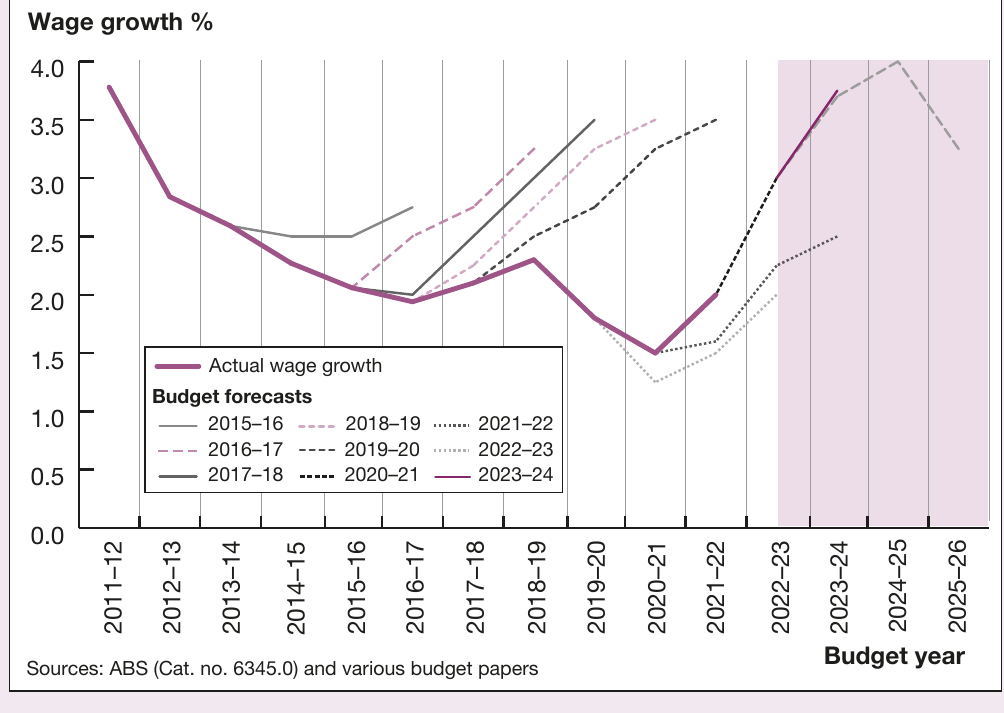
Figure 17.7 illustrates this phenomenon. Throughout the 2010s, the Treasury consistently forecast that wage growth would increase, but these predictions never materialised. The average national pay increase was just 2% for the five years between 2015 and 2020. Annual real wage growth fell to only 0.5%, meaning workers' purchasing power barely increased.
Several factors may explain this wage stagnation:
- Weak bargaining power of workers
- Changed expectations about wage growth
- Increased global competition
- Technological change affecting job security
Important
The 2022-23 Real Wage Decline
In 2022-23, nominal wages finally grew substantially for the first time since the global financial crisis, increasing 3.7% in the year to March 2023. However, inflation outpaced this growth, rising to a 30-year high of 7.8% over the same period.
Real wage change calculation:
This meant real wages fell by 4.1%, representing a significant decline in workers' purchasing power.
Note
Policy Response Debate
Economists debated the appropriate response to wage-inflation dynamics:
- Some argued wages growth should remain below inflation to prevent locking in higher inflation rates
- Others argued wages should keep pace with inflation to preserve living standards for low and middle-income earners
This debate highlights the ongoing tension between controlling inflation and protecting workers' living standards.
Ongoing policy debates
For over a century, Australians have debated how the economy should set wages and conditions for workers. This debate continues because labour represents around 60% of total business costs. Policies affecting labour costs therefore have major impacts on both individual businesses and the overall economy.
At the heart of this debate are different views about the appropriate roles of market forces and institutional intervention. Historically, Australian governments recognised that employers possess greater bargaining power than individual employees. This led to the creation of industrial tribunals to ensure fair outcomes for workers.
Note
Historical Labour Market Protections
Australia was among the first nations to recognise minimum entitlements such as:
- The eight-hour working day
- A minimum wage sufficient to support a decent family standard of living
These protections reflect a belief that purely market-based wage determination may not always produce equitable outcomes.
The Albanese Government's first term has prioritised reforms to strengthen both the Fair Work Commission's role and workers' bargaining power. This demonstrates that the fundamental debate over workplace relations remains as relevant today as it was at Federation over 120 years ago.
The processes for determining wages, work conditions and work practices are among the most important aspects of economic policy because they affect the economy broadly and impact people's daily lives significantly. For this reason, debate over labour market policies and their impacts will likely continue for many years to come.
Summary
Key Points to Remember:
-
Australia uses a hybrid wage determination system combining market-based enterprise bargaining with institutional oversight through the Fair Work Commission
-
Four key areas for evaluating labour market performance are: wages growth and inflation, productivity, unemployment, and income inequality
-
Productivity growth was strong in the 1990s (2.1% annually) but has been weak since the 2010s (0.6%)
-
Despite low unemployment and skills shortages, wage growth remained weak throughout the 2010s – a phenomenon that puzzled economists and policymakers
-
In 2022-23, nominal wages finally increased substantially (3.7%), but inflation was even higher (7.8%), causing real wages to fall by 4.1%
-
Decentralised wage determination has contributed to widening income inequality, though minimum wage protections have provided modest real wage growth for the lowest-paid workers
-
Remember the formula: