The Role of National and State Workplace Systems (HSC SSCE Economics): Revision Notes
📚Revision Notes
The Role of National and State Workplace Systems
Introduction to labour market regulation
Labour market policies in Australia involve government intervention in how wages are set and employment conditions are determined. The government plays an active role in regulating the labour market to achieve several economic and social objectives, including maintaining low inflation, improving productivity and competitiveness, and ensuring fair minimum standards for all workers.
In Australia, governments have historically taken a significant role in wage determination through independent industrial courts and tribunals. The balance between federal and state regulation has been debated since Federation in 1901.
Note
Why does the government intervene in labour markets?
While markets generally operate efficiently through supply and demand, governments intervene in labour markets to:
- Protect workers from exploitation and ensure minimum standards
- Maintain macroeconomic stability by influencing wage growth and inflation
- Promote productivity through better workplace practices
- Address market failures and information asymmetries in employment relationships
Constitutional framework: why Australia has dual systems
Australia's labour market regulation system has traditionally been split between federal and state levels due to constitutional limitations. The Australian Constitution does not grant the Commonwealth Government direct power to legislate over the entire labour market. Instead, the Constitution only provides the Commonwealth with power to resolve industrial disputes that cross state boundaries.
Important
Critical Constitutional Limitation
The Commonwealth Government's original constitutional power over workplace relations was extremely limited—it could only act when industrial disputes crossed state boundaries. This fundamental limitation is why Australia developed separate federal and state workplace systems, rather than a single national system from the beginning.
Despite these limitations, the Commonwealth has gradually expanded its involvement in labour market regulation over the past century by using other constitutional powers. These policies have historically been termed "industrial relations" or, more recently, "workplace relations".
Historical development of separate systems
Over time, Australia developed seven separate industrial relations systems: one federal system and six different state systems. These systems operated independently to establish minimum wages and working conditions for employees through industrial awards.
Note
What are Industrial Awards?
Industrial awards are legally binding documents that set out minimum employment conditions based on an employee's industry or occupation. They establish baseline standards for matters like:
- Minimum wage rates
- Working hours and overtime
- Leave entitlements
- Penalty rates for specific work conditions
Under the fragmented system, some employees had their awards set by the Commonwealth, while others were covered by state-level awards.
This created a complex regulatory landscape where employers and employees needed to determine which system applied to their particular situation.
Problems with fragmented regulation
The existence of multiple separate systems created significant inefficiencies for the Australian economy. Employers whose workforce operated across multiple states faced the burden of complying with different state systems as well as the federal system. Each system had its own rules, procedures, and requirements, making compliance complex and costly.
Important
The Cost of Fragmentation
Multi-state employers faced:
- Different award structures in each jurisdiction
- Multiple compliance requirements and reporting obligations
- Higher legal and administrative costs
- Inconsistent treatment of similar employees in different states
- Difficulty implementing standardized HR practices across their business
This fragmentation created pressure for reform and a shift toward a more unified national approach to workplace regulation.
The Fair Work Act 2009: establishing a national system
The inefficiencies inherent in separate state and federal systems led to the introduction of the Fair Work Act (2009). This legislation established a national workplace relations system that currently covers approximately 70% of Australian workers.
The Fair Work Act created a unified framework for workplace regulation, reducing the complexity employers faced when operating across state boundaries. The national system provides consistent rules and standards for the majority of Australian employees.
Coverage under the national system
The Federal Government's constitutional power under the Fair Work Act extends to specific categories of employees. The national system automatically covers all employees of incorporated businesses (companies) and federal government employees.
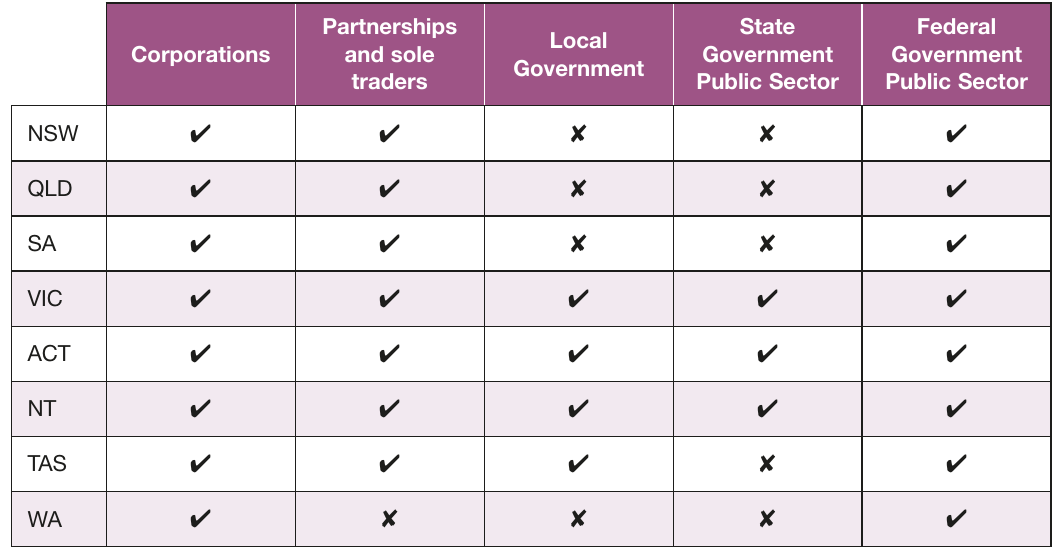
Beyond this constitutional baseline, some state governments have voluntarily "referred" their powers to the Federal Government. Referring powers means state governments have formally handed over their authority to regulate certain aspects of employment to the Commonwealth. These referred powers include regulation of employees working for sole traders, partnerships, local government, and state public sector organisations.
Note
Understanding Referred Powers
The concept of "referred powers" is crucial to understanding how the national system expanded beyond the Commonwealth's original constitutional limits. When a state "refers" its powers:
- The state voluntarily transfers its constitutional authority to the Commonwealth
- This transfer allows the federal system to cover employees who would otherwise fall under state jurisdiction
- The referral can be complete (all powers) or partial (specific categories of workers)
- States can theoretically withdraw referred powers, though this would create significant disruption
Victoria, the Australian Capital Territory, and the Northern Territory have referred all their powers, achieving complete coverage under the national system.
The table above shows the current coverage of the national workplace relations system across Australian jurisdictions. Three jurisdictions—Victoria, the Australian Capital Territory, and the Northern Territory—have referred all their powers to the Commonwealth and are fully covered by the national system. Tasmania has referred most powers except for state government public sector employees.
Important
Western Australia's Unique Position
Western Australia stands out as the only state that has not referred any powers to the Federal Government beyond what is constitutionally required. This means WA maintains its own separate state system for non-corporate employers, making it an outlier in the national approach to workplace regulation.
Simplification and standardization
During the shift to a national system, the Commonwealth Government replaced most state-based awards with simpler, more streamlined federal awards. This reduced the number of different awards and made the system easier for both employers and employees to navigate.
The Commonwealth also established a national system of occupational health and safety legislation, creating consistency in workplace safety standards across most of the country.
The Fair Work Commission
The national workplace relations system is overseen by the Fair Work Commission (FWC), an independent statutory body. The FWC plays a central role in administering the Fair Work Act, including setting minimum wages, approving enterprise agreements, and resolving workplace disputes.
Note
Role of the Fair Work Commission
As the key institution in Australia's national workplace relations system, the FWC:
- Makes annual decisions on minimum wage rates
- Reviews and approves enterprise agreements between employers and employees
- Resolves disputes through conciliation and arbitration
- Creates and updates modern awards
- Handles unfair dismissal claims
- Operates independently from government and political influence
Remaining state powers
While the national system now covers most Australian workers, state and territory governments retain some regulatory authority over the labour market. State regulation is primarily limited to:
- State government employees (in most states)
- Specific workplace issues such as workers' compensation schemes
- Public holiday provisions
- Some occupational health and safety matters in states that haven't referred these powers
This limited state involvement means the labour market is now predominantly regulated at the national level, with states playing a supplementary role in specific areas.
Benefits of the national system
The shift toward a unified national workplace relations system has delivered several advantages:
- Reduced complexity: Employers operating across multiple states face one set of rules rather than navigating different state systems
- Lower compliance costs: Simplified regulation reduces administrative burden and legal costs for businesses
- Greater consistency: Workers in similar roles across different states receive more consistent treatment
- Improved efficiency: Standardized processes make the labour market more efficient overall
- Easier dispute resolution: A single national body can handle workplace disputes more consistently
Summary
Key Points to Remember:
- Australia's Constitution limits Commonwealth power over labour markets to resolving interstate industrial disputes, leading to a historically fragmented federal-state system
- Seven separate industrial relations systems (one federal, six state) created inefficiency and complexity for multi-state employers
- The Fair Work Act 2009 established a national workplace relations system covering approximately 70% of Australian workers
- The national system covers all incorporated businesses and federal employees, plus areas where states have "referred" their powers to the Commonwealth
- The Fair Work Commission oversees the national system as an independent statutory body
- Western Australia is the only state that has not referred any additional powers to the federal system
- State regulation now focuses primarily on state government employees and specific issues like workers' compensation and public holidays
Memory Aids:
- "VAN" for full coverage: Victoria, ACT, and NT have referred all powers to the Commonwealth
- WA stands alone: Western Australia is the only non-referring state
- 70% rule: The national system covers approximately 70% of Australian workers
- Think "Fair Work = 2009": The national system was established in 2009