Microeconomic Policies and Aggregate Supply (HSC SSCE Economics): Revision Notes
📚Revision Notes
Microeconomic Policies and Aggregate Supply
Introduction to microeconomic policies
Microeconomic policies are government interventions designed to improve how efficiently firms and industries operate. Unlike macroeconomic policies that manage overall demand in the economy through tools like interest rates, microeconomic policies focus on increasing the economy's productive capacity. Think of macroeconomic policy as controlling how much we want to buy, while microeconomic policy is about improving our ability to produce.
Note
The key distinction is that microeconomic policies work on the supply side of the economy. They aim to increase aggregate supply by making businesses more productive and competitive. This approach is sometimes called supply-side economics because it focuses on improving the production capabilities of the economy rather than managing consumer demand.
Microeconomic policies are government actions that aim to increase aggregate supply by improving the efficiency and productivity of producers and industries.
Why microeconomic policies matter
Australia faces many economic challenges that cannot be solved simply by adjusting interest rates or government spending. These are structural problems embedded in how the economy operates.
Important
Structural Challenges Requiring Microeconomic Solutions:
- Skills shortages in the labour market cannot be fixed overnight with monetary policy
- Transitioning to renewable energy requires long-term structural changes
- Building new industries in knowledge-based services and green technology needs fundamental reforms
Microeconomic policies address these structural issues by improving productivity in existing industries and helping the economy transition to new industries. Key reform areas include tax reform, education system improvements, and investment in technology infrastructure.
The ultimate goal is to support sustainable long-term economic growth while reducing the constraints that inflation and external imbalances place on the economy.
How microeconomic policies increase aggregate supply
When microeconomic reforms successfully improve efficiency and productivity, they shift the aggregate supply curve to the right. This means the economy can produce more goods and services at every price level.
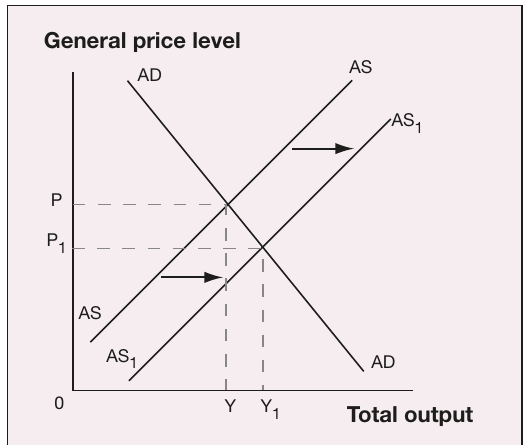
The diagram shows the impact of successful microeconomic reform. The aggregate supply curve shifts from to , moving the equilibrium point along the aggregate demand curve (). This produces two beneficial outcomes:
Note
Impact of Successful Microeconomic Reform:
- Higher output: Total production increases from to
- Lower prices: The general price level falls from to
This combination of increased production and lower prices represents an improvement in the economy's productive capacity. It means Australia can enjoy higher living standards without the inflationary pressures that would normally accompany economic growth.
Structural change and microeconomic policy
Structural change involves shifts in the pattern of production that reflect changes in technology, consumer preferences, global competitiveness and other factors. It results in some products, processes and even entire industries disappearing, while others emerge and become more prominent.
Microeconomic policies both promote and respond to structural change. They help the Australian economy adapt more effectively to changing conditions by making markets work more efficiently.
Product and factor markets
Microeconomic policies target two main types of markets:
Note
Product markets are markets for goods and services that consumers buy. Examples include the market for motor vehicles or transport services.
Factor markets are markets for the inputs used in production. The most important factor markets are:
- The labour market (where workers are hired)
- Financial markets (where businesses access capital)
Markets work efficiently when goods are produced at the lowest possible cost and resources flow to where they have the highest value. Microeconomic policies aim to remove barriers and distortions that prevent markets from achieving this efficiency.
Evidence of structural change in Australia
The structure of the Australian economy has transformed significantly since 1980, driven by technological improvements, increased trade, changing consumer preferences, and wide-ranging microeconomic reforms.
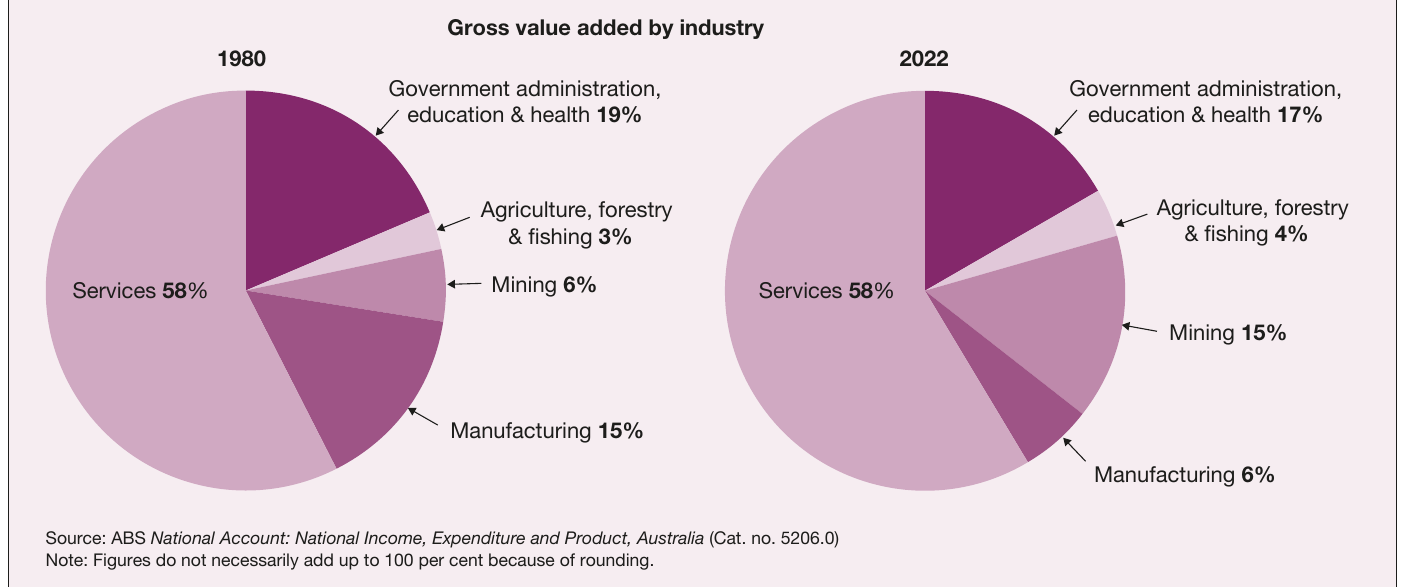
The pie charts reveal major shifts in Australia's industrial structure between 1980 and 2022:
- Manufacturing declined dramatically from 15% to just 6% of gross value added
- Mining expanded significantly from 6% to 15%
- Services remained stable at 58%, maintaining its dominance
- Government, education and health fell slightly from 19% to 17%
- Agriculture, forestry and fishing increased marginally from 3% to 4%
This structural transformation reflects both market forces and the impact of microeconomic policies. The decline in manufacturing and rise in mining shows how the economy responded to changing global demand patterns and Australia's comparative advantages.
The role of competition and market forces
Microeconomic theory suggests that product and factor markets operate most efficiently when:
- There is strong competition between private businesses
- Market forces of supply and demand can operate with minimal distortions
- Government interventions and anti-competitive behaviour are limited
However, this principle is not absolute. Consider the electricity sector, which provides a major input for production and an essential service for households. The debate around electricity price regulation illustrates the tensions in microeconomic policy:
Note
The Electricity Regulation Debate:
Arguments for deregulation: Price regulation may discourage investment in new energy generation facilities if investors expect lower profits. This could lead to underinvestment in infrastructure, resulting in less reliable energy supply, lower productivity, and ultimately higher prices.
Arguments for regulation: Large energy firms may exploit their market power to extract excessive profits if prices are not regulated. Some government oversight protects consumers from exploitation.
This example shows that microeconomic reform involves careful judgement about when market forces should operate freely and when some regulation serves the broader economic interest.
Three dimensions of efficiency
Microeconomic policies aim to improve efficiency in three distinct ways. While many policies affect all three types simultaneously, it is useful to understand each dimension separately.
Allocative efficiency
Allocative efficiency refers to the economy's ability to shift resources to where they are most valued and can be used most efficiently.
In a well-functioning market economy, resources should flow to producers who can use them most effectively. More efficient producers can afford to pay more for resources because they generate greater value from them. By minimising distortions such as government regulations, tax loopholes, subsidies, and anti-competitive behaviour, market forces can guide resources to their most productive uses.
Example
Worked Example: Allocative Efficiency Through Tariff Removal
Allocative efficiency promotes beneficial structural change. For example, removing tariff protection led to a reallocation of resources away from inefficient producers who could only survive behind protective barriers.
Outcome: Resources shifted toward more competitive producers who could thrive without protection. This improved the overall productivity of the Australian economy, even though it meant some businesses closed or downsized.
Technical efficiency
Technical efficiency refers to the economy's ability to produce the maximum level of output from a given quantity of inputs.
Technical efficiency is measured by productivity: how much output can be produced from a given quantity of inputs. When businesses achieve higher productivity, they can produce output more cheaply, making them more competitive in both domestic and global markets.
Businesses operating in competitive markets have strong financial incentives to maximise technical efficiency. Competition forces them to:
- Adopt the latest production technology
- Use the least-cost combination of resources
- Continuously improve their production processes
Example
Worked Example: Productivity Growth in Australian Industries
Different industries in Australia have achieved varying levels of productivity growth. The finance and insurance industry recorded average annual multifactor productivity growth of around 1.5% between 1997 and 2022, significantly higher than the manufacturing sector's 0.4% over the same period.
Contributing Factors: Industry changes contributing to increased productivity in finance included:
- Online banking
- Automation of information processing
- Bank branch closures
- Offsharing of processing functions
- Organisational restructuring
Reform Impact: Deregulation, privatisation, and increased competition all contributed to these productivity gains.
Dynamic efficiency
Dynamic efficiency refers to the economy's ability to shift resources between industries in response to changing patterns of consumer preferences.
Dynamically efficient producers can respond quickly to changes in both domestic and global demand patterns. For example, a dynamically efficient car manufacturer can shift from producing petrol vehicles to electric vehicles as consumer preferences change due to environmental concerns.
Important
Dynamic efficiency also involves the ability to adopt new technologies and innovative business practices. Increasing competition is one of the most effective ways to improve dynamic efficiency because competitive pressure forces producers to:
- Stay responsive to changes in consumer demand
- Quickly adopt new technologies
- Innovate to maintain market share
Example
Worked Example: Telecommunications Reform and Three Types of Efficiency
Past reforms to Australia's telecommunications industry demonstrate all three types of efficiency working together:
- Technical efficiency: Increased competition forced companies to become more technically efficient to maintain market share
- Dynamic efficiency: Competitive pressure encouraged innovation and quick adoption of new technologies
- Allocative efficiency: More investment flowed to the sector as it became more competitive and profitable
Overview of microeconomic reform areas
Australian governments have implemented microeconomic reforms across several key areas:
- Deregulation: Simplifying or removing rules that constrain market forces
- Reforms to public trading enterprises: Improving efficiency of government-owned businesses
- Competition policy: Promoting competitive markets
- Environmental management: Addressing environmental challenges while maintaining economic efficiency
- Reducing protection: Lowering tariffs and trade barriers
- Tax reforms: Improving efficiency of the tax system
- Labour market reforms: Making labour markets more flexible and efficient
Each of these reform areas targets different aspects of the economy but shares the common goal of increasing aggregate supply by improving efficiency and productivity.
Remember!
Summary
Key Points to Remember:
-
Microeconomic policies focus on supply, not demand – they increase the economy's capacity to produce rather than managing how much consumers spend
-
Three types of efficiency matter: Allocative efficiency (resources going where they're most valued), technical efficiency (producing maximum output from inputs), and dynamic efficiency (responding quickly to changing conditions)
-
Structural change is inevitable and necessary – microeconomic policies help the economy adapt by making markets work more efficiently as industries rise and decline
-
Competition drives improvement – when businesses face competitive pressure, they are forced to innovate, adopt new technologies, and operate more efficiently
-
Successful reforms shift aggregate supply rightward – this produces more output at lower prices, improving living standards without causing inflation