Conflicts in Government Policy Objectives (HSC SSCE Economics): Revision Notes
📚Revision Notes
Conflicts in Government Policy Objectives
Understanding policy trade-offs
Governments pursue multiple economic objectives simultaneously, including strong growth, low inflation, minimal unemployment, environmental sustainability and external stability. However, achieving one goal often makes it harder to achieve another. Policymakers must carefully balance these competing priorities when designing economic policy.
Important
Three major conflicts exist between the government's economic objectives. Understanding these trade-offs is essential for analysing policy decisions and their likely outcomes.
The unemployment-inflation trade-off
The Phillips curve relationship
In the short to medium term, policymakers face a fundamental trade-off between unemployment and inflation. This tension arises from the behaviour of aggregate demand in the economy.
When aggregate demand increases, businesses respond by hiring more workers to meet higher consumer spending. This drives unemployment down. However, the same demand pressures push prices upward as businesses face higher costs and consumers demonstrate willingness to pay more. The result is higher inflation.
Conversely, when aggregate demand weakens, businesses restrain their price increases to maintain sales. Inflation moderates. However, reduced demand also leads firms to cut costs by reducing their workforce, causing unemployment to rise.
Note
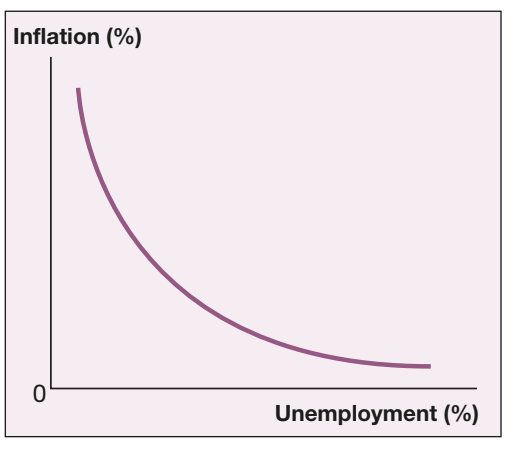
The Phillips curve illustrates this inverse relationship between inflation and unemployment. The curve shows that lower unemployment typically corresponds with higher inflation, whilst higher unemployment coincides with lower inflation.
Asymmetric Phillips curve behaviour
Recent research reveals that the Phillips curve relationship is not symmetrical. A 2021 Reserve Bank study found strong evidence that the curve flattens at higher unemployment levels.
When unemployment is high, wages growth and price inflation respond weakly to further changes in unemployment. Workers have little bargaining power in a slack labour market. However, when unemployment falls to low levels, wages and prices become increasingly sensitive to further reductions in unemployment. Tight labour markets give workers greater negotiating strength, pushing wages and prices higher.
Important
This asymmetry means the trade-off becomes more severe as the economy approaches full employment.
Australian policy example: 2023 inflation-unemployment trade-off
Example
Worked Example: Australia's 2023 Policy Trade-off
Australia's policymakers confronted the Phillips curve trade-off directly in 2023. In June 2023, Michele Bullock, then Deputy Governor of the Reserve Bank of Australia, indicated that unemployment would need to increase from 3.6% to 4.5% to bring inflation back to the RBA's target range of 2-3%.
This statement highlighted the difficult choice facing policymakers: tolerate temporarily higher unemployment to restore price stability, or keep unemployment low whilst accepting persistent inflation above target.
Exam insight: analysing the unemployment-inflation trade-off
Note
When evaluating policies affecting unemployment and inflation, consider:
- Time horizon: The Phillips curve trade-off is primarily a short to medium-term phenomenon
- Starting position: The trade-off becomes steeper when unemployment is already low
- Policy tools: Monetary policy works mainly through aggregate demand, creating this trade-off
- Long-term considerations: Some economists argue the trade-off disappears in the long run (see Long Run Phillips Curve in advanced analysis)
Economic growth versus environmental sustainability
The growth-environment conflict
Pursuing faster economic growth can impose significant environmental costs. Rapid expansion typically increases pollution, waste generation and carbon emissions. Key environmental pressures include:
- Land clearing: Approving new housing or agricultural developments in environmentally sensitive areas reduces forestation, disrupts ecosystems and threatens native species
- Resource degradation: Intensive farming practices can damage soil quality and deplete water resources
- Pollution and waste: Greater economic activity generates more industrial emissions and consumer waste
- Carbon emissions: Higher production and consumption increase greenhouse gas emissions, contributing to climate change
These environmental impacts create a short-term conflict between growth and sustainability objectives.
Long-term reconciliation of growth and environment
Note
Whilst growth and environmental protection often conflict in the short term, achieving both objectives simultaneously is possible and necessary over the long term. The goal of reducing carbon emissions has become increasingly central to policy frameworks worldwide.
Recent economic research demonstrates that early action on climate change can actually support economic growth. Transitioning to clean energy creates new industries and employment opportunities whilst reducing long-term environmental risks. Rather than viewing growth and environmental sustainability as mutually exclusive, policymakers increasingly recognise that sustainable growth requires environmental protection.
Economic growth versus external balance
Understanding the growth-external balance conflict
Strong economic growth frequently results in deterioration of the current account balance. This creates what economists call the balance of payments constraint - the limitation on growth rates imposed by the impact of expansion on the current account deficit.
Important
The mechanism works as follows:
Higher economic growth → Increased consumption and investment → Greater demand for imports → Larger current account deficit
When domestic incomes rise during periods of strong growth, Australian consumers and businesses purchase more goods and services. Many of these goods are imported, causing import volumes to surge. This worsens the current account deficit, potentially creating concerns about external stability and the nation's international debt position.
The balance of payments constraint reflects the extent to which a high current account deficit limits the speed at which the economy can grow sustainably. Policymakers must consider whether current growth rates are creating unsustainable external imbalances.
Exam insight: evaluating the growth-external balance trade-off
Note
When assessing this conflict, consider:
- Import elasticity: How responsive are imports to changes in domestic income?
- Export performance: Strong export growth can partially offset higher import volumes
- Capital flows: Foreign investment inflows can finance current account deficits
- Sustainability: Persistent large deficits may indicate structural imbalances requiring policy adjustment
Australia's wellbeing budget framework
Expanding the definition of economic success
In July 2023, Treasurer Jim Chalmers introduced a significant expansion of how Australia measures economic performance. The Measuring What Matters framework established 50 indicators providing a broader assessment of national prosperity beyond traditional metrics like GDP, inflation and unemployment.
This wellbeing approach follows similar frameworks adopted by Scotland, Wales, Canada, New Zealand and Germany. The framework aims to guide policymakers to consider how economic objectives interact with wider measures of prosperity and sustainability.
Key wellbeing indicators
Note
The 50 indicators show varied trends:
- Improving indicators (20): Life expectancy, experiences of discrimination, trust in others, and waste per person
- Deteriorating indicators (12): Biological diversity, productivity growth, homelessness and trust in government
- Mixed or stable indicators (18): Life satisfaction, psychological distress levels, and income inequality
Policy implications
The wellbeing framework reflects how governments increasingly view traditional economic objectives as means to broader ends, rather than ends in themselves. Treasurer Chalmers emphasised that these measures complement rather than replace conventional economic indicators. The government maintains its primary focus on inflation control and growth foundations, whilst simultaneously working to align economic and social goals.
The framework's annual updates may influence policy decisions by encouraging consideration of distributional impacts, environmental consequences and social outcomes alongside purely economic metrics. However, whether the framework leads to substantive policy changes remains to be seen.
Other policy conflicts
Economic growth versus income equality
Pursuing economic growth can sometimes increase income inequality. Several mechanisms create this tension:
Important
Market-oriented reforms may boost overall growth but have unequal distributional impacts. For example:
- User-pays charges for public services (such as road tolls) create proportionally larger burdens for lower-income households
- Labour market deregulation may improve productivity and flexibility but can increase wage dispersion
- Decentralised wage bargaining tends to benefit skilled workers more than those in weaker bargaining positions
However, the relationship between growth and inequality is not inevitably conflicting. Inclusive growth principles suggest that sharing economic gains more equitably can actually support stronger growth. Evidence shows:
- Providing quality education to children from disadvantaged backgrounds yields positive social outcomes and improves long-term labour market productivity
- Increasing female representation in business leadership correlates with higher firm productivity
- Reducing poverty expands the consumer base and economic participation
Achieving more equitable income and wealth distribution remains a significant long-term challenge for policymakers, but need not come at the expense of growth.
Short-term versus long-term objectives
Governments frequently confront conflicts between immediate priorities and long-term goals. Policies designed to achieve long-term objectives often involve substantial short-term costs, such as:
- Higher unemployment during structural reforms
- Reduced consumption when increasing national savings
- Initial costs of investing in infrastructure or education that only pay off over decades
- Short-term output losses when transitioning to more sustainable production methods
Policymakers must weigh these trade-offs carefully. Political pressures often favour short-term outcomes, as governments face regular elections. However, prioritising short-term objectives exclusively can undermine long-term prosperity and sustainability.
Remember!
Summary
Key Points to Remember:
-
The Phillips curve shows an inverse relationship between inflation and unemployment in the short to medium term. Lower unemployment typically means higher inflation, and vice versa. The relationship is asymmetric - becoming steeper when unemployment is already low.
-
Three major policy conflicts dominate macroeconomic management: unemployment versus inflation; economic growth versus environmental sustainability; and economic growth versus external balance.
-
The balance of payments constraint limits how fast the economy can grow sustainably. Strong growth increases imports, worsening the current account deficit.
-
Long-term reconciliation of conflicting objectives is often possible. Environmental sustainability and growth can reinforce each other through clean energy transitions. Inclusive growth principles show equality and growth need not conflict.
-
Australia's wellbeing framework introduced in 2023 represents a broader approach to measuring prosperity, using 50 indicators beyond traditional economic metrics. This reflects how governments increasingly view economic objectives as means to wider social ends.