The Economic Policy Mix (HSC SSCE Economics): Revision Notes
📚Revision Notes
The Economic Policy Mix
Introduction to policy instruments
Governments have several different types of economic policies they can use to achieve their objectives. These policy instruments are broadly divided into two main categories: macroeconomic policies and microeconomic policies. Each type works in a different way and targets different aspects of the economy.
Note
Understanding the distinction between macro and micro policies is fundamental to grasping how governments manage their economies. Think of macroeconomic policies as affecting the whole economy at once, while microeconomic policies work on individual parts.
Types of economic policies
Macroeconomic policies
Macroeconomic policies are designed to influence the overall level of economic activity across the entire economy. They include:
- Fiscal policy: Government decisions about taxation and government spending (the budget)
- Monetary policy: Changes to interest rates set by the Reserve Bank of Australia
These policies primarily work by influencing the level of aggregate demand in the economy. When governments adjust taxes, spending or interest rates, they affect how much consumers and businesses want to spend, which changes the total demand for goods and services.
Microeconomic policies
Microeconomic policies work at a much more specific level. They involve particular measures aimed at improving how individual firms, industries and markets operate. The focus is on achieving change at the level of individual businesses and sectors.
These policies tend to influence aggregate supply - the total amount the economy can produce. They do this by improving productivity and efficiency, which increases the overall production capacity of the economy.
The economic policy mix
Governments typically use a combination of both macroeconomic and microeconomic policies to achieve their economic objectives most effectively. This combination is known as the economic policy mix.
Important
Economic policy mix refers to the combination of macroeconomic (fiscal and monetary) and microeconomic policies used by the government to achieve its economic objectives.
The term 'policy mix' captures the overall impact of all the different macro and micro policy measures that are put in place. The 2023 review of the Reserve Bank of Australia recommended that the RBA and Treasury establish a research program to investigate the optimal balance between monetary and fiscal policy instruments.
Macroeconomic policy
Managing the business cycle
The primary role of macroeconomic policy is to manage the business cycle, which refers to the fluctuations in the level of economic activity over time. The economy never grows at a perfectly constant rate. Instead, it experiences continuous ups and downs caused by changes in aggregate supply and demand.
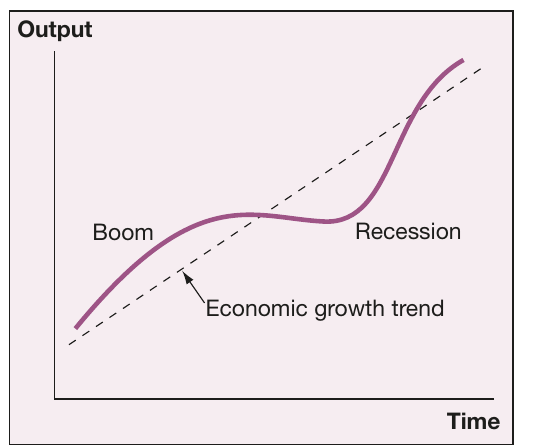
Note
As the diagram shows, actual economic output fluctuates around a long-term growth trend. During boom periods, output rises above the trend, while during recessions, output falls below it. Think of this like waves on the ocean - the water level goes up and down, but there's an average level underneath.
Purpose of macroeconomic management
Important
Macroeconomic management refers to the use of government policies to influence the economy with the aims of reducing large fluctuations in the level of economic activity and achieving certain economic goals.
The goal is to minimise these fluctuations so that the economy experiences:
- Low rates of inflation
- Low unemployment
- Relatively stable economic growth
Counter-cyclical policies
Government policies can help stabilise economic growth by smoothing out the peaks (booms) and troughs (recessions) of the business cycle. This is why macroeconomic policies are also called counter-cyclical policies - they work against the direction of the cycle.
Example
Worked Example: Contractionary Policies During Boom Periods
When the economy is growing too quickly, it may be necessary to reduce economic activity to prevent excessive inflation or a blowout in the current account deficit. Governments can use contractionary policies such as:
-
Higher tax rates: Increasing taxes reduces consumers' disposable income, which decreases spending and aggregate demand. This helps reduce pressure on inflation and the current account deficit.
-
Reduced government spending: Cutting government expenditure lowers aggregate demand by reducing the total level of spending in the economy.
-
Higher interest rates: When the Reserve Bank raises interest rates, borrowing money becomes more expensive. This discourages both consumers and businesses from borrowing and spending.
Remember: These policies "cool down" an overheating economy.
Example
Worked Example: Expansionary Policies During Recession Periods
When economic growth slows down, governments can use macroeconomic policy to stimulate activity and increase aggregate demand. For example, during the COVID-19 recession, the government used expansionary policies including:
- Increased government spending: Injecting more government expenditure into the economy directly increases aggregate demand
- Tax cuts: Giving households more disposable income to spend stimulates consumer spending
- Lower interest rates: Making borrowing cheaper to encourage spending and investment
Remember: These policies "warm up" a cooling economy.
Limitations of macroeconomic policy
Important
Critical Understanding: The Limitations of Macroeconomic Policy
An important lesson from Australia's recent economic performance is that macroeconomic policy alone is not sufficient to achieve complex policy goals. While macroeconomic policy works effectively in either stimulating or dampening the economy in the short term, it is much less effective in dealing with longer-term structural problems such as:
- Low productivity growth
- Entrenched underemployment
- Inequality
- Weak international competitiveness
- Low national savings
- The need to reduce carbon emissions
However, when macroeconomic and microeconomic policies are used together, they can be highly effective in achieving a broader range of economic objectives.
Microeconomic policy
Definition and purpose
Important
Microeconomic policy refers to policies that are aimed at individual industries, seeking to increase aggregate supply by increasing the efficiency and productivity of producers.
More specifically, microeconomic policy involves government action to improve resource allocation between firms and industries, in order to maximise output from scarce resources. These policies are central to the government's long-term aim of addressing potential constraints on growth, such as inflation and external imbalance.
Supply-side economics
Microeconomic policy over recent decades has reflected a major shift in the focus of economic management. Governments have moved away from mainly influencing demand towards measures that influence supply. This economic strategy is known as supply-side economics.
Note
As governments recognised the limited effectiveness of macroeconomic policies that mainly affected demand, they turned to policies focused on increasing aggregate supply. This represents a fundamental shift in economic thinking - instead of just managing how much people want to buy (demand), governments now focus on increasing what the economy can produce (supply).
This is achieved by:
- Improving the competitiveness of Australian industries
- Raising productivity levels
- Increasing efficiency across sectors
- Raising workforce participation rates
Objectives of microeconomic reforms
Microeconomic policy encompasses a wide range of specific policies, from practices in individual government departments to policies affecting entire industries. The overall aims of microeconomic reforms are to:
- Encourage the efficient operation of markets
- Increase aggregate supply by raising productivity
- Make the economy more adaptable to change
- Encourage Australian producers to adopt "world best" practices
These policies work at the supply side of the economy to improve long-term productive capacity and competitiveness.
Summary
Key Points to Remember:
Policy Types:
- Governments use two main types of policies: macroeconomic (affecting overall demand) and microeconomic (affecting supply at the industry level)
- The economic policy mix combines both macro and micro policies for optimal results
Macroeconomic Policy:
- Manages the business cycle through counter-cyclical measures - cooling booms and stimulating recessions
- During booms, contractionary policies (higher taxes, reduced spending, higher interest rates) reduce demand
- During recessions, expansionary policies (tax cuts, increased spending, lower interest rates) stimulate demand
Microeconomic Policy:
- Focuses on supply-side improvements through increased productivity, efficiency and competitiveness
- Addresses long-term structural problems that macroeconomic policy cannot solve
Key Terms:
- Economic policy mix: Combination of macro and micro policies used to achieve economic objectives
- Macroeconomic management: Using government policies to reduce economic fluctuations and achieve economic goals
- Counter-cyclical policies: Policies that work against the direction of the business cycle
- Supply-side economics: Focus on policies that increase aggregate supply rather than demand