An Overview of the Economy: The Circular Flow of Income (HSC SSCE Economics): Revision Notes
📚Revision Notes
An Overview of the Economy: The Circular Flow of Income
Introduction to the circular flow model
Economists use theoretical models to help explain how economies work. One of the most important models is the circular flow of income model. This model shows us how money moves between different parts of the economy and helps us understand the connections between economic sectors.
The model divides the economy into five main sectors:
- Individuals
- Businesses
- Financial institutions
- Governments
- International trade and financial flows
Note
A sector is defined as a part of the economy where the participants are engaged in a similar type of economic activity. Each sector represents a distinct group of economic participants with common roles and functions.
Each sector represents a group of participants who engage in similar types of economic activity. Understanding how these sectors interact gives us insight into how the whole economy operates.
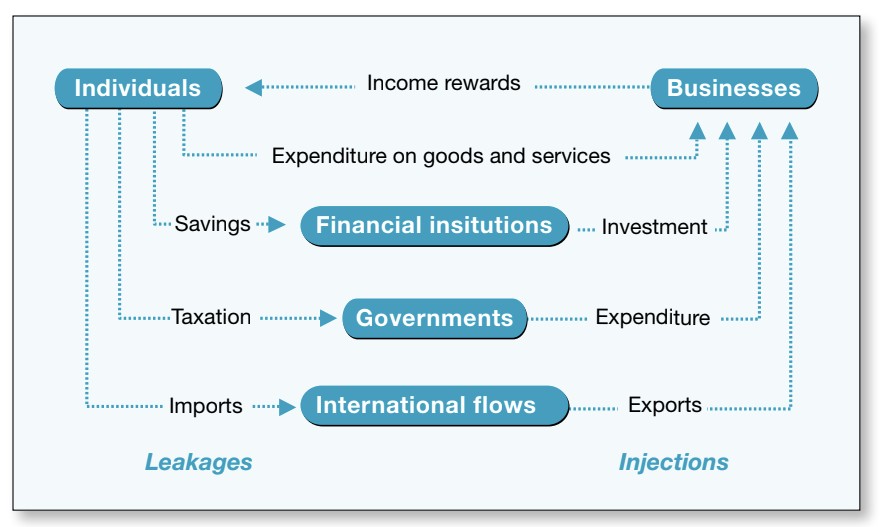
The five sectors of the economy
Individuals
The individuals sector includes all people in the economy. This sector focuses on two main activities: earning income and spending money on goods and services.
Individuals are important for two reasons. First, they own the factors of production - the resources needed to make goods and services. These factors include:
- Labour (work)
- Land
- Capital (equipment and buildings)
- Enterprise (business ideas and risk-taking)
Second, individuals are the consumers who buy the goods and services that businesses produce.
Here's how it works: individuals supply their resources to businesses. For example, people work for companies, or entrepreneurs start new ventures. In return for supplying these resources, individuals receive income in various forms:
- Wages for labour
- Rent for land
- Interest for capital
- Profit for enterprise
Once individuals earn income, they make decisions about what to do with it. Their income can be:
- Spent on locally produced goods and services (consumption)
- Saved in financial institutions
- Paid to the government as tax
- Spent on imported goods from other countries
Businesses
The businesses sector contains all firms that produce and sell goods and services. This includes everything from small shops to large manufacturers. Note that financial services are treated separately in the financial institutions sector.
Businesses perform several key functions:
- They buy factors of production from individuals
- They use these resources to produce goods and services
- They sell these goods and services to earn revenue
Important
An important concept here is interdependence - individuals and businesses depend on each other. Businesses need individuals to supply resources and to buy their products. Without individuals, businesses couldn't function. Similarly, individuals need businesses to produce the goods they want to consume and to provide them with income. Without businesses, individuals would struggle to meet their needs.
The circular flow diagram shows money flowing between these sectors, not the physical movement of goods or resources. When you see an arrow, it represents a payment or income flow.
Financial institutions
Financial institutions include banks, building societies, credit unions, finance companies, superannuation funds, and life insurance companies. These institutions play a crucial role as intermediaries - they connect people who want to save money with businesses that need to borrow money.
The financial sector performs an essential function by mobilizing savings. When individuals save money, they deposit it in financial institutions. These institutions then lend that money to businesses for investment purposes. Without this system, it would be difficult for businesses to obtain the funds they need to grow and expand.
Savings as a leakage
When individuals save money, this creates a leakage from the circular flow. A leakage occurs when money is withdrawn from the flow of income in the economy. This matters because leakages reduce the level of economic activity.
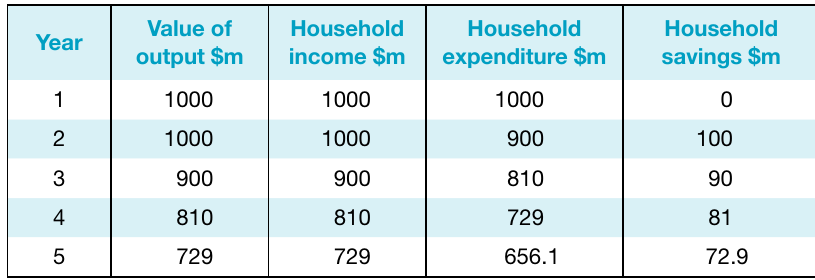
Let's examine why savings create problems if left unchecked. Consider the following scenario:
Example
Worked Example: The Effect of Savings on the Economy
-
Year 1: Businesses produce $1000 million of goods. This generates $1000 million in income for individuals, who spend all of it on consumer goods. Since nothing is saved, production next year remains at $1000 million.
-
Year 2: Production is still $1000 million, generating $1000 million in income. However, individuals now decide to save 10% of their income. Expenditure drops to $900 million, with $100 million going into savings.
-
Year 3: Because spending fell to $900 million, businesses cut production to $900 million. They need fewer resources, so they employ fewer workers. Income falls to $900 million. With 10% saved, spending drops to $810 million.
This pattern continues year after year.
The leakage of savings causes:
- Falling expenditure on goods and services
- Falling production
- Falling demand for resources
- Falling income
- Rising unemployment
Important
Left alone, this downward spiral would continue until the economy collapsed completely. Clearly, something must offset the leakage of savings.
Investment as an injection
Fortunately, savings enable investment, which provides an injection into the circular flow. An injection adds money to the flow, increasing economic activity.
Note
Investment is defined as any current expenditure that is made in order to obtain benefits in the future.
For example, when a business buys new machinery, this is investment. The company spends money now to increase future production and profits. Investment spending counteracts the leakage from savings.
Here's how investment creates a multiplier effect:
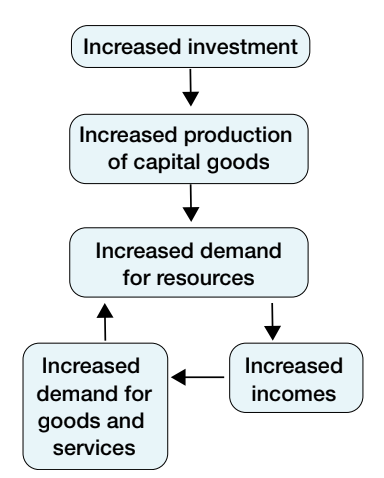
When businesses invest, they increase demand for capital goods (machinery, equipment, buildings). This stimulates production in the firms that make these capital goods. These firms then need more resources - they hire more workers and buy more materials. As employment rises, individuals earn more income. With higher incomes, they spend more on consumer goods and services. This increased consumption stimulates even more production, leading to more employment and higher incomes.
In other words, investment creates a positive cycle of:
- Rising expenditure
- Rising production
- Rising employment
- Rising incomes
Note
Importantly, savings make investment possible. By forgoing some current consumption, we can invest in capital goods that improve the economy's productive capacity. This increases our ability to produce goods and services in the future, leading to higher living standards. This is why saving and investing are essential for economic growth and prosperity.
The individuals, businesses, and financial institutions together form what we call the private sector of the economy.
Governments
In Australia, the government sector has three levels: Commonwealth (federal), state, and local. Governments provide collective goods and services that benefit the whole community, such as:
- Roads and railways
- Schools and universities
- Hospitals and health services
- Defence and police services
- Parks and public spaces
To pay for these services, governments collect taxes from individuals and businesses. The government plays two key roles in the circular flow:
Taxation as a leakage
Taxation represents a leakage from the circular flow. When individuals pay income tax, they have less money to spend on goods and services. Similarly, when businesses pay company tax, they have less money available to pay for resources or to distribute to owners.
The circular flow diagram shows taxation flowing mainly from individuals, even though governments tax businesses too. This is because the majority of tax revenue comes from individuals through income tax.
Like all leakages, taxation tends to reduce the level of economic activity by lowering income, output, and employment.
Government expenditure as an injection
Government expenditure is an injection that increases economic activity. The government injects money into the economy in two ways:
- Direct spending: When the government buys goods and services (like building roads or paying teachers), it provides income to government employees and to private businesses that supply goods and services.
- Transfer payments: The government also makes payments like pensions, unemployment benefits, and family allowances. These represent income to the people who receive them.
Government expenditure increases the level of economic activity, leading to rising income, output, and employment opportunities.
Note
The government sector is also called the public sector. Together with the private sector (individuals, businesses, and financial institutions), it makes up the domestic sector of the economy.
International trade and financial flows
This sector covers all transactions between Australia and other countries. It includes:
- Exports: Goods and services produced in Australia and sold overseas
- Imports: Goods and services produced overseas and sold in Australia
- International money flows: Financial transactions like borrowing, lending, and income payments between Australia and other countries
For simplicity, the circular flow model focuses on imports and exports. Other international money flows work similarly - money flowing into Australia acts like export receipts, while money flowing out acts like import payments.
Imports as a leakage
When Australians buy imports, money leaves the Australian economy and goes to overseas businesses. This makes imports a leakage from the circular flow. Any other outward money flow, such as lending money overseas or paying income to foreigners, also constitutes a leakage.
Like all leakages, imports reduce economic activity by decreasing income, output, and employment in Australia.
Exports as an injection
When overseas customers buy Australian exports, money flows into the Australian economy. This makes exports an injection into the circular flow. Similarly, money flowing in from overseas lending or income received from abroad represents an injection.
Like all injections, exports increase economic activity by raising income, output, and employment in Australia.
Understanding leakages and injections
Leakages
Important
Leakages are the items that remove money from the circular flow of income, decreasing aggregate income and the general level of economic activity.
The three leakages are:
- Savings: Money individuals set aside rather than spend
- Taxation: Money collected by the government
- iMports: Money paid to overseas producers
Remember the acronym STM to recall these leakages - think of it as "Stop The Money" (money stops flowing in the economy).
When leakages occur, less money circulates through the economy. This leads to:
- Lower consumer spending
- Reduced business production
- Fewer jobs and higher unemployment
- Lower incomes overall
Injections
Important
Injections into the circular flow model of income are those flows of money that increase aggregate income and the general level of economic activity.
The three injections are:
- Investment: Business spending on capital goods
- Government expenditure: Government spending and transfer payments
- eXports: Money received from overseas customers
Remember the acronym IGX to recall these injections - think of it as "Inject Growth, eXpand" (injecting money expands the economy).
When injections occur, more money circulates through the economy. This leads to:
- Higher consumer spending
- Increased business production
- More jobs and lower unemployment
- Higher incomes overall
Equilibrium in the circular flow
What is equilibrium?
Note
Equilibrium occurs in the circular flow of income when the sum of all the leakages is equal to the sum of all the injections in an economy.
At equilibrium, the circular flow maintains a steady size - neither expanding nor contracting.
The equilibrium condition can be expressed as:
Where:
- = Savings
- = Taxation
- = Imports
- = Investment
- = Government expenditure
- = Exports
When the economy is in equilibrium, economic activity remains stable. However, this doesn't mean the economy is static - it simply means the forces pulling money out (leakages) are balanced by forces putting money in (injections).
Disequilibrium and adjustment
Disequilibrium occurs when total leakages don't equal total injections. The economy naturally moves toward equilibrium, but as it adjusts, the level of income changes.
When leakages exceed injections (L > I)
If total leakages are greater than total injections, the economy experiences a downturn:
- Income levels fall
- Production decreases
- Unemployment rises
Note
As economic activity falls, leakages automatically decrease too. Why? Because people have less income to save, less income to be taxed, and less income to spend on imports. Eventually, leakages fall enough to equal injections, and equilibrium is restored - but at a lower level of economic activity.
When injections exceed leakages (I > L)
If total injections are greater than total leakages, the economy experiences an upturn:
- Income levels rise
- Production increases
- Employment grows
Note
As economic activity increases, leakages automatically increase too. Why? Because people have more income to save, more income to be taxed, and more income to spend on imports. Eventually, leakages rise enough to equal injections, and equilibrium is restored - but at a higher level of economic activity.
Government influence on the circular flow
The government has significant power to influence the circular flow because it controls both taxation (a leakage) and government expenditure (an injection). By adjusting these variables, the government can:
Stimulate the economy by:
- Reducing taxes (decreasing leakages)
- Increasing government spending (increasing injections)
- This makes injections greater than leakages, expanding economic activity
Dampen the economy by:
- Increasing taxes (increasing leakages)
- Reducing government spending (decreasing injections)
- This makes leakages greater than injections, contracting economic activity
Important
Through these tools, the government can offset undesirable economic outcomes. For example, if savings are too high and investment too low, the government might cut taxes and increase spending to keep the economy in balance. Or if imports are too high and exports too low, the government might take action to maintain equilibrium without causing a recession.
Remember!
Summary
Key points to remember:
- The circular flow model divides the economy into five sectors: individuals, businesses, financial institutions, governments, and international trade
- The model shows how money flows between these sectors in the economy
- Leakages (STM: Savings, Taxation, iMports) withdraw money from the circular flow and reduce economic activity
- Injections (IGX: Investment, Government spending, eXports) add money to the circular flow and increase economic activity
- Equilibrium occurs when total leakages equal total injections:
- When leakages exceed injections, the economy contracts until equilibrium is restored at a lower income level
- When injections exceed leakages, the economy expands until equilibrium is restored at a higher income level
- The government can influence economic activity by adjusting taxation and government expenditure
Key terms to know:
Circular flow of income, sector, factors of production, interdependence, leakages, injections, investment, equilibrium, disequilibrium, private sector, public sector, domestic sector, transfer payments, productive capacity