The Supply of Labour (HSC SSCE Economics): Revision Notes
📚Revision Notes
The Supply of Labour
Introduction
Labour supply represents individuals who are ready and willing to work in the labour market. Understanding labour supply is crucial because, while we often focus on labour demand, demographic changes (ageing populations and lower birth rates) mean industrialised nations may face skilled labour shortages in coming decades.
Note
The labour supply curve slopes upward: as wages rise, more individuals are willing to sacrifice leisure time and enter the workforce. Unlike product markets where firms supply goods and consumers demand them, the labour market reverses this relationship—individuals supply labour whilst firms demand it.
Factors affecting the supply of labour
Pay levels
Wages and salaries represent the price paid for labour and serve as a critical determinant of labour supply. When firms offer higher wages, more people become willing to trade their leisure time for work.
Beyond basic wages, remuneration packages often include non-wage incentives such as:
- Company vehicles
- Additional superannuation contributions
- Performance bonuses
- Share options
Note
These additional benefits can be just as influential as base salary in attracting workers. The total remuneration package—not just wages alone—determines how attractive a position is to potential employees.
Working conditions
The quality of working conditions directly impacts how many people choose to work for particular employers. Attractive conditions increase labour supply, whilst poor conditions reduce it.
Factors that attract workers include:
- Flexible working hours
- Work-from-home opportunities
- Generous holiday leave entitlements
- Pleasant working environments
- International travel opportunities
- Quality training and career development
- Meaningful work that provides job satisfaction
Note
The Trade-off Between Monetary and Non-Monetary Benefits
Some workers prioritise non-monetary benefits over high salaries. For instance, younger employees might value excellent training opportunities, whilst others might seek roles offering cultural experiences through travel, even if salaries are lower. This demonstrates that labour supply decisions are influenced by factors beyond simple wage levels.
Education, skills and experience requirements
Jobs requiring higher levels of education, skills and experience face more limited labour supply. These elements constitute human capital—the total sum of knowledge, skills, training and experience that workers bring to production. Human capital reflects workforce quality and drives productivity growth.
Important
The Importance of Human Capital
Acquiring education and skills requires substantial time, sacrifice and effort, which restricts the number of people able to enter highly skilled occupations. This is why professions like medicine, engineering, and law face constrained labour supply—the barriers to entry are significant.
Additionally, changes in education access (such as government scholarships or course fee subsidies) influence workforce skill levels and therefore labour supply.
Countries with higher human capital levels typically achieve lower unemployment rates because workers can more easily adapt to changing labour market demands.
The mobility of labour
Labour mobility measures how responsive workers are to changes in labour demand across different areas and industries. Two types exist: occupational mobility and geographical mobility.
Occupational mobility
Occupational mobility refers to workers' ability to move between different jobs in response to wage differences and employment opportunities. This mobility depends primarily on:
- Education requirements for target occupations
- Skills needed
- Time required to gain necessary credentials
Important
As skill requirements increase, occupational mobility decreases because workers need more time and effort to acquire new qualifications.
Example
Example: Comparing Occupational Mobility
A motor mechanic would find it difficult to become a veterinary surgeon due to extensive retraining requirements (requiring years of university study in veterinary science). However, the same mechanic could relatively easily become a bar attendant because the skill requirements are lower and less specialised.
Geographical mobility
Geographical mobility describes workers' ability to relocate between different locations for improved wages or job opportunities. Several factors limit geographical mobility:
- Relocation costs: Travel expenses, transportation of belongings, and real estate costs (both selling existing property and purchasing in new locations)
- Personal disruption: Breaking ties with family and friends, children changing schools, leaving established social networks
Note
Jobs requiring relocation to remote locations (such as solar power plants in western New South Wales) typically receive lower labour supply. Consequently, employers in isolated areas must offer higher wages to attract workers—demonstrating the relationship between geographical mobility constraints and wage levels.
The labour force participation rate
The labour force participation rate measures the proportion of the population actively supplying labour. In Australia, anyone aged 15 or over can participate in the workforce (though the working-age population officially spans ages 15–64).
People may choose not to participate because they:
- Want to pursue further education
- Need to care for family members
- Prefer leisure activities
- Believe they're unlikely to find work
- Rely on alternative income sources
Important
Definition: Labour Force Participation Rate
The labour force participation rate represents the percentage of the civilian population aged 15 years and over who are in the workforce (either working or actively seeking work).
Example
Calculating the Labour Force Participation Rate
The formula is:
For instance, if a country has a labour force of 13 million people and a population aged 15 or over of 20 million people:
This means that 65% of the eligible population is either working or actively seeking work.
Key terms
Working-age population: The number of people in an economy who are at least age 15.
Labour force (or workforce): All employed and unemployed persons in the country at any given time.
Australian participation rate trends
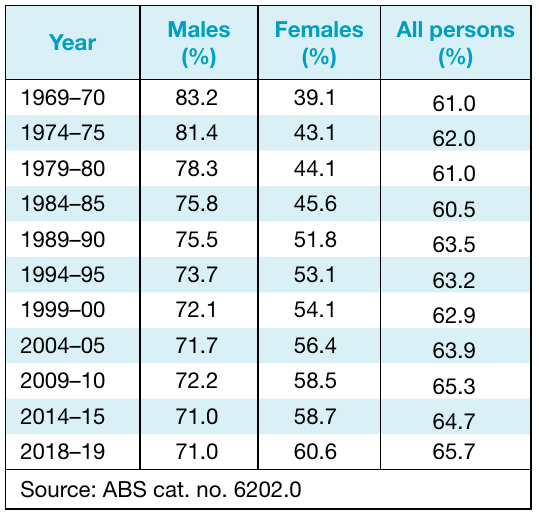
The table reveals several important trends:
- Overall increase: The total participation rate rose gradually from 61% in 1969–70 to 65.7% in 2018–19, reaching a record high of 66% in 2019.
- Male participation decline: Male participation dropped significantly from 83.2% in 1969–70 to 71.0% by 2018–19—a decrease of over 12 percentage points.
- Female participation growth: Female participation increased substantially from 39.1% in 1969–70 to 60.6% in 2018–19, driven particularly by increased participation of married women.
- Converging rates: The gap between male and female participation rates has narrowed considerably, from 44.1 percentage points in 1969–70 to just 10.4 percentage points in 2018–19.
- Stabilisation: Both male and female rates changed dramatically during the 1970s and 1980s but have plateaued over the past decade.
Factors influencing participation rates
Short-term factors
Economic conditions represent the most important short-term influence. The participation rate is pro-cyclical, meaning it moves with the economic cycle:
- During prosperity and economic growth, better job prospects encourage more people to actively seek work
- During recessions, pessimism about employment opportunities discourages job-seeking
Important
Understanding Pro-Cyclical Behaviour
The pro-cyclical nature of labour force participation means that participation rates can amplify economic cycles. During booms, rising participation increases labour supply, while during recessions, falling participation can hide the true extent of unemployment as discouraged workers stop actively seeking jobs.
Long-term factors
- Population ageing and retirement age: The 2015 Intergenerational Report projected the participation rate would decline from around 65% to 62% by 2054–55 due to population ageing. Although participation among those aged 15–64 is expected to rise from 76.2% (2015) to 79.3% (2055) as people delay retirement, the growing proportion of people aged 65+ will reduce overall participation.
Note
However, the shift towards less labour-intensive, services-based industries might enable older Australians to work longer. Office-based and service roles are generally less physically demanding than traditional manufacturing or agricultural work, potentially supporting higher participation rates among older workers.
- Changing social attitudes towards women in work: Evolving attitudes about women's roles, improved childcare provision, and declining birth rates have encouraged married women to participate in the workforce for longer periods. This explains most of the increased female participation rate and was the primary cause of the 2019 participation rate increase.
- Increased school retention rates: Young people now tend to remain in school longer and pursue tertiary education, joining the workforce later. The proportion of Australians with university degrees rose from 23% (for those now aged 55–64) to 39% (for those now aged 25–34). Overall, 46% of Australians aged 25–64 have obtained post-secondary qualifications, significantly above the OECD average of 37%.
Other factors affecting labour supply
Immigration
Australia has historically filled labour market gaps through immigration. Immigration policies heavily favour skilled migrants—in 2016–17, more than two-thirds of newcomers (123,567 out of 183,608) entered based on their skills.
Key features of skilled migration:
- Most skilled migrants are professionals (64% of intake)
- Around 39% are individually sponsored by employers (48,250 in 2016–17)
- They possess skills in short supply within Australia
Note
Skilled migration allows Australia to quickly address labour shortages in specific occupations without waiting for domestic training programs to produce qualified workers. This is particularly important in rapidly evolving industries where skill needs change quickly.
Professional associations
Professional bodies such as the Law Society, Australian Medical Association, and Engineers Australia impose standards for:
- Education requirements
- Continuing professional development
- Professional conduct
These standards restrict labour supply to these occupations. Historically, some unions pressured employers to hire only union members, though this practice has been prohibited for many years.
Government regulation
Government can limit labour supply to specific occupations through qualification and licensing requirements. For example, builders must meet competency standards to obtain builder's licences. These regulations ensure quality and safety but reduce the number of people who can enter these occupations.
Summary
Key Points to Remember:
Core Concepts:
- The labour supply curve slopes upward—higher wages attract more workers
- Main supply factors include pay levels, working conditions, education requirements, and labour mobility
- Occupational mobility depends on skills required; geographical mobility is limited by relocation costs and personal disruption
Labour Force Participation Rate:
- Formula: (Labour force ÷ Population aged 15+) × 100
- Australian participation has risen from 61% to 66% over 50 years
- Driven by increased female participation (39% to 61%) despite declining male participation (83% to 71%)
- The gap between male and female rates has narrowed from 44.1 to 10.4 percentage points
Factors Affecting Participation:
- Participation is pro-cyclical: it rises during economic growth and falls during recessions
- Long-term factors include population ageing, changing attitudes to women's work, and higher education participation
- Immigration, professional associations, and government regulation also affect labour supply
Essential Definitions:
- Human capital: Knowledge, skills, training and experience that contribute to production and productivity growth
- Occupational mobility: Ability to move between different jobs
- Geographical mobility: Ability to relocate for work
- Pro-cyclical: Moving in the same direction as the economic cycle