Income Trends and Non-Wage Outcomes (HSC SSCE Economics): Revision Notes
📚Revision Notes
Income Trends and Non-Wage Outcomes
Understanding income distribution in Australia
Over the last thirty years, Australia's labour market has experienced significant transformation. These changes have fundamentally altered how workers receive wage increases and affected the overall distribution of income across society.
The shift from centralised wage setting to enterprise bargaining
During the 1980s, most Australian workers received wage increases through a centralised system. The Australian Industrial Relations Commission (now called the Fair Work Commission) determined wage levels through the award wages system. This approach meant that wage differences between workers and across different jobs remained relatively small and consistent.
Enterprise bargaining occurs when employers and employees negotiate pay and working conditions directly at the workplace level, rather than through a centralised system. Since the early 1990s, this approach has become increasingly common in Australia.
Important
This shift towards enterprise bargaining has created much larger variations in what workers earn. These differences now exist both between different industries and between individual workers doing similar work. At the national level, this has led to growing gaps in how income is distributed across different groups in society.
Recent trends in income distribution
Income distribution refers to how an economy's total income is spread among different social and socioeconomic groups. Despite these structural changes to the labour market, the overall distribution of household income has remained relatively stable since the mid-1990s. This stability exists because increased government benefits for lower-income families have partly offset the growing wage differences created by enterprise bargaining.
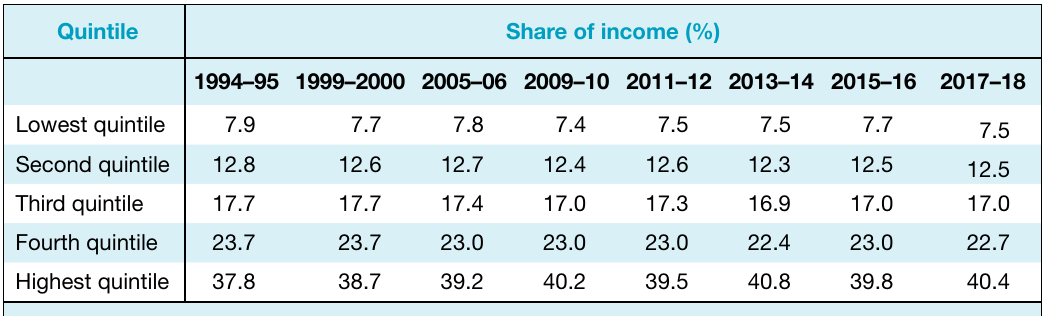
The data in Figure 10.7 divides all Australian income earners into five equal groups (quintiles), ranked from lowest to highest income. Each quintile represents 20% of the population. The table reveals several important patterns:
Key findings on income inequality:
- Significant inequality persists in Australia's income distribution, and this has increased slightly over the past decade
- The highest-earning 20% of Australians received 40.4% of all income in 2017-18
- High-income earners had average weekly incomes more than five times greater than those in the lowest quintile
- The bottom 40% of income earners (lowest two quintiles combined) have maintained a fairly constant share of total income in recent years
- Over two decades, the highest income earners have captured a larger proportion of total income, while all other groups have seen their shares decline
- The middle-income groups have experienced the largest relative losses, as the top earners have gained income share primarily at their expense
Note
The stability in overall income distribution masks important underlying changes. While government transfers have prevented the income gap from widening dramatically, the fundamental shift toward enterprise bargaining has created greater wage inequality in the labour market itself.
How industry structure affects wage outcomes
Changes in Australia's economic structure also contribute to different wage outcomes across industries. Emerging industries that require skilled workers often face labour shortages. When skilled labour is scarce, these industries typically offer higher wages to attract workers. In contrast, declining industries experiencing reduced demand for their products and services generally cannot afford to pay wages as high as growing sectors.
Income distribution within occupations
Beyond the widening gaps between different occupations and social groups, recent years have seen increased variation in earnings even among workers in the same occupation or with similar qualifications. The move away from centralised wage determination since the 1990s has contributed to this trend, though it began emerging in the 1980s.
Another important factor is declining union membership across Australia. When union membership rates are higher, workers doing similar jobs in different firms and industries tend to receive more similar wages. As unions have played a smaller role in wage negotiations, greater variation in pay has emerged within industries and occupations.
Important
This means two workers with identical qualifications doing the same job may now earn quite different amounts depending on where they work.
Non-wage outcomes
Workers receive many valuable benefits beyond their regular wages and overtime pay. These additional benefits are called non-wage outcomes. Examples include sick leave, holiday leave, superannuation contributions, company cars, gym memberships, and flexible working arrangements.
Non-wage outcomes represent significant value to employees and substantial costs to employers, yet they do not appear in standard wage statistics. This means official average weekly earnings data does not capture the full value of what workers receive from their employment.
Superannuation is a compulsory form of retirement saving in Australia. Employers must contribute a percentage of each employee's wages into a superannuation fund. Workers cannot access these savings until they reach retirement age.
Variation in non-wage benefits
There is no single comprehensive measure of non-wage outcomes because many benefits cannot be easily quantified in monetary terms. These benefits vary considerably between different workplaces and industries. In some sectors, workers effectively earn far more than their stated wage when non-wage allowances are included.
Types of non-wage outcomes
Salary packaging has become a popular way to supplement wages. Under these arrangements, employees receive benefits such as:
- Company vehicles for personal use
- Laptop computers or other technology
- Subsidised childcare services
- Gym or health club memberships
- Other forms of employer assistance
Performance-based bonuses represent another significant type of non-wage outcome. Employers provide these cash payments on top of regular wages. Bonus structures typically link to either:
- The company's overall profit performance
- Individual employee work performance and achievements
Workplace flexibility arrangements have become increasingly valued by employees. These non-wage outcomes include:
- Study leave provisions
- Extended parental leave beyond minimum requirements
- Leave to care for sick family members
- Extended unpaid leave options
- Working from home arrangements for part of the week
- Job-sharing arrangements between employees
Work and quality of life
Employment provides more than just income. Work significantly influences individual quality of life by creating a sense of productivity and social value. It makes people feel needed by society and provides crucial social connections.
The social dimension of work
The workplace offers important opportunities for social interaction. Colleagues often become more than just work associates—they may become friends, sports teammates, or even life partners. Research consistently demonstrates a strong relationship between secure employment and personal happiness or wellbeing, both in Australia and internationally.
Evidence from wellbeing research
The Australian Unity Wellbeing Index, published regularly since 2002, provides ongoing data about how work affects personal satisfaction. Key findings include:
- People in full-time employment have significantly higher wellbeing scores (76) compared to unemployed individuals (68)
- However, wellbeing declines when work hours become excessively long
- Full-time students report similar wellbeing levels to full-time workers
- Retired people generally report even higher wellbeing (78) than those currently working (74)
- Part-time unpaid volunteers (such as charity workers) record the highest work-related satisfaction levels
- Even full-time volunteers report greater wellbeing than full-time paid workers
Note
The wellbeing data reveals an interesting paradox: while employment is strongly associated with higher wellbeing than unemployment, paid work is not the highest source of work-related satisfaction. Voluntary work and retirement both correlate with higher wellbeing scores than full-time paid employment.
What drives job satisfaction in Australia
The 2014 Australian Workplace Relations Study asked workers to rate their job satisfaction on a scale from 1 (low) to 7 (high). The average score was 5.42, indicating most Australians feel relatively satisfied with their jobs.
The research identified several patterns:
- Women report higher job satisfaction than men overall
- Part-time workers are more satisfied than full-time workers
- Employees in small organisations report greater satisfaction than those in large organisations
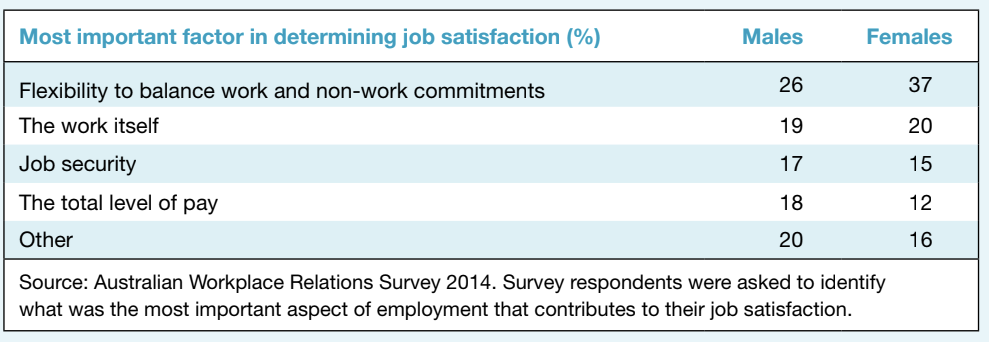
The most striking finding concerns what contributes most to job satisfaction. While the nature of the work itself matters, both men and women identified flexibility to balance work and non-work commitments as the most important factor. This was particularly pronounced for women, with 37% identifying flexibility as most important, compared to 26% of men.
The data reveals interesting gender differences in workplace priorities:
- Women place greater value on work-life flexibility (37% vs 26% for men)
- The work itself ranks second in importance for both genders (approximately 20%)
- Men prioritise pay levels more highly (18% vs 12% for women)
- Men also place slightly more emphasis on job security (17% vs 15% for women)
These findings highlight that job satisfaction depends on multiple factors beyond wages. Workplace flexibility, job security, and the nature of the work all contribute significantly to how satisfied people feel with their employment.
Summary
Key Points to Remember:
- Income inequality has grown slightly over the past two decades, with the highest 20% of earners now receiving over 40% of all income while earning more than five times the average of the lowest quintile
- Enterprise bargaining has increased wage variation both between industries and within occupations, as workplace-level negotiations replaced centralised wage setting
- Declining union membership has contributed to greater wage dispersion within industries, as workers in similar roles now receive more varied pay depending on their specific employer
- Non-wage outcomes add significant value beyond stated wages, including superannuation, salary packaging, bonuses, and flexibility arrangements that do not appear in standard wage statistics
- Work-life flexibility is the top priority for job satisfaction among Australian workers, ranked more important than pay levels, job security, or the nature of the work itself