Unemployment and the Movement Away From Full-Time Work (HSC SSCE Economics): Revision Notes
📚Revision Notes
Unemployment and the Movement Away From Full-Time Work
What is unemployment?
Unemployment occurs when people want to work but cannot find a job. This means that labour resources in the economy are not being used effectively. The concept of unemployment is central to understanding labour market performance.
To be officially classified as unemployed in Australia, a person must meet specific criteria:
- Be over the age of 15
- Be without a job or have been let go without pay
- Be actively seeking full-time or part-time work
Note
What does "active job seeking" really mean?
Active job seeking means more than just browsing job advertisements. It requires:
- Regularly checking job advertisements from multiple sources
- Being willing to apply for jobs and attend interviews
- Being registered with employment placement providers (such as Job Services Australia members)
- Being able to start work if offered a position
Calculating the unemployment rate
The Australian Bureau of Statistics (ABS) defines the unemployment rate as the number of unemployed persons expressed as a percentage of the total labour force.
The formula is:
Example
Worked Example: Calculating the Unemployment Rate
If the labour force comprises 10 million people and 1 million are unemployed, the unemployment rate would be:
Types of unemployment
Different types of unemployment exist in the economy, each with distinct causes. Some are related to the business cycle, others result from structural changes in the economy, and some have separate causes altogether.
Cyclical unemployment
Cyclical unemployment occurs during economic downturns. It arises because the demand for labour is a derived demand - businesses need workers to produce goods and services.
When the business cycle enters a downturn:
- Demand for goods and services falls
- Firms reduce production levels
- Workers are laid off to maintain profit levels
- Unemployment increases
Note
The reverse happens during economic upturns. As aggregate demand rises, firms increase production and hire more workers, reducing unemployment.
Structural unemployment
Structural unemployment results from a mismatch between the skills workers possess and the skills employers need. This type of unemployment often increases when:
- The economy restructures from old industries to emerging ones
- New technology is introduced
- Traditional industries decline
Workers laid off from declining industries may find their skills are not suitable for new industries. Even when jobs are available and workers want to work, the skills mismatch prevents employment.
Long-term unemployment
Long-term unemployment applies to individuals who have been without work for 12 months or more. This type of unemployment is particularly problematic because:
- Workers lose job-related skills over extended periods
- Employers become reluctant to hire people with long gaps in employment
- Initial cyclical unemployment can become long-term if economic recovery is slow
Important
After prolonged unemployment, re-entering the workforce becomes increasingly difficult, creating a negative cycle that can trap workers in unemployment.
Seasonal unemployment
Seasonal unemployment occurs due to regular yearly patterns in certain industries, independent of the business cycle. Examples include:
- Tourist-related employment
- Holiday season jobs (such as Christmas retail positions)
- The December-March period when school leavers enter the labour force
This type of unemployment is predictable and typically temporary.
Frictional unemployment
Frictional unemployment occurs naturally as people move between jobs. It takes time to:
- Search for new employment opportunities
- Attend job interviews
- Complete administrative requirements
Note
A small level of frictional unemployment always exists in healthy labour markets. Improving job placement services can reduce this type of unemployment.
Hard-core unemployment
Hard-core unemployment refers to individuals who face personal barriers to employment, such as:
- Mental illness
- Physical disabilities
- Drug addiction
These individuals may be considered unsuitable for work due to these personal circumstances.
Hidden unemployment
Hidden unemployment includes individuals not counted in official unemployment statistics because they have:
- Stopped actively seeking work after becoming discouraged
- Returned to education or training
This type of unemployment typically rises during prolonged economic downturns. When job prospects are poor, some people become discouraged and stop looking for work. Because they are no longer actively seeking employment, they are not officially unemployed.
Important
Hidden unemployment is reflected in a falling labour force participation rate rather than in rising unemployment figures. This means the true extent of unemployment may be underestimated during economic downturns.
Underemployment
Underemployment describes workers with part-time or casual jobs who want to work more hours per week. While technically employed, these workers represent underutilised labour resources.
Key features of underemployment:
- Workers are willing and able to work additional hours
- Labour market conditions prevent them from obtaining more work
- Estimates have risen significantly in recent decades
- Linked to the growth of part-time and casual employment
Underemployment is discussed further in the section on movement away from full-time work.
Recent unemployment trends in Australia
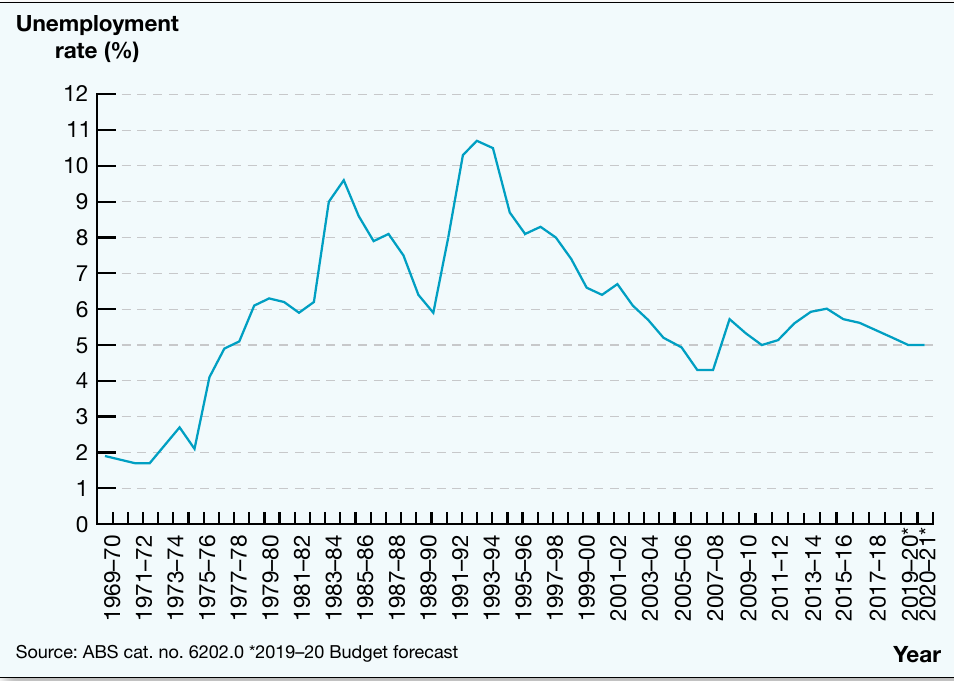
Unemployment has been a major economic policy challenge in Australia for four decades.
Historical patterns:
1960s-1970s: Australia experienced very low unemployment rates in the 1960s and early 1970s.
1980s-1990s: An upward trend emerged between the 1970s and 1990s. Unemployment averaged 8.6% in the 1990s, peaking at 10.7% in 1992-93 - the highest level since the Great Depression.
Note
Understanding recessions
A recession is a period of decreasing economic activity, defined as two consecutive quarters of negative economic growth. This recession affected both Australia and the global economy, causing:
- Falling aggregate demand
- Production cutbacks
- Business closures
- Widespread job losses
Structural factors also contributed to high unemployment in the early 1990s:
- Microeconomic reform changed business structures
- New technologies altered production techniques
- Workers from declining industries lacked skills for emerging industries
1993-2008: A gradual downward trend saw unemployment fall to 4% by 2008 - the lowest level since 1974.
2008-2009: The global financial crisis triggered a worldwide recession. However, Australia's unemployment increase was much milder than in most advanced economies, rising by almost 2% before quickly recovering.
2010-present: Unemployment has remained mostly between 5% and 6%. Australia's rate has been around the OECD average (5.3% in 2019) but above rates in:
- United States (3.6%)
- United Kingdom (3.8%)
- New Zealand (3.9%)
Note
Recent observations: During 2018-2019, economists noted surprising labour market strength despite economic slowing, with continuing jobs growth, rising participation rates, and low unemployment. Similar patterns in other economies suggest broader factors may be at play.
Future outlook: Budget forecasts predict unemployment will remain around 5% in 2019-20 and 2020-21.
Unemployment and geography
Labour market conditions vary significantly across Australia's regions. Understanding these variations helps policymakers identify structural adjustments in the economy.
State and territory variations:
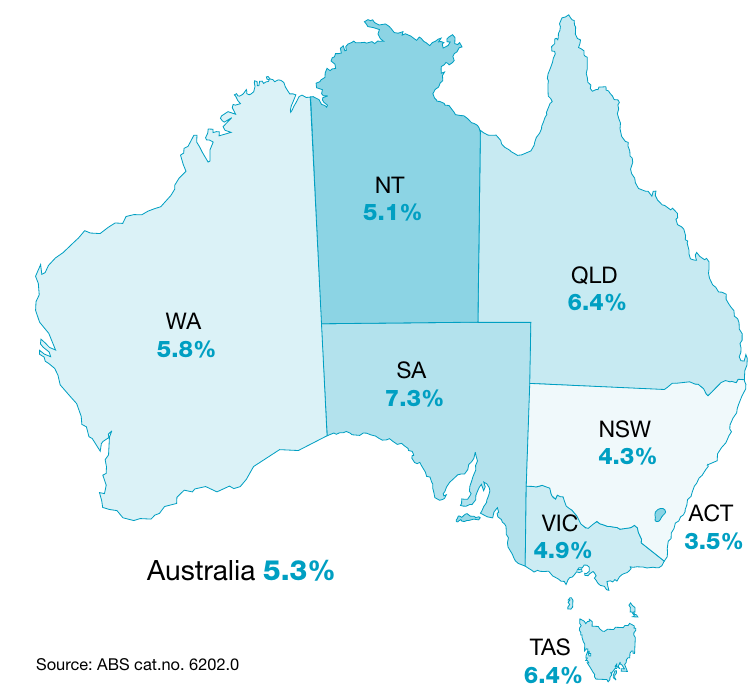
States experiencing high economic growth (such as NSW with significant infrastructure investment) record lower unemployment than the national average. States with slower growth (such as South Australia affected by manufacturing job losses) have higher unemployment rates.
Note
August 2019 unemployment rates:
- Australian Capital Territory: 3.5% (lowest)
- New South Wales: 4.3%
- Victoria: 4.9%
- Northern Territory: 5.1%
- Western Australia: 5.8%
- Queensland: 6.4%
- Tasmania: 6.4%
- South Australia: 7.3% (highest)
- National average: 5.3%
Regional differences within states:
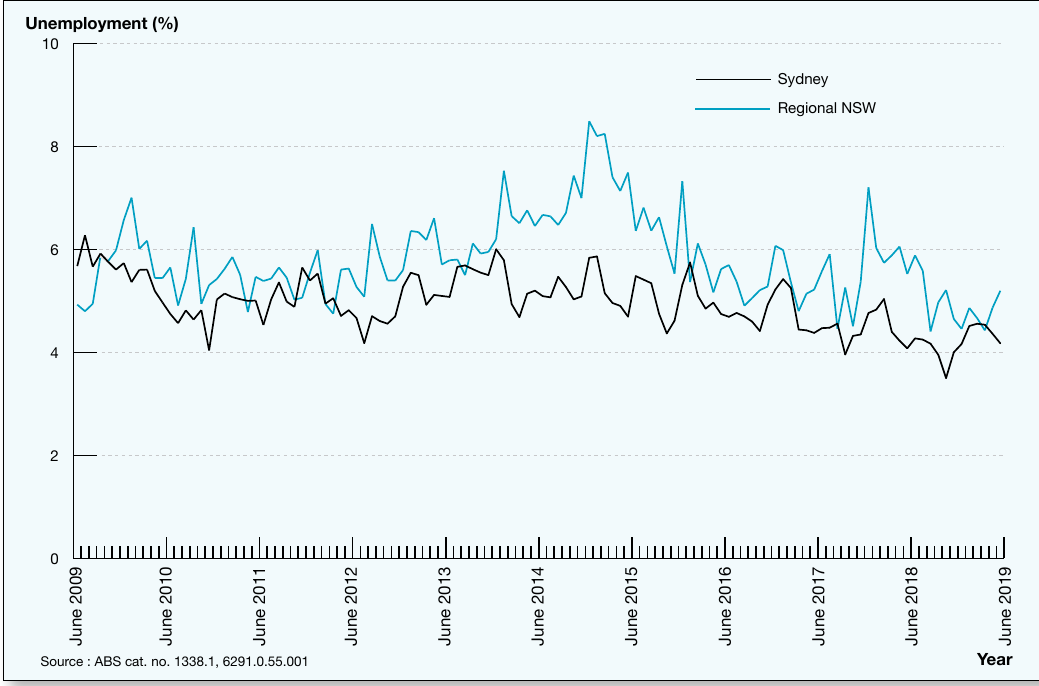
Regional areas typically experience higher unemployment than metropolitan areas.
Example
New South Wales regional variations (2018-19):
- Sydney: 4.2% unemployment
- Rest of NSW: 4.9% average unemployment
- Sutherland region (Sydney): around 2%
- Many regional areas: above 6% (including Parramatta in Sydney and Coffs Harbour region)
These geographic patterns reflect:
- Different industry structures across regions
- Varying levels of economic activity
- Access to education and training
- Infrastructure differences
The movement away from full-time work
The Australian labour market has undergone substantial change in recent decades. The most significant trend is the shift away from full-time work toward more flexible arrangements.
This shift includes:
- Part-time employment
- Casual jobs
- Outsourcing
- Individual contracts
- Sub-contracting
Part-time employment
Definitions:
Part-time employed: Workers regularly working less than 35 hours per week (ABS definition).
Casual employment: Workers with occasional working hours that do not follow any set pattern. Casual employees are the most insecure because they lack certainty about future work.
Important
Australia's international position:
Australia has the third-highest rate of part-time employment in the industrialised world at 25.7%, compared to an OECD average of 16.5%.
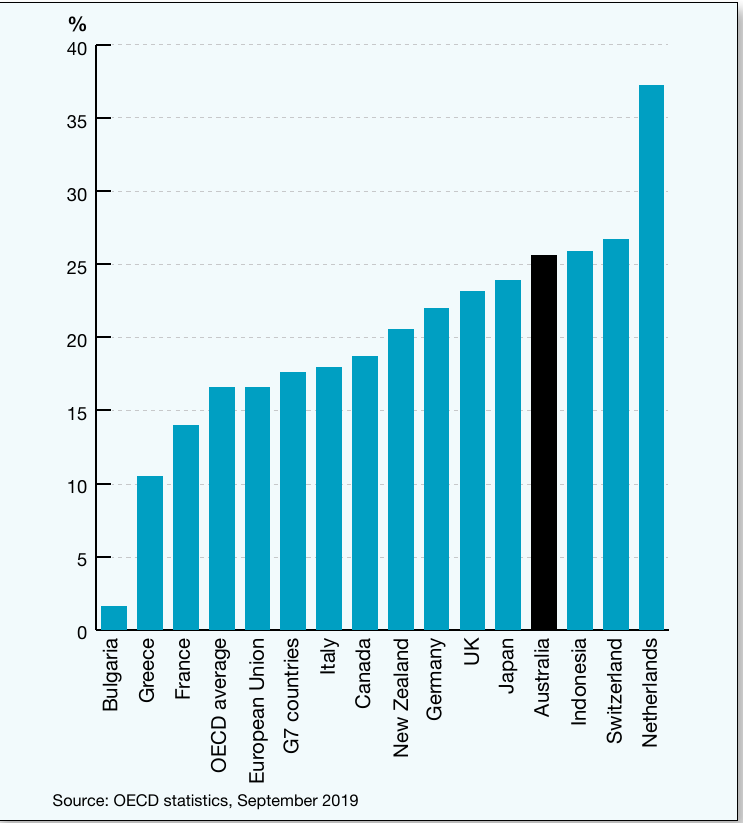
Recent trends:
The proportion of part-time workers has grown dramatically over recent decades. Australia has also experienced a large increase in casual employment - a trend known as the casualisation of work (the growth of casual employment and relative decline of full-time permanent jobs as a proportion of the total workforce).
Reasons for the shift:
Employee preferences:
- Some workers prefer part-time work to balance family commitments
- Women are more likely to work part-time (46% of employed women versus 19% of employed men)
- This partly reflects that women often carry greater child-raising responsibilities
- Technology (particularly information and communications) enables flexible work arrangements, including working from home
Employer preferences:
- Greater staffing flexibility - can increase hours during busy periods without overtime costs
- Avoid costs of hiring additional full-time staff
- May reduce obligations to workers, including:
- Holiday leave entitlements
- Long service leave
- Sick pay entitlements
- Redundancy pay
Important
However, not all part-time or casual work reflects employee choice. For many workers, these arrangements are employer-driven rather than voluntary.
Changing employment structures
Beyond part-time work, there has been a shift toward contractors, outsourcing, and sub-contracting arrangements. These changes aim to give businesses greater flexibility to adjust staffing levels as conditions change.
Contractors:
Contractors are paid to provide specific services rather than being employed directly. Key features:
- Governed by commercial law rather than employment law
- Theoretically have greater control over how they provide services
- Common in industries like trucking, where drivers own their trucks and are paid per kilometre or assignment
Outsourcing (sub-contracting or contracting out):
Outsourcing occurs when organisations pay other businesses to perform functions not considered core to their operations.
Example
Outsourcing in practice:
Governments now outsource most information technology operations, including:
- Data processing for social security claims
- Medical claims processing
- Taxation return processing
Advantages of outsourcing:
- Allows organisations to focus on areas of specialisation
- Specialised companies perform other functions more efficiently
Disadvantages:
- Creates shorter-term employment arrangements
- Workers employed by different organisations than those receiving services
- Workers typically on short-term contracts
Implications for employers and employees:
These changing structures allow firms to have staff benefits without traditional employment obligations:
- No requirement to pay award wages
- No workers' compensation
- No superannuation contributions
- No long-service leave
- No redundancy entitlements
Note
Flexibility benefits some employees but can result in:
- Less job security
- Lower incomes for "permanent casuals"
Employer downsides:
- Loss of staff loyalty (workers feel no security)
- Higher staff turnover rates
- Less experienced workforce
- Potentially lower skill levels
- Not always cheaper (contractors often charge higher hourly rates to cover costs firms no longer pay directly)
Advantages and disadvantages of casualisation
Advantages:
- For employers: Flexibility to adjust staff levels as business demands change
- For employers: May avoid non-wage costs (penalty rates, redundancy entitlements)
- For employees: Flexibility to manage family or other commitments
Disadvantages:
- Less job security for workers
- Difficult for employees to plan financially, obtain home loans without secure income
- Reduced staff loyalty
- Less development of workforce skills
Summary
Key Points to Remember:
-
Unemployment occurs when people want to work but cannot find jobs. The unemployment rate equals unemployed persons divided by the total labour force, expressed as a percentage.
-
Seven types of unemployment exist: cyclical (business cycle related), structural (skills mismatch), long-term (12+ months), seasonal (regular yearly patterns), frictional (job transitions), hard-core (personal barriers), and hidden (discouraged workers not counted in official statistics).
-
Australia's unemployment peaked at 10.7% in 1992-93 but has remained around 5-6% since 2010. Geographic variations exist, with regional areas typically experiencing higher unemployment than cities.
-
Part-time and casual work has grown significantly. Australia has the third-highest part-time employment rate in the OECD (25.7%). This reflects both employee preferences and employer strategies for flexibility.
-
Casualisation provides flexibility but reduces job security. Changing employment structures (contractors, outsourcing) allow firms to adjust staffing easily but can decrease workforce loyalty and skill development.