The Role of Trade Unions and Employer Associations (HSC SSCE Economics): Revision Notes
📚Revision Notes
The Role of Trade Unions and Employer Associations
Introduction to the industrial relations system
The industrial relations system (also called workplace relations system) consists of the laws, institutions and processes that manage the relationship between employers and employees in the labour market. This system exists because employers and employees have conflicting interests regarding wages: employees want higher wages to maximise their income, while employers want lower wages to minimise production costs.
Australia has developed a unique industrial relations system over the past century, shaped by egalitarian values that aim to ensure fair outcomes for all workers. Historically, this system relied heavily on special tribunals to make decisions about wages and resolve disputes. In recent decades, there has been a shift towards direct negotiation between employers and employees.
Note
The labour market is not perfectly competitive due to four key institutional forces that affect market operations to improve labour market outcomes, such as guaranteeing minimum wage levels:
- Trade unions - Worker organisations that negotiate collectively
- Employer associations - Business groups that represent employer interests
- Industrial tribunals - Special courts that resolve workplace disputes
- Government regulations - Laws that set minimum standards and conditions
Trade unions: definition and purpose
A trade union is an organisation formed by workers to improve their wages and working conditions. The primary function of unions is negotiating wage increases on behalf of their members. Beyond wages, unions also represent employees on issues such as:
- Workplace training and development
- Health and safety standards
- Organisational restructuring
- Work-life balance policies
Types of trade unions
Unions can be classified into four main categories based on their membership structure:
Occupational unions (craft unions): These represent workers with specific skills or qualifications, regardless of where they work. Examples include the Electrical Trades Union and the Australian Medical Association.
Industry-based unions: These cover all workers within a particular industry, regardless of their specific role. Examples include the Australian Meat Industry Employees Union and the Finance Sector Union.
Enterprise-based unions: These represent workers from a single company only. This type is rare in Australia, although some past policies attempted to encourage their formation.
General unions: These cover workers with diverse skills across multiple industries. Examples include the Australian Workers' Union and the Construction, Forestry, Mining and Energy Union.
The Australian Council of Trade Unions (ACTU)
Most unions are affiliated with the ACTU, established in 1927 as the national voice of the trade union movement. The ACTU's main roles include:
- Coordinating union activities nationwide, including wage claims and industrial action
- Conducting research and campaigns on workplace issues
- Providing input to government policy development
- Representing the collective interests of Australian workers
The decline in union membership
Important
Australia has experienced a dramatic fall in union membership over recent decades. At its peak in the mid-1970s, 55% of workers belonged to a union. By 2018, this had declined to just 15% of the workforce - representing a 40 percentage point decrease.
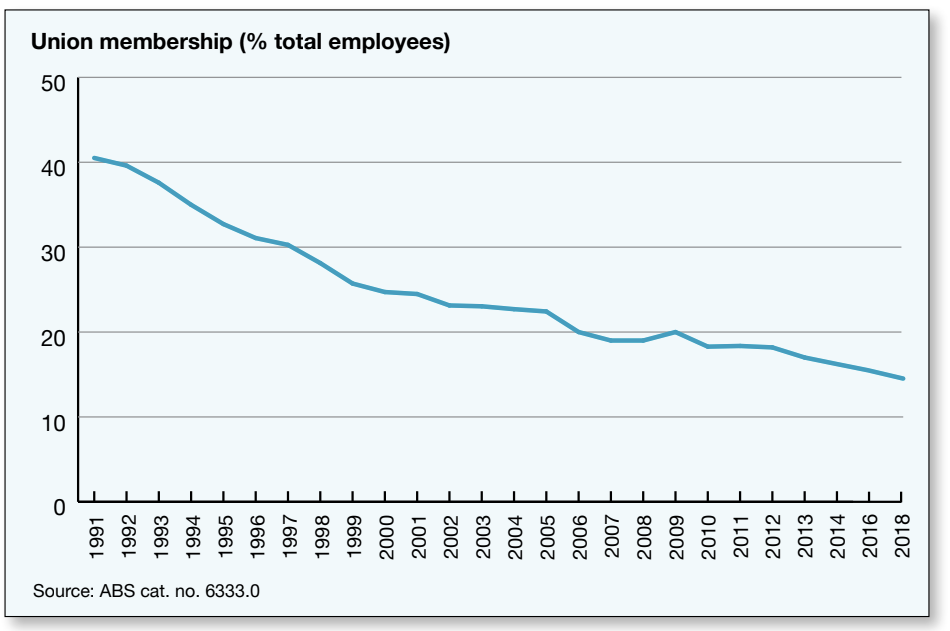
This decline has not been uniform across all sectors:
- Public sector membership (39%) remains significantly higher than private sector (9%)
- Older workers (25% for ages 55-59) have much higher membership rates than younger workers (8% for ages 20-24)
Factors contributing to declining union membership
Changes to wage determination: The shift from centralised wage-setting to enterprise bargaining has reduced unions' overall influence in wage outcomes.
Changes within industries: Industries experiencing strong growth, such as business services, domestic services and retail trade, have historically low union membership. Conversely, sectors with high union membership, such as manufacturing and government-owned businesses, have shrunk as a proportion of total employment.
Changes in employment types: Union membership has always been highest among permanent full-time workers. However, the fastest employment growth has occurred in casual, part-time and temporary work, and among contractors—all employment types with lower union membership rates.
How unions influence the labour market
Representing employee interests
Unions provide individual employees with legal assistance and advice. They also give workers a collective voice when management implements organisational changes. Unions advocate for improved access to training, better safety standards, family-friendly policies and changes to work structures.
Exercising bargaining power in negotiations
Individual employees have limited bargaining power because they can usually be easily replaced. However, when employees unite through a union, they gain significant power because replacing an entire workforce is extremely difficult.
Example
Worked Example: Union Wage Negotiation Effect
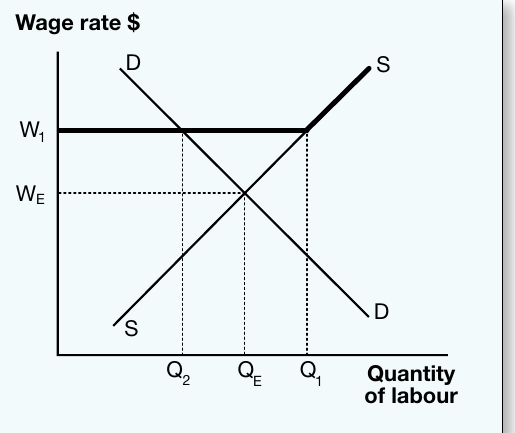
Through collective bargaining, unions can negotiate wage rates above what market forces alone would determine. Consider this scenario:
Initial equilibrium: Wage rate with quantity of labour
After union negotiation: When unions successfully negotiate wages above equilibrium (from to ), this changes the shape of the supply curve.
The trade-off:
- At the higher wage rate , the quantity of labour supplied increases to
- However, the quantity of labour demanded falls to
- Employment falls below the original equilibrium quantity:
This demonstrates that higher wages come with the cost of reduced employment opportunities.
Note
Evidence suggests union members earn higher wages: across 17 out of 19 industries, union members are better paid than non-union members, with differences of up to 38%. Overall, Australian union members receive wages that are 12% higher on average.
Important
The Union Wage-Employment Trade-off
Unions must balance achieving higher wages against maintaining employment levels. Excessive wage demands may contribute to unemployment by pricing labour out of jobs. This fundamental trade-off is a key consideration in all wage negotiations.
Restricting the supply of labour
Unions can also increase wages by reducing the labour supply to a firm or industry on an ongoing basis. Methods include:
- Restricting hiring of employees (for example, professional associations opposing recognition of overseas-trained workers)
- Demanding employers only hire union members
- Requiring professional licences that are only available to association members
Example
Worked Example: Labour Supply Restriction Effect
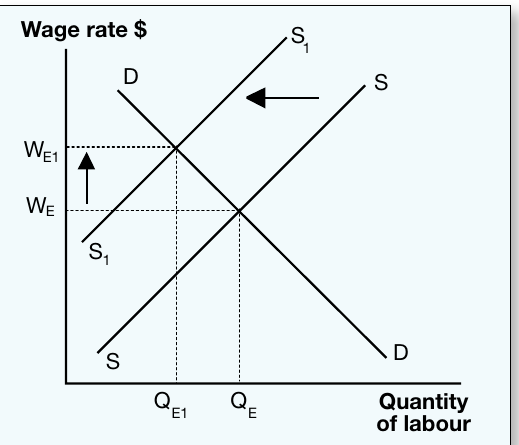
When unions restrict labour supply, this creates a different mechanism for wage increases:
Step 1: Supply curve shifts leftward from to due to labour restrictions
Step 2: The new equilibrium shows:
- Wage rate increases from to
- Quantity of labour employed decreases from to
Result: Unlike collective bargaining, this method changes the market equilibrium itself, but still results in lower employment levels.
Most forms of compulsory union or association membership are now prohibited, making these restrictions less common.
The minimum wage debate
There is ongoing debate among economists, employers, governments and unions about the relationship between minimum wages and unemployment.
Note
Different Perspectives on Minimum Wages:
Union argument: Wage increases for low-income earners boost consumer spending, which stimulates economic growth and job creation.
Employer argument: Wage increases make employees more expensive, leading to higher unemployment.
Economic theory: Generally suggests wage growth should not exceed the sum of inflation plus productivity growth. However, the concept of price elasticity of demand is important—the responsiveness of labour demand to wage changes varies.
Australian experience: The past two decades show it is possible to reduce unemployment while awarding moderate minimum wage increases. During the 2008-09 global financial crisis, minimum wages were frozen, causing real wage reductions due to inflation. Between 2010 and 2019, the Fair Work Commission awarded modest real wage increases, arguing these were affordable and consistent with low unemployment and low inflation goals.
Important
Recent Economic Thinking on Minimum Wages
There has been a shift among central banks and institutions like the International Monetary Fund towards supporting higher wage growth in current conditions. They argue that higher minimum wages:
- Increase household spending and economic activity
- Potentially create more jobs despite higher costs
- Work because labour demand is a derived demand—based on consumer demand for goods and services
While higher wages increase costs for individual firms, they also increase consumers' purchasing power, potentially increasing overall labour demand. This represents a significant change from traditional economic thinking.
Employer associations: definition and purpose
Employer associations are organisations formed by employers to represent their interests. Although larger employers have greater financial resources than unions, they are generally less coordinated because:
- Employers already have greater bargaining power without needing to coordinate
- Employers are often in direct competition with each other
- Larger employers typically deal with unions directly rather than through associations
Employer associations mainly operate as lobby groups representing business interests on economic policy issues such as taxation, regulations and industrial relations.
Main roles in the labour market
Lobbying government: Representing and promoting members' interests by advocating for favourable industrial relations policies.
Providing industrial relations support: Assisting employers in managing industrial relations issues, including representation in industrial tribunals during disputes.
Key employer associations
Note
Federal Level Employer Associations:
At the federal level, the three most important employer associations are:
- Business Council of Australia (BCA) - Represents major corporations
- Australian Industry Group - Represents manufacturers and service providers
- Australian Chamber of Commerce and Industry (ACCI) - Peak body for chambers of commerce
These organisations provide a national voice for employers and play an important role in industrial relations policy debates.
Industry-specific associations also exist, such as:
- National Farmers Federation (NFF)
- Housing Industry Association
- Minerals Council of Australia
These represent specific industry concerns, participate in wage negotiations, and represent employers in industry-specific disputes.
How employer associations influence the labour market
Individual companies generally have more direct influence on wage outcomes than employer associations. Large businesses typically have the expertise and resources to negotiate directly with unions, and employers mostly do not coordinate negotiations with each other.
However, employer associations can sometimes benefit both employers and employees. Historically, by lobbying government for protection from foreign competition, tax exemptions or industry assistance, employer associations secured larger domestic market shares for Australian producers.
Example
Worked Example: Industry Assistance Effect on Labour Market
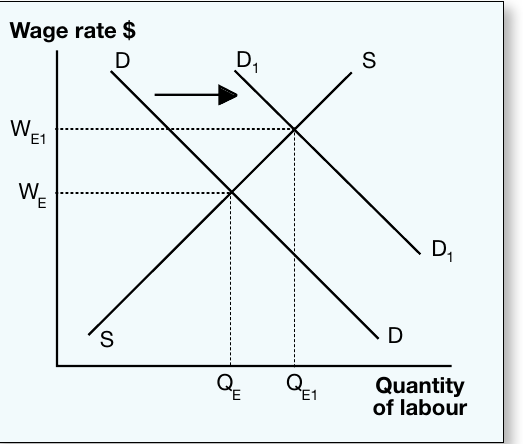
When employer associations successfully lobby for industry assistance:
Step 1: Increased market share for Australian producers increases labour demand
Step 2: Demand curve shifts rightward from to
Step 3: The new equilibrium shows:
- Wage rate increases from to
- Employment increases from to
Result: This is a win-win scenario where both wages and employment rise simultaneously.
Important
Such demands have been less successful in recent years as governments have reduced protection levels and industry assistance. Economists generally believe that even if industry assistance helps one sector, it harms others and has negative effects on employment in the long run.
Current main roles of employer organisations
- Assisting members in negotiating wage agreements with employees
- In some cases, negotiating wage agreements covering multiple members (though government argues this undermines enterprise-specific focus)
- Providing advice, training and direct assistance to employers
- Lobbying government for policy changes, especially regarding industrial relations and skills training
- Representing employers' interests in industrial tribunal hearings
Summary
Key Points to Remember:
-
The industrial relations system manages the conflicting interests of employers (who want low wages) and employees (who want high wages) through laws, institutions and processes
-
Trade unions are worker organisations that improve wages and working conditions through collective bargaining, giving workers greater power than they would have individually
-
Union membership in Australia has declined dramatically from 55% in the mid-1970s to 15% in 2018, due to changes in wage determination, industry structure and employment types
-
Unions influence wages through two main mechanisms: exercising collective bargaining power (which can push wages above equilibrium) and restricting labour supply (which shifts the supply curve left)
-
Both union strategies create a trade-off between higher wages and lower employment levels—a key consideration in wage negotiations
-
Employer associations represent business interests through lobbying and providing industrial relations support, though individual large companies often negotiate directly with unions
-
The debate over minimum wages and unemployment is complex: while higher wages increase costs for individual firms, they also boost consumer purchasing power, potentially increasing overall labour demand