Competition and Market Power (HSC SSCE Economics): Revision Notes
📚Revision Notes
Competition and Market Power
Understanding market structure
Market structure determines the level of competition within an industry. It is defined by three key factors:
- The number and relative size of firms operating in the industry
- The nature of the product being sold (whether products are identical or differentiated)
- The ease with which new firms can enter or exit the industry
These factors directly influence the degree of market power that firms possess. Market power refers to a firm's ability to raise prices above the competitive equilibrium without losing all its customers. The greater a firm's market power, the higher the equilibrium price (and the lower the equilibrium quantity) compared to what would exist under conditions of pure competition.
Note
The relationship between market power and market outcomes is crucial to understanding economics. When firms possess significant market power, they can restrict output and raise prices, leading to outcomes that differ substantially from competitive markets. This affects both consumer welfare and economic efficiency.
The four main market structures
Markets can be classified into four main structures, each representing different levels of competition and market power.
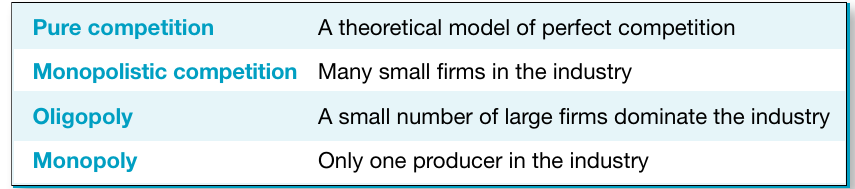
These structures form a spectrum from maximum competition (pure competition) to minimum competition (monopoly). Understanding where an industry sits on this spectrum helps economists predict firm behavior and market outcomes.
Pure competition
Pure competition, also called perfect competition, represents a theoretical ideal rather than a real-world market structure. While some industries like fresh food markets may come close, no industry perfectly meets all the conditions.
Characteristics of pure competition
A purely competitive market must satisfy all of the following conditions:
- Many small buyers and sellers: No individual buyer or seller is large enough to influence the market price through their actions alone
- Homogeneous products: All firms sell identical products, and buyers know this
- Perfect information: Both buyers and sellers know the market price and the prices offered by all sellers
- No switching costs: Buyers can move between suppliers without incurring any costs
- No barriers to entry or exit: Firms can freely enter or leave the market
- Unlimited sales at market price: Sellers can sell as much as they want at the prevailing market price
Price-taking behavior
Under pure competition, firms are price takers. This means they must accept the market price determined by supply and demand forces and cannot influence it through their own actions.
Important
Why are firms price takers in pure competition?
If a firm attempts to charge above the market price, it will lose all its customers immediately. Buyers know they can purchase the identical product elsewhere at the lower market price, and there are no costs to switching suppliers. Conversely, no firm would choose to sell below the market price, as this would reduce profits unnecessarily when they can sell the same quantity at a higher price.
In this environment, advertising would be wasteful. Since all products are identical and firms can already sell as much as they want at the market price, promotional spending would not increase sales.
Note
The absence of advertising in purely competitive markets contrasts sharply with other market structures. This highlights how market structure fundamentally shapes firm behavior – in pure competition, the nature of the market makes advertising economically irrational.
Real-world application
Pure competition is primarily a theoretical model used to understand market dynamics. However, some agricultural markets, particularly for fresh fruit and vegetables, approximate these conditions relatively closely.
Example
Real-World Application: Agricultural Markets
Fresh fruit and vegetable markets in Australia come close to pure competition. At wholesale markets, numerous farmers sell similar produce (such as tomatoes or apples), and buyers can easily compare prices across sellers. Products from different farms are largely interchangeable, barriers to entry are relatively low, and individual farmers have little ability to influence market prices. While not perfectly competitive, these markets demonstrate many characteristics of the model.
Monopoly
A monopoly sits at the opposite end of the spectrum from pure competition, representing the most extreme case of market power.
Characteristics of monopoly
A monopoly market structure exists when:
- Single seller: Only one firm produces and sells the product
- No close substitutes: The product has no alternatives that consumers can easily switch to
- Extremely high barriers to entry: Potential competitors are effectively prevented from entering the market
Price-setting power
Unlike firms in pure competition, a monopolist is a price setter. The monopolist can determine the product's price to maximize profit without fear of losing all customers to competitors.
Important
Monopolists face constraints
This does not mean monopolists can charge any price they wish. They still face the constraint of the demand curve – higher prices will reduce the quantity demanded. The monopolist must balance the trade-off between price and quantity to maximize profit. Even with complete market power, economic forces still impose limits on pricing decisions.
Monopolists may still engage in advertising, but for different reasons than firms in competitive markets. Rather than attracting customers from competitors, advertising serves to maintain the product's image and justify its price.
Impact on markets
When a product is produced by a monopolist rather than under competitive conditions, the outcome differs significantly. The monopolist restricts output and raises prices compared to the competitive equilibrium. This creates a transfer of surplus from consumers to the firm and typically results in allocative inefficiency.
Example
Australian Example: Water Supply
Water supply in Australia remains one of the few genuine monopolies, with single providers in most regions due to the impracticality of competing distribution infrastructure. The high fixed costs of building water networks and the inefficiency of duplicating infrastructure create natural barriers to entry. This explains why water utilities are typically government-owned or heavily regulated to protect consumers from potential monopoly pricing.
Monopolistic competition
Monopolistic competition, along with oligopoly, represents imperfect competition – market structures that fall between the extremes of pure competition and monopoly.
Characteristics of monopolistic competition
This market structure is defined by:
- Many relatively small firms: Numerous competitors operate in the market, each with a small market share
- Differentiated products: While products are similar, they are not identical. Firms engage in product differentiation to make their offerings appear distinct
- Some price-setting power: Product differentiation gives firms limited ability to set prices above competitors without losing all customers
- Low barriers to entry: New firms can enter the market relatively easily, though established firms benefit from existing customer loyalty
Product differentiation and brand loyalty
Product differentiation is a key strategy in monopolistic competition. Firms package and present their products to appear different from competitors' offerings, even when the underlying product is similar. This creates brand loyalty – when customers prefer a particular firm's product and are willing to pay slightly more for it.
Through successful product differentiation, firms gain some degree of price-setting power. However, this power is limited compared to a monopoly. Firms remain aware that many close substitutes exist and that competition is intense. If they raise prices too high, customers will switch to competitors' products.
Note
The power of differentiation
Product differentiation transforms otherwise identical products into unique offerings in consumers' minds. This perceived uniqueness gives firms limited market power, even in markets with many competitors. A café selling coffee can charge more than competitors if customers value its atmosphere, location, or service quality – despite coffee itself being largely homogeneous.
Role of advertising
Advertising plays a crucial role in monopolistic competition. Firms use it to:
- Attract new customers by highlighting their product's unique features
- Maintain existing customer relationships by reinforcing brand loyalty
- Differentiate their product from competitors' offerings
Example
Australian Examples: Restaurants and Hairdressers
Restaurants and hairdressers are classic examples of monopolistic competition in Australia. Each establishment offers similar services but differentiates through factors like ambiance, style, location, and branding. A restaurant might emphasize its authentic Italian cuisine, family-friendly atmosphere, or waterfront location to distinguish itself from competitors. Similarly, hairdressers differentiate through stylist expertise, salon environment, and brand reputation.
Motels similarly compete through product differentiation while offering fundamentally similar accommodation services. Each motel differentiates through location, amenities, cleanliness standards, and customer service quality.
Oligopoly
Oligopoly is the most common market structure in Australia's major industries. It represents imperfect competition dominated by a few large firms.
Characteristics of oligopoly
An oligopolistic market structure features:
- Few large firms: Only a small number of firms control most of the market, with each holding a significant market share
- Differentiated products: Firms typically sell similar but not identical products
- High barriers to entry: Significant obstacles prevent new firms from entering the industry, which explains why only a few firms dominate
Strategic interdependence
The defining feature of oligopoly is strategic interdependence. Oligopolist firms constantly monitor and respond to their rivals' behavior. Any decision about pricing or output must consider how competitors will react.
Important
The danger of price competition
This creates a distinctive competitive dynamic. If one firm lowers its price to undercut rivals, competitors will likely respond with their own price cuts. This could trigger a price-cutting war that reduces profits for all firms in the industry. The interdependent nature of oligopolistic competition makes price wars potentially devastating for all participants.
For this reason, oligopolists typically avoid price competition and instead compete through:
- Advertising campaigns promoting their products
- Non-price factors like service quality, convenience, or product features
- Brand building and customer loyalty programs
Note
Non-price competition in oligopolies
Oligopolists prefer non-price competition because it allows them to compete for market share without triggering destructive price wars. When supermarkets compete through loyalty programs, convenience initiatives, or advertising campaigns rather than price cuts, all firms can maintain profitability while still competing for customers. This explains why oligopolistic industries often feature intense advertising and marketing efforts.
Example
Australian Examples: Major Oligopolies
Major Australian oligopolies include:
-
Supermarkets: Dominated by Woolworths and Coles, which together control the majority of grocery retail. These firms compete primarily through loyalty programs (Everyday Rewards and Flybuys), store locations, product range, and brand marketing rather than aggressive price competition.
-
Airlines: Qantas and Virgin Australia are the primary domestic carriers. They differentiate through service quality, route networks, frequent flyer programs, and brand positioning while maintaining relatively similar pricing structures.
-
Banking: The "big four" banks (Commonwealth Bank, NAB, Westpac, and ANZ) dominate the financial services sector. Strategic interdependence is evident when one bank changes interest rates, others typically follow within days.
-
Petrol retailers: A small number of major oil companies control most service stations. Price movements at one station often trigger matching changes at nearby competitors, demonstrating classic oligopolistic behavior.
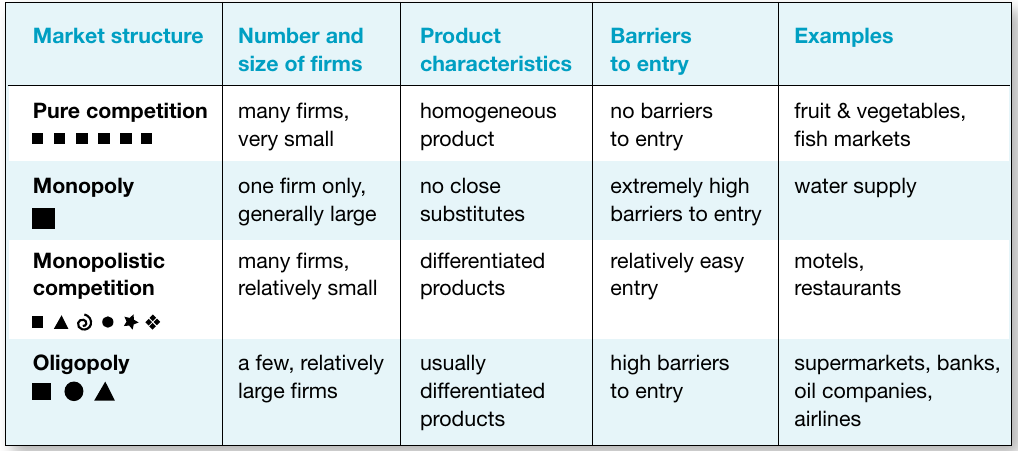
Comparison of market structures
The following table summarizes the key differences between the four market structures:
Market power and competition
An important relationship exists between the level of competition and market outcomes:
- As competition increases, prices tend to fall and output tends to increase
- As market power increases (moving from pure competition toward monopoly), firms gain greater ability to raise prices and restrict output
- The degree of price-setting power ranges from none (price takers in pure competition) to substantial (price setters in monopoly)
Exam technique: Analyzing market structures
When analyzing an industry's market structure, systematically examine:
- Number and size of firms: How many firms operate? Do a few large firms dominate or are there many small firms?
- Product characteristics: Are products identical or differentiated? How significant is the differentiation?
- Barriers to entry: What prevents new firms from entering? Are these barriers low, moderate, or high?
Note
Systematic analysis approach
Use these three factors to classify the market structure, then explain the implications for firm behavior, pricing, and market outcomes. This structured approach ensures you consider all relevant factors and can justify your classification with clear evidence. In exam situations, showing your analytical process demonstrates deeper understanding than simply stating a conclusion.
Summary
Summary
Key Points to Remember:
-
Market structure determines the degree of competition and market power in an industry, based on the number of firms, product characteristics, and barriers to entry
-
Pure competition is a theoretical model where many small firms sell identical products with no barriers to entry; firms are price takers with no market power
-
Monopoly occurs when a single firm dominates with no close substitutes and high barriers to entry; the monopolist is a price setter with maximum market power
-
Monopolistic competition features many small firms selling differentiated products; product differentiation gives firms limited price-setting power through brand loyalty
-
Oligopoly is dominated by a few large firms with strategic interdependence; firms avoid price competition and compete through advertising and non-price factors
-
As competition increases across market structures, prices fall and output increases; Australian examples include fresh food markets (pure competition), water supply (monopoly), restaurants (monopolistic competition), and supermarkets (oligopoly)