Economic Collapse in Sri Lanka (HSC SSCE Economics): Revision Notes
📚Revision Notes
Economic Collapse in Sri Lanka
Introduction
In July 2022, Sri Lanka experienced the worst economic crisis in its 74-year history. The government defaulted on its debt for the first time, the country was declared bankrupt, and the currency lost half its value. Severe shortages of food, fuel and medicine, combined with soaring prices and power disruptions, triggered widespread protests that ultimately forced the president to flee the country. This case study demonstrates how external economic shocks, when combined with poor policy decisions, can create a devastating economic collapse.
Background
Prior to the crisis, Sri Lanka had been one of South Asia's more successful economies. However, the country's economic stability proved fragile when faced with a combination of global economic pressures and flawed domestic policies.
Note
The Sri Lankan crisis provides an important lesson: even relatively stable and successful economies can experience rapid collapse when external pressures combine with poor policy decisions. Economic stability cannot be taken for granted.
The crisis reveals important lessons about economic management in an increasingly interconnected global economy.
Causes of the crisis
The collapse of Sri Lanka's economy resulted from a combination of external shocks and domestic policy failures that compounded each other.
External shocks
Three major external events weakened Sri Lanka's economic position:
- Tourism collapse (2019): Terrorist attacks in 2019 devastated Sri Lanka's tourism industry, eliminating a crucial source of foreign exchange earnings. Tourism had been a significant contributor to the economy, and its sudden loss reduced the country's ability to earn foreign currency.
- COVID-19 pandemic: The pandemic further disrupted economic activity and international trade, reducing both domestic output and foreign exchange inflows. Like many countries, Sri Lanka faced lockdowns, business closures and reduced consumer demand.
- Commodity price surge (2021): Rising global commodity prices from 2021 onwards significantly increased the cost of essential imports such as fuel, food and raw materials. This placed additional pressure on Sri Lanka's foreign exchange reserves as the country had to pay more for the same volume of imports.
Note
While these external shocks created serious challenges, they did not inevitably lead to economic collapse. Many countries faced similar pressures during this period but managed them successfully. The critical factor was how the government responded to these pressures.
Policy failures under President Rajapaksa
After President Rajapaksa's election in 2019, the government implemented several policies that transformed manageable economic challenges into a full-blown crisis:
Protectionist policies: Rather than pursuing conventional strategies for integrating with the global economy, the government adopted protectionist policies designed to reduce imports and save foreign currency. However, this approach failed to address the underlying problems and created new difficulties.
Fertiliser import ban: In an attempt to conserve foreign exchange, the government banned fertiliser imports overnight, claiming this represented a national shift to organic farming. This policy had catastrophic consequences:
- Agricultural output declined sharply
- Food production fell, creating domestic shortages
- The country needed to import more food, increasing rather than reducing foreign exchange outflows
- The currency crisis worsened
Important
Common Policy Mistake: Protectionism During Crisis
The fertiliser ban demonstrates a critical error in economic policy-making: implementing simplistic solutions without considering unintended consequences. By banning fertiliser imports to save foreign currency, the government actually made the crisis worse because reduced agricultural output required increased food imports. This illustrates why protectionist policies often backfire in interconnected modern economies.
Ill-timed tax cuts: President Rajapaksa announced massive tax cuts designed to stimulate economic growth. However, this policy emptied government revenue just as the COVID-19 pandemic struck, leaving the government unable to fund essential services or provide economic support during the crisis.
Soft peg exchange rate system: Sri Lanka used a soft peg approach to manage its exchange rate, where the currency was allowed to fluctuate within a limited range. This system enabled foreign currency outflows to exceed inflows because:
- The central bank had to sell foreign reserves to maintain the exchange rate target
- As confidence in the currency fell, more people and businesses sought to convert rupees into foreign currency
- The system was unsustainable given the declining reserve position
The economic collapse
The combination of external pressures and policy failures led to a severe economic crisis characterized by the exhaustion of foreign exchange reserves and the collapse of the currency.
Depletion of foreign exchange reserves
Foreign exchange reserves are crucial for:
- Defending the currency's value in foreign exchange markets
- Paying for essential imports (food, fuel, medicine)
- Servicing foreign debt obligations
Sri Lanka's foreign reserves fell from almost US$8 billion in 2019 to near-zero by 2022 as the government struggled to defend the currency value and meet foreign debt payments.
Note
The Role of Foreign Exchange Reserves
Foreign exchange reserves act as a financial cushion that allows countries to weather economic storms. They enable central banks to stabilize currency values, pay for imports when export earnings decline, and maintain confidence in the financial system. Once reserves are exhausted, a country loses its ability to defend against currency collapse.
Once reserves were exhausted, the government could no longer:
- Prevent currency depreciation
- Import essential goods
- Service foreign debt
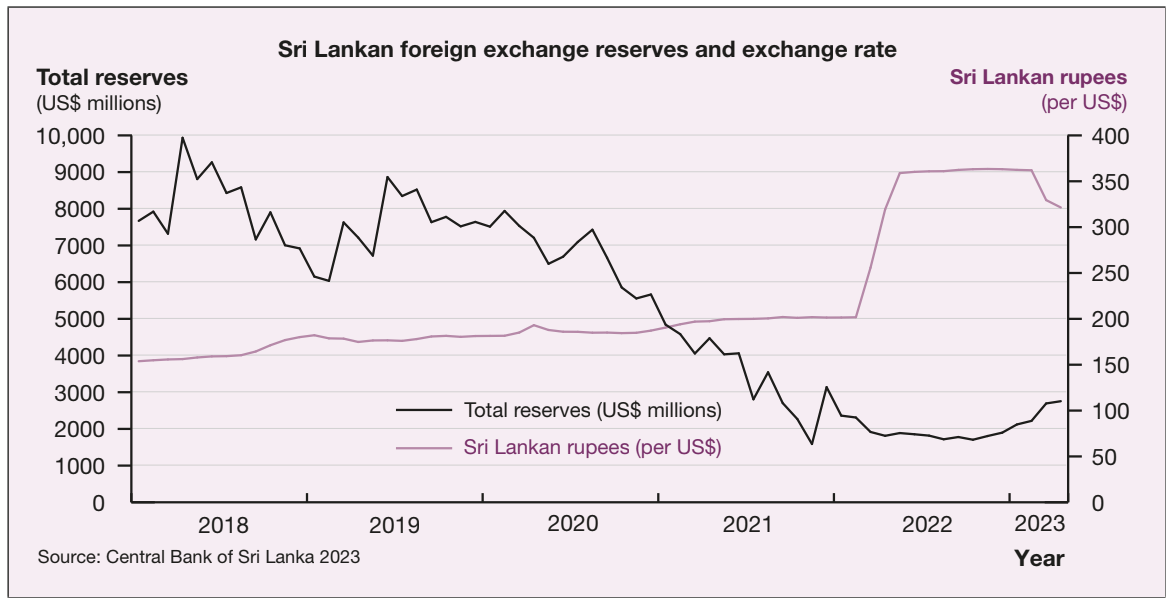
The diagram above illustrates the relationship between reserve depletion and currency depreciation. The black line shows total foreign reserves falling dramatically from around US$8,000 million in 2018-2019 to below US$2,000 million by 2021-2022. The purple line shows the Sri Lankan rupee exchange rate, which remained relatively stable around 180 rupees per US dollar until 2021, then spiked sharply to approximately 360 rupees per US dollar during 2022.
Impact on key economic indicators
By the end of 2022, Sri Lanka's economic indicators showed the severity of the crisis:
Example
Economic Impact Statistics: 2022 Crisis Year
The following figures illustrate the scale of Sri Lanka's economic collapse:
GDP contraction: The economy contracted by 7.8% in 2022, meaning total output fell dramatically. This represents a severe recession with widespread business failures and income losses.
Currency depreciation: The Sri Lankan rupee depreciated by 81% by the end of 2022. This means the currency lost most of its value against other currencies, making imports extremely expensive and eroding purchasing power.
Inflation: Inflation reached 57% in 2022, representing hyperinflationary conditions. Prices increased at unprecedented rates, destroying savings and making basic goods unaffordable for many citizens.
Employment: The manufacturing and construction sectors experienced severe input shortages, leading to 500,000 job losses. Workers lost their livelihoods as businesses closed or reduced operations due to lack of raw materials, fuel and electricity.
Poverty: The national poverty rate doubled as unemployment rose, real wages fell, and prices soared. Millions of Sri Lankans fell below the poverty line during the crisis.
Shortages and disruptions
The economic collapse created severe shortages of essential goods:
- Food: Agricultural production declined and the country could not afford food imports
- Fuel: Without foreign currency to pay for petroleum imports, fuel shortages led to long queues at petrol stations and transport disruptions
- Medicine: Shortages of imported medicines created a health crisis
- Electricity: Power cuts disrupted daily life and economic activity
These shortages particularly affected the manufacturing and construction sectors, which rely on imported inputs and reliable energy supplies.
International response
The severity of Sri Lanka's crisis prompted support from neighboring countries and international financial institutions. However, this assistance came with conditions requiring policy reforms.
External financial support
Multiple international actors provided financial assistance to prevent complete economic collapse:
World Bank: Lent US$600 million to support basic services and economic recovery programs.
India: As Sri Lanka's closest neighbor, India provided over US$4 billion in support through loans and credit lines. This assistance helped Sri Lanka pay for essential imports.
International Monetary Fund (IMF): Approved a US$2.9 billion debt relief program that was later extended to 2027. This program provided:
- Immediate financial support
- More time for the government to restructure its external debt
- A framework for policy reforms
G7 economies: The group of seven major advanced economies committed to helping Sri Lanka secure debt relief from various creditors.
China: The Export-Import Bank of China announced a two-year moratorium on debt repayments, providing temporary relief from debt service obligations.
Note
By 2023, Sri Lanka's external debt had risen to 75% of GDP, highlighting the scale of the country's foreign borrowing and the challenges ahead for debt repayment. Total international assistance exceeded US$7 billion, representing one of the largest coordinated rescue packages for an emerging economy.
Government policy responses
The Sri Lankan government implemented several policy measures, partly to satisfy conditions for IMF support:
Contractionary monetary policy: The central bank raised interest rates by 10 percentage points to combat inflation. Higher interest rates:
- Reduce consumer spending and borrowing
- Slow economic activity
- Help bring inflation under control
- Make the currency more attractive to hold
Fiscal consolidation: The government took measures to improve its budget position:
- Increased value-added tax (VAT) to 15% to raise government revenue
- Cut government spending to reduce the budget deficit
- These measures aimed to restore fiscal sustainability but also reduced aggregate demand further
Structural reforms: The government began reforming state-owned enterprises (SOEs), which often operate inefficiently and drain government resources. These reforms were partly required as conditions for IMF support.
Mass emigration: Approximately 300,000 Sri Lankans emigrated in 2022 seeking employment abroad. While this reduced domestic unemployment, it also represented a loss of skilled workers and human capital.
Recovery and outlook
Recovery from the crisis has been extremely slow, with the economy continuing to face significant challenges.
Short-term outlook
The IMF's forecasts for Sri Lanka's economic recovery were pessimistic:
- 2023: A further contraction of 3% was expected, meaning the economy would continue shrinking
- 2024: Growth of just 1.5% was forecast, representing minimal recovery
These projections suggest a prolonged period of economic difficulty before the country can return to pre-crisis living standards.
Continuing challenges
Several indicators showed the crisis was far from resolved:
Currency depreciation: The rupee remained around 40% below its pre-crisis level in 2023, meaning imports remained expensive and purchasing power remained reduced.
Persistent inflation: Inflation remained high at almost 30% in 2023, continuing to erode real incomes and living standards.
Important
Reform Requirements for Continued Support
The IMF urged further reforms ahead of elections scheduled for September 2024:
- Increase government revenue through tax reforms
- Reduce corruption
- Improve governance and institutional quality
- Continue restructuring of state-owned enterprises
These reforms are necessary for long-term economic stability but may be politically difficult to implement. Without continued reforms, international support may be withdrawn, potentially triggering another crisis.
Lessons from the crisis
The Sri Lankan crisis demonstrates several important economic principles:
Integration with the global economy: In an age of globalisation, protectionist policies that attempt to isolate the economy from international trade are likely to fail. Modern economies depend on imports for essential goods and exports for earning foreign currency.
Policy credibility matters: Simplistic policies that ignore fundamental economic principles create more problems than they solve. The fertiliser ban, for example, was implemented without considering its impact on agricultural production and food security.
Exchange rate management: A soft peg exchange rate system can only work if a country has sufficient foreign exchange reserves. Without adequate reserves, the system becomes unsustainable and eventually collapses.
Fiscal responsibility: Tax cuts that deplete government revenue during an economic crisis leave the government unable to respond effectively to external shocks or provide support to affected citizens.
The cost of crisis: Economic collapse imposes enormous costs on society. For Sri Lanka, restoring stability, confidence and living standards will require many years of difficult reforms and slow recovery.
Summary
Key Lessons from Sri Lanka's Economic Collapse:
- External shocks do not automatically cause crises - it is the policy response that determines outcomes
- Protectionist policies in a globalized economy typically worsen rather than solve problems
- Foreign exchange reserves are critical for economic stability and crisis management
- Fiscal responsibility matters - depleting government revenue before a crisis leaves no room for response
- Simplistic policies that ignore economic fundamentals will fail
- Economic collapse imposes devastating and long-lasting costs on society, particularly on the most vulnerable populations
Remember!
Summary
Key Points to Remember:
The Crisis Overview:
- Sri Lanka experienced its worst economic crisis in 2022, resulting from a combination of external shocks (tourism collapse, COVID-19, commodity price surge) and catastrophic policy failures
- Foreign exchange reserves fell from US$8 billion (2019) to near-zero (2022), leading to currency collapse and inability to import essential goods
Economic Impact (End 2022):
- GDP contracted 7.8%
- Currency depreciated 81%
- Inflation reached 57%
- 500,000 jobs lost
- Poverty rate doubled
International Response:
- International assistance (World Bank, India, IMF, G7, China) totaled over US$7 billion but came with strict reform conditions
- World Bank: US$600 million
- India: over US$4 billion
- IMF: US$2.9 billion debt relief program
Government Policy Responses:
- Raised interest rates by 10 percentage points
- Increased VAT to 15%
- Cut government spending
- Began reforming state-owned enterprises
Ongoing Challenges:
- Recovery remains very slow with continued high inflation (30% in 2023) and currency depreciation (40% below pre-crisis level)
- External debt reached 75% of GDP by 2023
Key Terms:
- Sovereign default: When a government fails to meet its debt obligations to creditors
- Foreign exchange reserves: Holdings of foreign currencies and assets used to defend domestic currency and pay for imports
- Currency depreciation: Fall in the value of a currency relative to other currencies
- Soft peg exchange rate: Managed exchange rate system where currency fluctuates within a band with central bank intervention
- External debt: Total debt owed to foreign creditors
Critical Lesson: In a globalised economy, simplistic policies that ignore fundamental economic principles will fail, and the cost to society can be devastating and long-lasting.