The Impact of Globalisation (HSC SSCE Economics): Revision Notes
📚Revision Notes
The Impact of Globalisation
Introduction
Globalisation has fundamentally transformed the world economy. This note examines how globalisation affects economic growth, development, production processes, income distribution and environmental outcomes. While globalisation generally improves economic outcomes, it also creates challenges and risks.
Note
The impacts of globalisation are complex and multifaceted, affecting different countries and populations in different ways. Understanding both the positive contributions and negative consequences is essential for evaluating economic policy responses.
The key impacts include:
- Changes to economic growth rates across different regions
- Shifts in how goods are produced and traded
- Effects on income inequality within countries
- Environmental consequences
- Increased influence of global financial markets
- Greater synchronisation of economic cycles between countries
Economic growth and development
How globalisation affects different economies
Globalisation creates different opportunities for different types of economies. Developing economies can access global markets for their products and benefit from foreign investment and new technologies. High-income economies, particularly through transnational corporations, have found opportunities in global supply chains and service markets.
Important
Uneven Distribution of Benefits
Not all economies have gained equally from globalisation. Economic integration has caused disruptive structural changes in some regions. The free movement of people, goods and data also increases risks including cybercrime, disinformation and the spread of diseases like COVID-19.
Global growth acceleration
Evidence suggests globalisation has accelerated global economic growth, though the benefits are unevenly distributed. Global real GDP growth increased from 3.1% per year during the 1980s-1990s to 3.8% from 2000 until the COVID-19 pandemic in 2020.
The fastest-growing economies have been emerging economies like China and India. Advanced economies have experienced slower growth. Since 1990, some emerging and developing economies have been "catching up" to advanced economies, although this pattern does not hold for all countries, particularly when measured by per capita income.
Regional growth patterns
East Asia and Pacific (excluding high-income countries)
This region achieved the world's fastest growth rates, averaging 8.7% per year during the 1990s and 2000s (falling to 7.3% in the 2010s). China's growth was particularly remarkable at 10.4% in the 2000s, demonstrating how industrialisation and globalisation can drive economic expansion. The region grew 7.2% overall in 2021, with China at 8.1% and the rest of the region at 2.6%.
South Asia
This region experienced successful growth averaging 5.7% since 2000. India sustained 6% growth after increasing integration with the global economy, while Bangladesh also achieved 6% growth. The region contracted by 5% in 2020 due to COVID-19 but rebounded with 8% growth in 2021.
Europe and Central Asia
Former socialist economies grew 5.1% in the 2000s and 3.1% in the 2010s. These economies made a generally successful transition to market systems after experiencing severe contraction during the 1990s (-0.9%) due to the difficult transition process. Growth fell below 1% in 2022 because of the war in Ukraine.
Middle East and North Africa
The region experienced strong growth (4.4%) throughout the 1990s and 2000s, including Egypt (4.7%) and Saudi Arabia (3.6%). Higher energy prices during the globalisation era supported this growth compared to the 1980s (0.1%). However, this growth did not resolve high inequality levels in many regional economies. Political instability and declining oil prices reduced average growth to 2% since 2011.
Sub-Saharan Africa
Average growth reached 4% from 2000 to 2021, with strong performance in Ethiopia (8.7%), Mozambique (6%) and Nigeria (5.2%). However, other African countries have been less successful, with some experiencing growth rates so low they see very little improvement in living standards.
Latin America
Strong annual growth occurred in the first decade of the 2000s (3.1%), improving from 2.4% in the 1980s and 1990s. Growth fell back to 1% annually in the 2010s, reflecting weaker commodity prices and political instability. Latin American economies experienced the greatest COVID-19 shock of any region, contracting by 6.5% in 2020.
High-income economies
Advanced economies grew by just 2.1% on average from 1991-2021, slower than the 3.3% recorded during the 1980s. Average annual growth rates were 2.4% in the United States, 1.6% in the European Union and only 0.8% in Japan.
The war in Ukraine – a trillion-dollar inflationary shock
Russia's invasion of Ukraine in February 2022 fundamentally changed the global security and economic environment. The war created major economic consequences beyond the immediate humanitarian crisis:
Important
Major Economic Impacts of the Ukraine War
-
Refugee crisis: Over 8 million Ukrainians became refugees in 2023.
-
Inflation shock: The war caused a global inflation surge, reducing real incomes for 60% of workers worldwide. World output grew 3.4% in 2022, a full percentage point lower than pre-war forecasts.
-
Energy price surge: Energy costs rose more sharply than at any time in half a century, with crude oil prices reaching 10 times higher than 2020 levels. Many Western European nations rely on Russian gas, and Russia reduced supply before and during the war.
-
Food insecurity: Food prices rose sharply due to disrupted grain exports from Ukraine and Russia, plus higher costs for energy, fertilisers and shipping. By the second half of 2022, 323 million people faced severe food insecurity.
-
Interest rate increases: The inflation surge forced central banks globally to quickly reverse the low interest rate policies implemented during the pandemic, adding to borrowing costs. 60% of the poorest countries faced debt distress.
Interpreting growth trends
The remarkable growth in emerging economies that embraced international trade, foreign investment and transnational corporation participation may indicate that globalisation facilitates higher growth rates. China and India's sustained growth is linked to policies encouraging increased trade and foreign investment.
However, the most globally integrated economies—the advanced economies—have experienced comparatively weak growth over the past two decades, especially since the late 2000s global recession. The 2010s saw prolonged lacklustre growth despite record low interest rates and very low inflation. High indebtedness constrained governments from using fiscal policy to stimulate growth.
Note
The global economic contraction from COVID-19 and the Ukraine war highlighted how more integrated economies are more exposed to the transmission of economic shocks. This represents one of the key trade-offs in the globalisation process.
Economic development and wellbeing
Globalisation impacts economic development (the wellbeing of individuals and societies) mainly through its link to economic growth. When globalisation lifts growth rates, it also raises income levels and provides more resources for education, health care and environmental programs.
However, globalisation can have negative development consequences if it increases income inequality and accelerates climate change and environmental damage. The slow global response to climate change is likely to widen the gap between growth and development indicators in coming decades, as countries need to allocate more resources to addressing climate change impacts like extreme weather events.
China's role
Any analysis of globalisation's impacts is inevitably dominated by China's rising economic power. China's rise represents a major structural change in the global economy occurring alongside globalisation. Globalisation has contributed to China's extraordinary development speed.
Trade has been central to China's rapid industrialisation, as growth has been led by export-oriented manufacturing. China's growth also accelerates globalisation by deepening trade and financial links among economies. The speed and scale of China's economic expansion dwarfs any other emerging economy.
Human Development Index trends
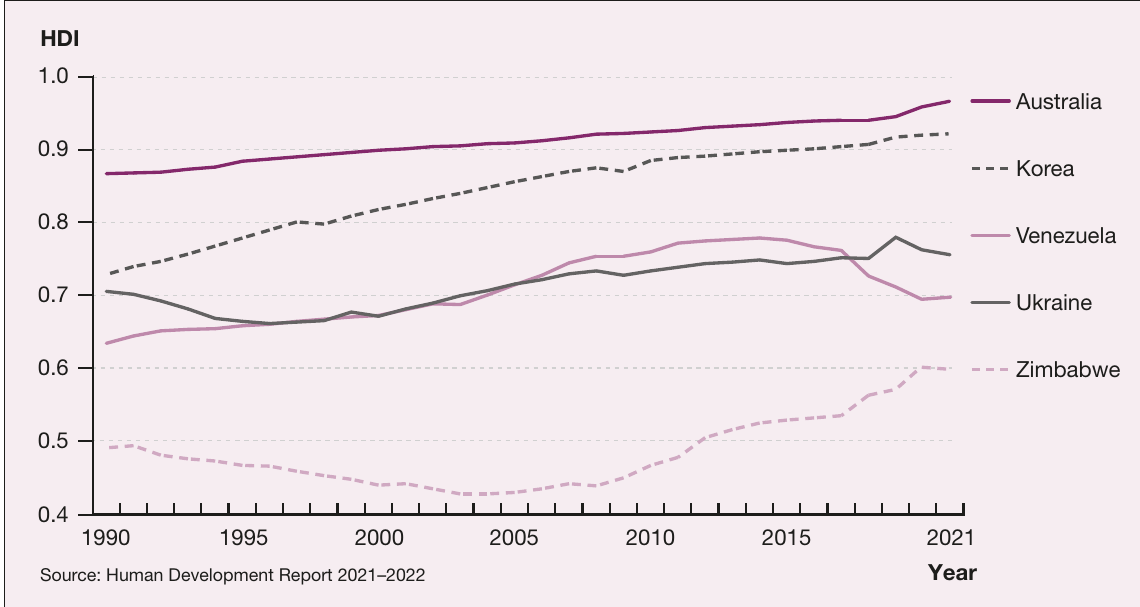
The Human Development Index (HDI) measures a combination of material living standards, education and health outcomes. Since the 1980s, almost all countries have experienced major improvements in economic development. There is little evidence that globalisation, on balance, contributed negatively to economic development.
Declines in economic development are restricted to a handful of countries experiencing upheaval in transition from planned systems (Russia, Moldova, Tajikistan) or serious political turmoil (Zimbabwe, Democratic Republic of Congo, Afghanistan).
Note
The chart shows HDI trends for selected countries from 1990 to 2021. Australia maintains the highest HDI levels throughout the period. Korea shows consistent upward progress. Venezuela and Ukraine show fluctuating patterns. Zimbabwe exhibits a U-shaped curve with initial decline followed by recovery.
Trade, investment and transnational corporations
Globalisation has resulted in substantial increases in trade flows and foreign investment, reaching a record US$32 trillion in 2022. Transnational corporations (TNCs) play a key role in both trade and investment flows, increasingly dominating business activity worldwide.
Growth of international trade
International trade in goods and services continues to grow at least as fast as global economic growth in most years, now equaling over half of global output. All regions have experienced this trend as technology changes and government policies have fostered trade growth.
Global value chains
An important feature of trade growth during the globalisation era is that goods are produced through multiple stages in different economies through global value chains (or supply chains). Countries engage in "vertical specialisation," focusing on just one or two parts of the production process.
Example
Worked Example: iPhone Production
Manufacturing computer chips, logic boards, camera parts, screen casings and final assembly might all occur in different countries. The globalisation of production processes means there are many international trade transactions rather than just exporting a finished iPhone from one country to another.
Apple's organisation and operation of the value chain allows it to capture the largest proportion of added value (59%) for the iPhone X. For the first time in history, intellectual property and commercial know-how are constantly being traded across economies. Investment now extends beyond physical capital into productivity training for labor and long-term business relationships.
Since the early 1990s, trade through global value chains has increased from less than half to about 80% of total trade.
COVID-19 supply chain disruption
The COVID-19 pandemic caused the most significant disruption to international supply chains of the globalisation era. Before March 2020, there was an assumption that supply chains would continue becoming ever more interconnected.
Important
Vulnerability of Global Supply Chains
The pandemic highlighted countries' vulnerability to global chains. When every country needed respirators and personal protective equipment, they could not obtain enough supplies from China, and many economies lacked capacity to manufacture these goods themselves. A 2022 survey revealed 85% of supply chains were impacted by the pandemic.
The pandemic resulted in huge disruptions to air travel and major delays in agricultural, mining and pharmaceutical supply chains. Finding alternative sourcing options (or improving supply chain reliability) became a priority for both TNCs and governments.
Foreign Direct Investment
The globalisation of financial markets has increased reliance on foreign sources of finance for investment. More countries now have greater access to overseas funds than ever before. FDI now plays a greater role in generating economic activity in every region.
In 2021, FDI was over nine times higher than in 1990 (though only 69% of its peak level recorded in 2007). Very large increases occurred in high-growth emerging economies that relaxed barriers to foreign investment. However, the benefits have mostly been enjoyed by economies with already favorable economic prospects. Only a trickle of FDI has flowed to the least developed countries (LDCs). The growth of short-term financial flows has had a destabilising impact on many economies.
Transnational corporations
The removal of restrictions on foreign ownership and development of global capital markets have spurred TNC growth. There are now more than 104,000 TNCs. Foreign affiliates of TNCs employ over 83 million people globally. They dominate major industries including motor vehicles, telecommunications and pharmaceuticals.
Performance of TNCs
TNCs generally perform better than domestic firms on indicators including productivity, quantity sold, production size and export market share.
Concerns about TNCs
Note
World Bank research found that, on average, benefits to local communities were lower as foreign firms tend to use less domestic capital and labor. Full advantages of FDI inflow can only be realised if TNCs connect to local suppliers.
Another concern is that TNCs do not operate under any one country's laws, so they can move production facilities to countries with weakest laws and artificially structure financial flows to avoid paying taxes. According to the OECD, developing economies are disproportionately affected by tactics TNCs use to avoid US$240 billion in corporate taxes annually. Lower labor standards and environmental protection laws in developing nations can lead to worker exploitation and environmental degradation.
Income inequality
Globalisation impacts income inequalities within countries because, as trade and financial flows grow, it changes economic structures.
How globalisation affects inequality
Trade effects
Increased openness to trade provides more export opportunities, which can raise incomes of trade-exposed or agricultural workers in developing countries. Lower tariffs on imports improve living standards for the poor by reducing goods prices.
In advanced economies, higher trade levels may shift employment towards higher-paid service industries, but may also depress incomes of workers in import-competing sectors. For example, employees in the American motor vehicle industry have seen incomes decline as US car producers compete against cheaper Asian imports.
Financial flow effects
Increased financial flows provide greater employment opportunities and fuel economic growth. However, FDI flows tend to be concentrated in higher skill and higher technology sectors, favoring those already better off. IMF research found that financial globalisation increases income inequality within countries.
Skilled labor mobility effects
Income inequality has increased in many emerging economies because global mobility of skilled labor means highly skilled workers may emigrate to more advanced economies with higher-paying jobs unless they receive higher pay. This contributes to large pay increases for highly skilled workers, while incomes for other workers grow much slower.
Trends in inequality
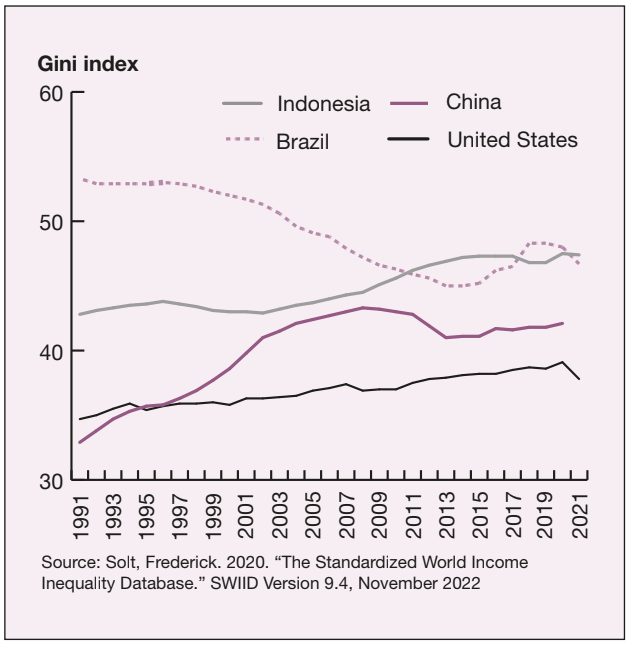
According to the IMF, income inequality rose by almost 0.45% per year during the three decades up until the mid-2000s, as measured by the Gini index (a common measure of inequality where a higher number indicates higher inequality).
Important
How Inequality Affects Economic Development
IMF studies found that increased inequality reduces economic development. Increases in income share for the top 20% of households are associated with an 8% fall in average growth rates over the following five years. In contrast, income increases for the lowest 20% of households lead to a 38% increase in average growth rates over the same period.
Note
The charts show the general trend of rising inequality. According to the IMF, about one-fifth of the increase in income inequality globally results from globalisation. A major part of increasing inequality is the impact of technological change, which shifts production processes away from low-skilled labor towards higher-skilled jobs. This benefits people with higher education levels but increases unemployment for less skilled workers.
COVID-19 inequality impacts
While COVID-19 impacted advanced economies first, the greatest effects were in emerging economies, whose GDP per capita declined by more than double—6.7%—in 2020. A 2023 IMF report found that emerging economies suffered the worst impacts due to high employment in face-to-face jobs and low social security transfers.
Environmental sustainability
The relationship between globalisation and environmental factors is complex.
Negative environmental impacts
Globalisation can have negative environmental consequences for several reasons. Low-income countries desperate to attract foreign investment and earn higher export revenue may engage in economic behavior that harms the environment:
- Deforestation for paper or woodchip industries
- Depletion of marine life through unsustainable fishing practices
- Water poisoning by mining operations
- Pollution from manufacturing industries
- Carbon dioxide emissions from power plants, contributing to climate change
Additionally, growth in global trade itself increases consumption of non-renewable fuels for transport by air, road, rail and sea.
Climate change as the primary threat
Important
Climate Change: The Most Significant Environmental Threat
Climate change is the most significant environmental threat in the early twenty-first century. Atmospheric warming has potentially irreversible and catastrophic impacts on all aspects of the natural environment including oceans, marine life, weather, wildlife, air quality and water supplies.
While carbon emissions contributing to climate change come from individual countries, climate change impacts affect the whole world. The impacts are also disproportionate. A World Bank report found that the 74 lowest-income countries are most affected by climate change despite accounting for less than one-tenth of global emissions.
This means nations need to work together to address climate change. A 2022 study by Standard Chartered estimated that globally, beyond what is already planned, an investment of US$95 trillion will be needed to achieve net-zero targets. Developing economies with large debt obligations have limited capacity to make required investments.
International climate agreements
Global efforts to reach agreements on reducing carbon emissions are coordinated by the United Nations Framework Convention on Climate Change (UNFCCC).
Kyoto Protocol (1997)
The 1997 UNFCCC summit produced the Kyoto Protocol on Climate Change, which set carbon emission reduction targets for industrialised countries. The Kyoto Protocol entered into force in 2005 and expired in 2020.
Paris Agreement
The Paris Agreement followed the Kyoto Protocol, aiming to keep "the increase in global average temperature to well below 2 degrees Celsius above pre-industrial levels"—the benchmark scientists believe necessary to prevent the most dangerous climate change impacts.
Note
The Paris Agreement was significant because, for the first time, it included developing nations like China and India alongside the United States (which had refused to ratify the Kyoto Protocol). Unlike the Kyoto Protocol, the Paris Agreement included mechanisms for transparency and review processes, intending increased global scrutiny to encourage countries to meet their emissions reduction contributions.
Nevertheless, countries set their own targets, meaning the world is still not on target to achieve the extent of carbon emission reductions required.
Glasgow Climate Pact (2021)
The 2021 Climate Conference in Glasgow (COP26) produced the Glasgow Climate Pact, ratified by 197 countries. It made progress in several areas and was the first climate deal to commit to reducing coal use.
Climate finance
The 2022 Climate Conference in Sharm, Egypt, called for developed economy parties to replenish the Green Climate Fund to assist developing economies. Although the original goal of mobilising US$100 billion per year by 2020 had not been met, progress was made in establishing a loss and damage fund for low- and middle-income economies facing climate disasters.
High Seas Treaty (2023)
In 2023, United Nations members signed the historic "High Seas Treaty," which agreed to protect the ocean outside national borders (99% of which was previously unprotected).
Positive opportunities from globalisation
Globalisation also offers opportunities to protect the world's environment by forcing individual nations to address their global responsibility for environmental preservation. It makes it possible for preservation costs to be shared and increases scrutiny of transnational corporations' environmental practices.
Globalisation has facilitated the transfer of new technologies to improve energy efficiency and reduce environmental pollution. Over time, globalisation may create international mechanisms to enforce agreements on preventing environmental damage.
However, problems involving global environmental resources, such as fish stocks or climate, have proved difficult to tackle. Progress in making agreements to combat global environmental problems has been slow.
The role of financial markets
The influence of global financial markets on economies has increased substantially during the globalisation era. Driven by global information and communications networks, global financial markets dominate financial flows worldwide. Governments have encouraged their development by removing "capital controls" on finance flows, floating exchange rates and deregulating domestic banking sectors.
Positive impacts of financial markets
Global financial markets can have positive impacts:
- Countries would be unable to conduct international transactions without foreign exchange markets
- Businesses would find it more difficult to access loans or attract investors if confined to domestic financial markets
- Efficient international financial markets should encourage greater transparency of business and government actions
- They should foster economic development
Negative impacts of financial markets
Global financial markets have also produced negative results during the globalisation era. Financial markets shift massive volumes of money around the world every day. If investor sentiment turns against a particular economy, it can result in:
- Collapse in exchange rates
- Economic shock and recession
- Rising unemployment
Important
Global Financial Crisis (2008)
In the late 2000s, global financial markets played a part in producing the worst economic crisis since the Great Depression. Originating in the United States housing market, the 2008 global financial crisis saw a collapse in worldwide investor confidence and seizure of the global financial system.
Central banks flooded financial markets with liquidity, governments guaranteed banking deposits to improve confidence, and many governments provided "bail-outs" to prevent troubled banks and financial institutions from collapsing. Although these emergency measures helped avoid global economic depression, the world economy still contracted by 2%.
COVID-19 and Ukraine impacts
The COVID-19 pandemic onset in 2020 and Ukraine invasion in 2022 showed how global financial markets can exacerbate economic volatility. During the pandemic's height, loss of investor confidence saw US$100 billion in investment outflows from emerging economies—twice as big as outflows during the global financial crisis.
Note
As many economies cut interest rates to record lows, some economists raised concerns that government and corporate borrowers might take on more risk and create over-indebtedness problems. The subsequent interest rate rises since 2022 have placed pressure on nations that accumulated large debt stocks during the pandemic, as well as financial and non-financial institutions that failed to anticipate the rapid financial tightening.
The IMF warned in 2023 that uncertainty surrounding these events could lead to large capital outflows from emerging and developing economies, potentially reducing per capita incomes by around 15%.
Reserve currencies
Despite several decades of globalisation, the US dollar remains the dominant reserve currency in global financial markets.
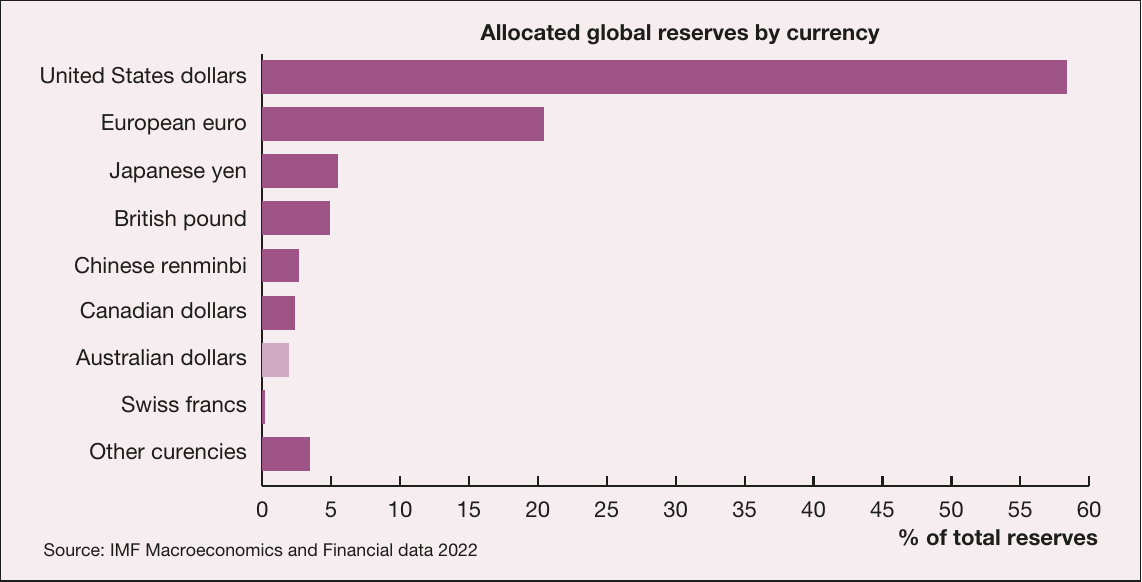
Nearly 60% of global reserves are held in US dollars, and 20% in euro. Reserves are held for various reasons including exchange rate management, debt servicing and addressing economic shocks.
Holding reserves in US dollars has been standard practice for many nations since World War II due to its widespread use and stability. US financial markets are still the largest and most liquid, giving central banks confidence they can access their US dollar reserves when needed. The US dollar is also the most widely used currency in trade, giving governments with US dollar reserves confidence they can use them to import necessary goods.
The international business cycle
The linkages between economies hold both benefits and risks for countries in the global economy.
Benefits of integration
The benefit of integration is that it allows countries to achieve faster economic growth rates by specialising in certain production types and engaging in trade. Countries with higher trade levels also experience faster economic growth. During times when world economic growth is higher, individual economies are likely to benefit from the upturn.
Risks of integration
Closer economic integration also makes economies more exposed to downturns in the international business cycle and developments in their regions.
Note
The strength of global economic growth in the mid-2000s resulted from simultaneous upswings in the United States and China that propelled the global economy to its fastest growth rates in 30 years. Equally, closer links between economies resulted in the late 2000s US downturn and COVID-19 economic fallout spreading more quickly to other developed and developing economies.
As trade and financial integration continues to increase, there is likely to be greater synchronisation of the international business cycle, intensifying both downturns and upswings in the global economy.
Need for policy coordination
Greater synchronisation of business cycles between different countries has increased the need for coordinated macroeconomic policies. Following the late 2000s recession, the IMF recommended that countries use their combined budgets to stimulate the world economy by 2% of global GDP.
However, economies generally do not coordinate macroeconomic policies unless in a global crisis, as seen during the COVID-19 pandemic. Governments worldwide announced macroeconomic policies to combat stalling economic activity, with many copying each other's policy approaches.
The COVID-19 pandemic struck when global growth was already weak, making it certain that the first half of the 2020s will be a period of slower growth. Russia's invasion of Ukraine in 2022, which destabilised commodity markets and contributed to a global inflation shock, added further uncertainty around the economic outlook for the 2020s.
Remember!
Summary
Key Points to Remember:
-
Globalisation has accelerated economic growth overall, but the effects are unevenly distributed. Emerging economies (especially in East Asia) have experienced the fastest growth, while advanced economies have grown more slowly.
-
The Human Development Index shows that almost all countries have experienced major improvements in economic development since the 1980s, suggesting globalisation has not negatively impacted development on balance.
-
Global value chains now account for about 80% of total trade, with production processes spread across multiple countries. The COVID-19 pandemic exposed vulnerabilities in these supply chains.
-
Income inequality within countries has risen, with about one-fifth of this increase attributable to globalisation. The impacts work through trade, financial flows and skilled labor mobility.
-
Climate change is the most significant environmental threat. While globalisation can harm the environment, it also enables international cooperation through agreements like the Paris Agreement and facilitates technology transfer for cleaner energy.
-
Global financial markets have increased influence on economies, bringing both benefits (access to capital) and risks (volatility and crises). The US dollar remains the dominant reserve currency.
-
Greater economic integration has led to more synchronized international business cycles, amplifying both upswings and downturns and increasing the need for coordinated macroeconomic policies.
Key terms: Globalisation, Human Development Index (HDI), transnational corporations (TNCs), foreign direct investment (FDI), global value chains, vertical specialisation, Gini index, climate change, Paris Agreement, reserve currency, international business cycle