Government Economic Forums (HSC SSCE Economics): Revision Notes
📚Revision Notes
Government Economic Forums
What are government economic forums?
Government economic forums bring together world leaders to coordinate economic policies between major economies. These forums enable heads of state, finance ministers and central bank governors to discuss pressing global economic challenges, with a focus on maintaining economic stability and promoting growth.
Note
These organisations play a particularly vital role during times of economic or financial crisis, when coordinated international action is needed. This coordination allows countries to align their responses and prevent isolated national policies from undermining global recovery efforts.
In the early 2020s, government economic forums have addressed several major challenges, including recovery from the COVID-19 pandemic, managing the economic fallout from the war in Ukraine, and developing cooperative measures to address climate change.
The two most significant government economic forums are the Group of Seven Nations (G7) and the Group of Twenty Nations (G20).
Group of Seven Nations (G7)
Composition and formation
The G7 consists of seven of the world's largest industrialised nations. Its members are the United States, United Kingdom, France, Germany, Canada, Japan and Italy. The forum was established in 1976 and has met annually since then to discuss conditions in the global economy.
Role and influence
The G7 has functioned as an economic council for the world's wealthiest nations. Its key role has been coordinating global macroeconomic policy, given its influence over the fiscal and monetary policies of the world's largest advanced economies. This unofficial coordination mechanism has allowed these nations to align their economic strategies and respond collectively to global challenges.
Because of the G7's status as a forum for powerful economies, its agenda has expanded beyond purely economic matters. Discussions now regularly include broader political issues and priorities such as climate change, global poverty and international security.
Criticisms and declining influence
Important
Critical Challenge: Declining Global Relevance
The G7 faces significant criticism regarding its relevance in the modern global economy. The membership no longer accurately reflects the most important economic forces worldwide. Notably, China and India have become more significant to the global economy than some G7 members like Canada and Italy, yet they are excluded from the group.
The statistics highlight this declining influence:
- The G7's share of global GDP fell from 68% in 1992 to just 43% in 2023
- G7 nations represent only 10% of the world's population
This shrinking economic footprint raises questions about the forum's ability to effectively coordinate global economic policy. During the COVID-19 pandemic, when the world faced sudden disruption to trade, travel and economic activity, the G7 did not provide the major leadership role that might have been expected.
Recent developments and expansion
The G7 has taken steps to remain relevant through expansion and engagement with other nations. The 2023 summit in Hiroshima, Japan, provided an important forum for coordinating responses to the war in Ukraine. Discussions covered defence matters, energy prices, global food security and military assistance packages for Ukraine.
Note
Recent summits have invited observer nations to participate. In 2023, leaders from eight economies joined by special invitation: Australia, Brazil, Comoros, the Cook Islands, India, Indonesia, South Korea and Vietnam. Ukraine was also invited as a guest. This approach allows the G7 to engage with emerging economies without formally expanding its membership.
Exam tip: When evaluating the effectiveness of the G7, consider both its declining economic share and its continued role as a coordination forum. Questions asking you to "assess" or "evaluate" require you to present both strengths and limitations with evidence.
Group of Twenty Nations (G20)
Composition and global coverage
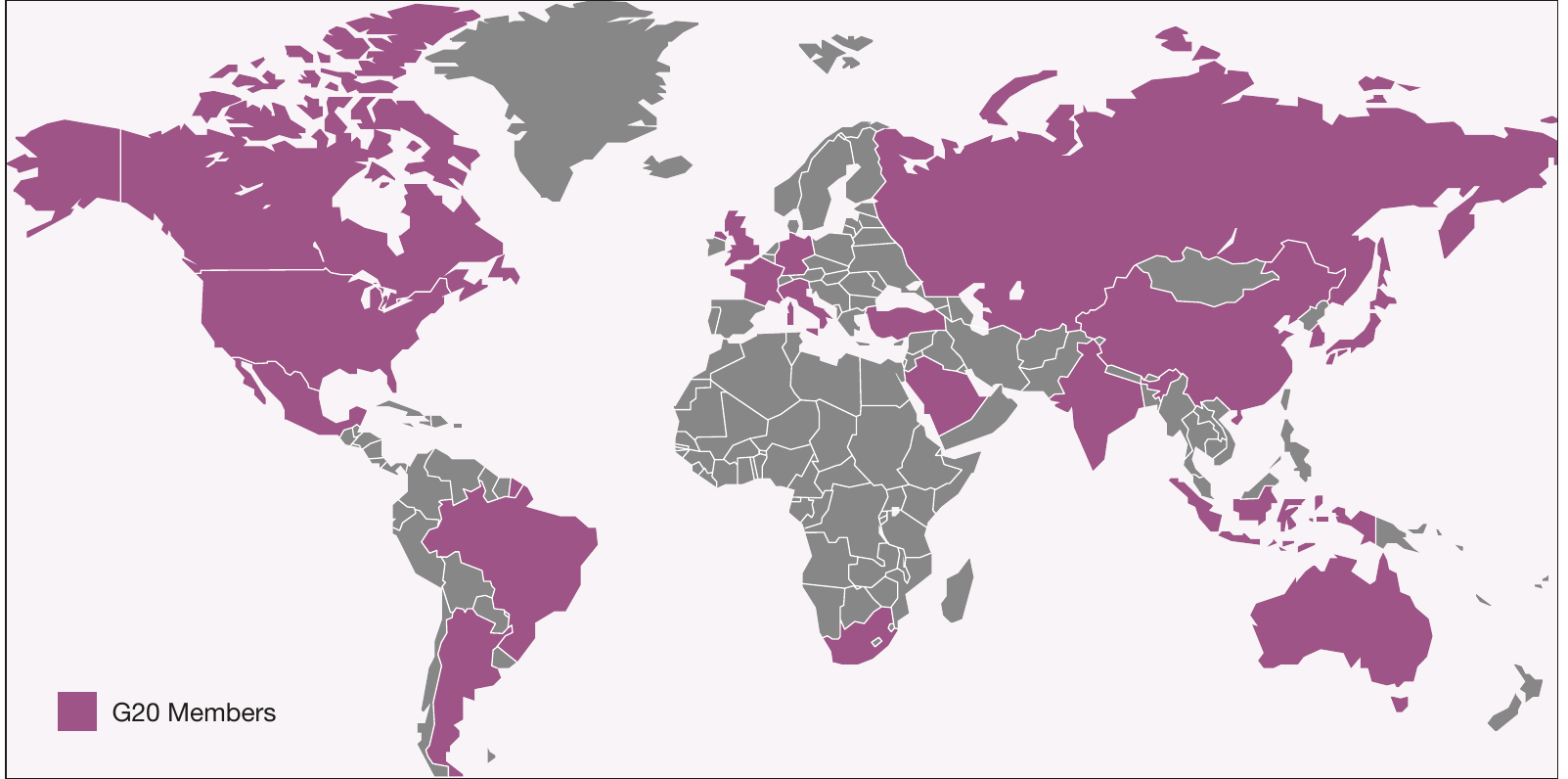
The G20 provides broader representation than the G7, including 19 of the world's largest national economies plus the European Union. This gives the forum significantly greater global economic coverage:
- Approximately 85% of world GDP
- 65% of the world's population
Crucially, the G20 membership includes several emerging economies that have been driving forces behind world economic growth since 2008. This makes it more representative of the actual balance of economic power in the contemporary global economy.
Key achievements and role
The G20 has demonstrated its capacity for effective coordination during major crises. During the 2009 global financial crisis, the forum played a pivotal role in the international response. It helped coordinate fiscal stimulus measures across member countries and worked to improve supervision of the global financial system and international financial institutions.
Example
Success Story: G20 Tax Reform Achievement
In 2021, the G20 achieved important agreements on tax reform in partnership with the OECD. This resulted in:
- A minimum global corporate tax rate
- Measures designed to reduce tax avoidance by multinational corporations
These reforms addressed concerns about tax competition between nations and the ability of large companies to minimise their tax obligations.
The G20 has also coordinated on development issues. Member nations agreed on measures to provide large-scale debt relief for developing countries, working in conjunction with the World Bank and IMF. This recognition of the need to support poorer nations reflects the G20's broader perspective compared to the G7.
Limitations and challenges
Despite these achievements, the G20 faces structural limitations that affect its effectiveness. Following the COVID-19 pandemic, international economic cooperation weakened considerably. Countries mostly determined their economic policy responses at the national level rather than through coordinated international action. This represented a less central role for the G20 compared to its response to the 2009 financial crisis.
Important
Structural Weaknesses of the G20
The forum lacks permanent leadership and headquarters, which limits its ability to drive ongoing policy coordination. Its main activity is the annual summit, which typically addresses a wide range of current issues rather than advancing specific economic goals. This means the G20's effectiveness relies heavily on individual heads of state providing momentum and leadership to work together on particular global challenges.
Exam tip: When comparing the G7 and G20, focus on representation (who's included), global coverage (GDP and population shares), and effectiveness (specific achievements and limitations). Use recent examples like COVID-19 or the financial crisis to support your analysis.
Remember!
Summary
Key Points to Remember:
-
Government economic forums coordinate policies between major economies, especially during crises, bringing together heads of state, finance ministers and central bank governors
-
The G7 consists of seven wealthy industrialised nations but has declining relevance, with its share of global GDP falling from 68% (1992) to 43% (2023) and covering only 10% of world population
-
The G20 provides broader representation with 19 major economies plus the EU, covering approximately 85% of world GDP and 65% of world population
-
The G20 played a crucial role coordinating responses to the 2009 financial crisis and has achieved agreements on global tax reform and debt relief
-
International economic cooperation has weakened in recent years, with both forums facing challenges in providing effective leadership during the COVID-19 pandemic