Trade Agreements (HSC SSCE Economics): Revision Notes
📚Revision Notes
Trade Agreements
Trade agreements have become increasingly important as countries seek to expand their trade opportunities and avoid being excluded from emerging trading blocs. These agreements range from bilateral arrangements between two countries to large multilateral regional agreements and global agreements coordinated through the World Trade Organization.
Understanding trade agreements
Trade agreements are formal arrangements between countries designed to reduce barriers to trade. While often called "free trade agreements" (FTAs), they are more accurately described as preferential trade agreements because they provide more favourable access to goods and services from specific nations or groups of nations compared to others.
Bilateral agreements involve two countries, while multilateral or regional agreements involve three or more economies. In contrast to preferential arrangements, global free trade agreements conducted through the World Trade Organization aim to remove barriers to trade uniformly across all economies.
Note
A trade bloc occurs when multiple countries join together in a formal preferential trading arrangement that excludes other countries. Examples include the European Union and the United States-Mexico-Canada Agreement (USMCA).
Growth of trade agreements
Regional trade agreements have proliferated dramatically in recent decades. The number of agreements registered with the World Trade Organization jumped from just 27 in 1990 to 585 in 2023. More than half of international trade is now covered by regional trade agreements.
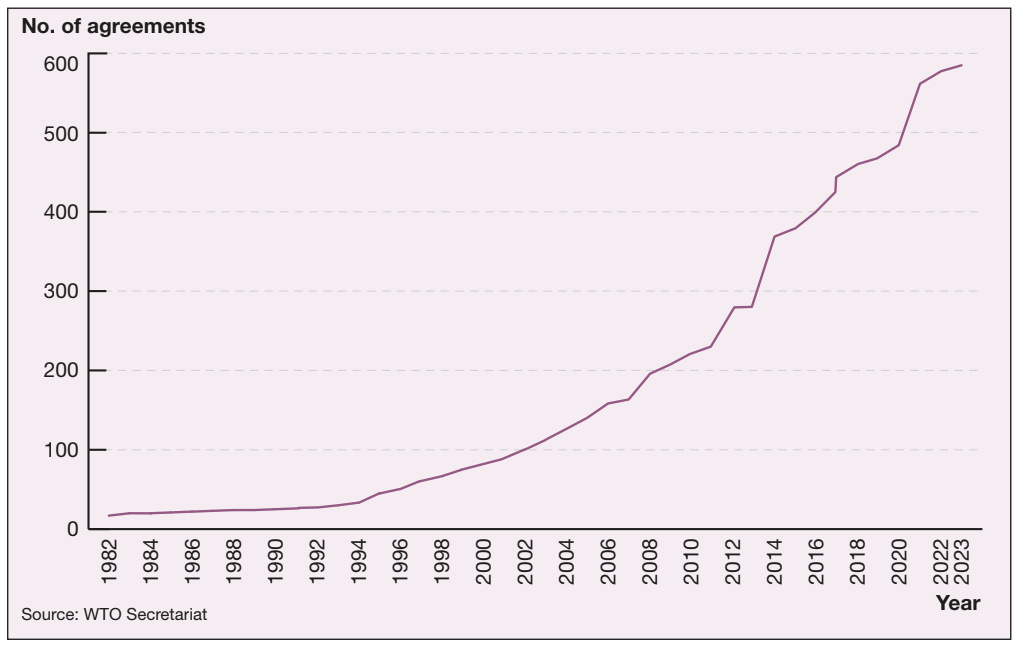
This rapid growth has led economists to argue that regionalisation is becoming as important as globalisation in understanding current developments in global trade relations. While trade typically increases faster between countries with trade agreements, concerns exist about trade diversion – where a country's imports switch from the most efficient producer to a less efficient one with whom a regional trade agreement exists.
Note
The extent of intra-regional trade varies considerably between trading blocs. Around 60 per cent of European Union exports go to other EU members. By contrast, ASEAN economies conduct approximately three-quarters of their trade with countries outside their region, reflecting their focus on exports to industrialised economies.
While trading with neighbouring countries offers economic efficiencies through lower transport costs, there are risks that regional trade blocs could fragment global trade into self-contained regions, hindering the spread of free trade.
Major multilateral and regional agreements
Trans-Pacific Partnership (CP-TPP or TPP-11)
The Comprehensive and Progressive Agreement for Trans-Pacific Partnership (commonly known as CP-TPP or TPP-11) is a multilateral trade agreement among 11 Pacific Rim countries formally signed in March 2018. Its members are Australia, Brunei, Canada, Chile, Japan, Malaysia, Mexico, New Zealand, Peru, Singapore and Vietnam.
The agreement represents:
- 14 per cent of global economic output
- Around 15 per cent of global trade
- A market of over 500 million people
- 22 per cent of all Australian trade
Despite covering only 6 per cent of the global population, the TPP-11 economies make a significant contribution to global trade. The agreement was designed to lower 18,000 tariffs, representing over 98 per cent of all tariffs within the free trade area. However, its significance was reduced following the United States' withdrawal in 2017.
Note
The TPP-11 lacks a clear implementation timeline, with some members having up to 10 years to implement their commitments. The agreement includes controversial provisions giving corporations the right to sue governments for policy decisions that might harm their investments.
In 2022, President Biden announced the Indo-Pacific Economic Framework (IPEF), a new economic pact comprising mostly the same members as the TPP. The IPEF focuses less on tariffs and market access and more on strengthening supply chains, promoting infrastructure investment, cooperating on tax rules and fighting corruption.
Regional Comprehensive Economic Partnership (RCEP)
The RCEP is the world's largest multilateral trade agreement by share of global economy, surpassing the TPP-11, EU and USMCA. It commenced in 2022 and was in effect for all 15 members by June 2023, after almost a decade of negotiations.
RCEP comprises 15 economies: China (which led its formation), all ASEAN nations, Japan, South Korea, Australia and New Zealand. India participated in negotiations but withdrew in 2019.
The agreement accounts for:
- One-quarter of global trade
- 30 per cent of the world's population
- 30 per cent of global GDP
- 59 per cent of Australia's two-way trade
- 73 per cent of Australia's goods and services exports
Note
The World Economic Forum estimates the RCEP will remove 91 per cent of tariffs on goods traded in the region. UNCTAD has estimated it will boost intra-regional trade by 2 per cent, creating new trade worth US$17 billion and diverting existing trade worth US$25 billion.
Asia-Pacific Economic Cooperation (APEC) forum
Established in the early 1990s in response to trading blocs forming in other regions, the APEC forum brings together 21 member economies: Australia, Brunei, Canada, Chile, China, Hong Kong, Indonesia, Japan, Malaysia, Mexico, New Zealand, Papua New Guinea, Peru, the Philippines, Russia, Singapore, South Korea, Taiwan, Thailand, the United States and Vietnam.
Despite having only 21 members, APEC accounts for:
- Almost 40 per cent of the world's population (2.9 billion people)
- Over 60 per cent of world GDP
- Around three-quarters of Australia's total trade in goods and services
The APEC forum's original vision of establishing free trade among member countries by 2020 was not achieved. A 2019 PricewaterhouseCoopers report noted almost $800 billion of non-tariff trade barriers remain across APEC nations. Nevertheless, APEC has contributed to progress on trade liberalisation, with UNCTAD estimating that average tariff rates fell from 10.2 per cent in 1999 to 5.2 per cent in 2020.
Note
APEC operates on the principle of non-discriminatory arrangements, meaning nations will trade with countries outside the grouping on the same basis as members if they provide equal market access. This contrasts with trade blocs like the EU, which increase barriers for external countries.
Although APEC meetings have never resulted in a regional trade agreement, they have created a forum for annual leader meetings and helped develop other agreements such as the CP-TPP.
Association of South-East Asian Nations (ASEAN)
Established in 1967, ASEAN covers emerging and developing economies in South-East Asia and has become the most effective force for trade negotiations within the Asia Pacific region. The ASEAN Free Trade Area (AFTA) comprises Indonesia, Thailand, Malaysia, Singapore, Philippines, Vietnam, Brunei, Burma, Cambodia and Laos.
The ASEAN-Australia-New Zealand Free Trade Area (AANZFTA) agreement came into effect in 2010, with ASEAN nations committing to lower and eliminate tariffs on 96 per cent of Australian exports to the region (compared to 67 per cent previously).
Collectively, the ASEAN region has:
- A population of 690 million across 12 countries
- Combined GDP of $4.5 trillion (almost 5 per cent of the global economy)
- 11 per cent of Australia's two-way trade volumes (as of 2021)
Pacific Agreement on Closer Economic Relations Plus (PACER Plus)
PACER Plus is a multilateral trade agreement comprised of 11 Pacific Island Forum members: Australia, Cook Islands, Kiribati, Nauru, New Zealand, Niue, Samoa, Solomon Islands, Tonga, Tuvalu and Vanuatu.
Note
Unlike most trade agreements, PACER Plus places specific emphasis on economic development, integrating foreign aid programs from Australia and New Zealand to assist with agricultural development, financial stability, trade infrastructure and implementation of the agreement itself. At ratification, it represented $2.1 trillion in GDP and $30 billion of Australia's two-way trade.
The European Union
The European Union is the most important trade bloc in the world economy. Its 27 member countries span the European continent, with a combined population of 450 million accounting for around 15 per cent of world trade in goods – a market similar in size to the United States.
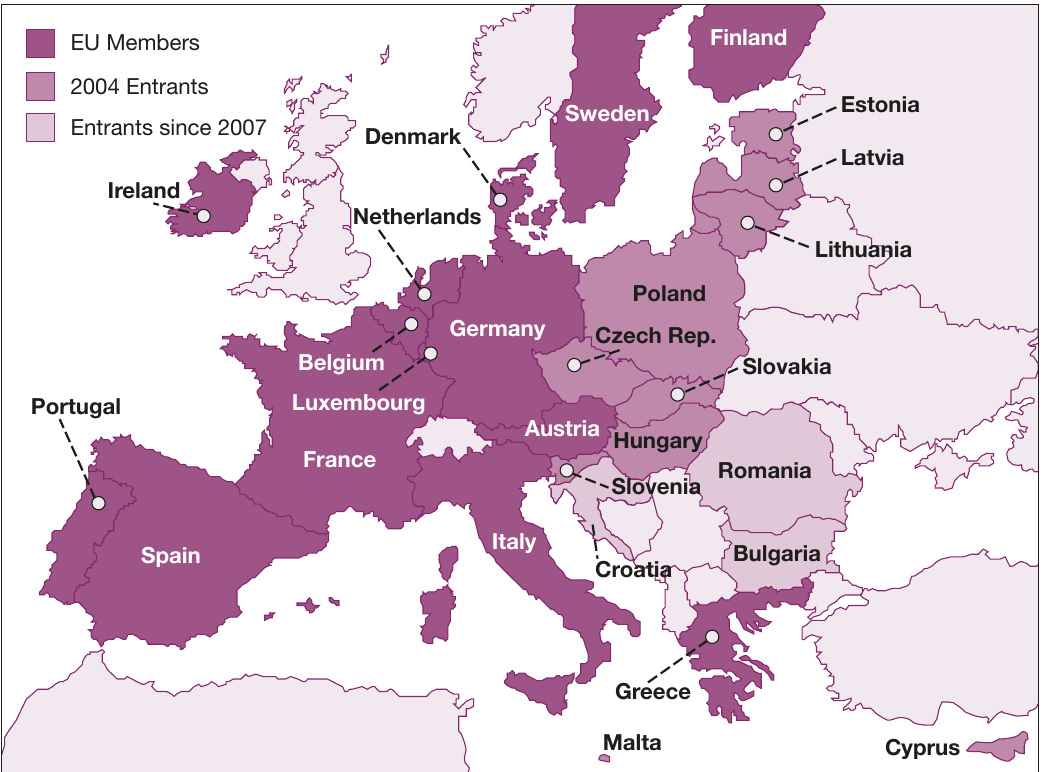
Eight additional candidate countries have begun negotiating potential EU membership: Albania, Bosnia and Herzegovina, Moldova, Montenegro, North Macedonia, Serbia, Türkiye and Ukraine. Although the EU represents 17 per cent of global GDP, it has been weakened by the departure of the United Kingdom, one of its largest members.
The EU's formation in the late 1950s (formerly the European Economic Community) helped dismantle trade barriers within Europe. A single market for goods and services was established in 1992, driving strong trade growth within the EU. However, the EU frequently uses tariff barriers against non-member countries, leading to accusations that it is a closed trading bloc.
Important
The EU applies particularly high rates of protection to agricultural products. Direct subsidies and rural support under the Common Agricultural Policy absorb around one-third of the EU's total budget, at a total cost of US$436 billion between 2021 and 2027. This policy has been criticised by agricultural trading countries worldwide, including Australia, and the United States has used it to justify its own continuation of farm subsidies.
Within the EU, 20 member countries participate in a voluntary monetary union (the eurozone), adopting a common currency (the euro) and common interest rates. While successful in promoting trade and economic integration, slower growth rates in EU economies (averaging just 1.1 per cent per year in the decade to 2022) have meant its share of world output has almost halved since 1980.
Other regional agreements
Two other significant regional agreements operate on other continents:
US-Mexico-Canada Agreement (USMCA): Previously known as NAFTA (North American Free Trade Agreement), this three-country trade deal contributed to trade values more than tripling between the economies in the 25 years after its introduction. The agreement was renegotiated and re-branded as the USMCA, coming into effect from 2020 with minor revisions addressing digital trade, corruption and intellectual property.
African Continental Free-Trade Area (AfCFTA): With 55 countries and 1.3 billion people, AfCFTA has the largest number of member economies of any regional trading agreement. Its combined GDP is US$3.4 trillion. AfCFTA came into force in 2021, with the goal of eliminating 90 per cent of tariffs between member economies. The World Bank estimates it will boost the regional economy by 7 per cent by 2035, lifting GDP by $450 billion and bringing 30 million people out of extreme poverty. However, its impact depends on successful implementation in each country.
Bilateral trade agreements
In addition to global and regional agreements, economies enter into bilateral agreements between two countries. Australia's most far-reaching bilateral agreement is the Closer Economic Relations Trade Agreement (CERTA) with New Zealand, which began in 1983. CERTA is one of the most comprehensive free trade agreements in the world, prohibiting all tariffs and export restrictions. It has gradually extended to include harmonisation of business regulations and tax laws. Since 1983, it has contributed to an average annual increase in trade between Australia and New Zealand of around 7 per cent and is widely regarded as successful.
Bilateral trade agreements have experienced a resurgence in recent years. This reflects the loss of momentum around multilateral agreements and the United States' increased use of its economic power to negotiate more favourable trade relationships on a country-by-country basis. These agreements are often as much about shoring up open trading arrangements against rising protectionism as unlocking new trading opportunities.
Note
In the past decade, Australia has concluded nine new bilateral agreements with Malaysia (2013), South Korea (2014), Japan and China (2015), Peru, Hong Kong and Indonesia (2020), India (2022) and the United Kingdom (2023).
The Australia-UK Free Trade Agreement
The Australia-UK Free Trade Agreement came into effect in 2023, eliminating tariffs on 99 per cent of Australian exports to the UK. Tariffs on imports from the UK are also being phased out, with all UK imports entering Australia duty-free after five years. This is expected to save approximately $200 million per year, helping ease cost-of-living pressures for households and input costs for businesses.
However, the economic impact is likely to be relatively small, with the UK estimating it would add just 0.08 per cent per year to GDP by 2035.
Debate over bilateral agreements
Economists are divided over whether bilateral trade agreements assist or obstruct progress towards global free trade. A 2017 Productivity Commission study, Rising protectionism: challenges, threats and opportunities for Australia, noted that although governments often claim large increases in trade will result, the actual impact is often much smaller because:
- Benefits are frequently exaggerated
- Costs of establishing and implementing agreements are underestimated
- Bilateral agreements can contribute to greater "trade diversion" rather than adding to overall world trade
Note
Nevertheless, pursuing bilateral trade agreements remains a key component of Australia's trade policy, particularly given the weakened state of the WTO in recent years. One advantage of bilateral agreements is that they are generally much faster to conclude than multilateral agreements (although the 10-year China-Australia FTA negotiations show this is not always the case).
Important
Australia's experience with China has highlighted that bilateral agreements do not guarantee harmonious relationships. Nothing in the bilateral agreement prevented China from imposing punitive tariffs and trade barriers on Australian exports of barley, wine, coal, timber and lobster in recent years.
Challenges in the global trading system
Trade diversion
Trade diversion occurs when a country's imports of a good or service switch from the most efficient producer to a less efficient one because of a trade agreement's provisions, such as tariff levels, import quotas or other rules. This can reduce overall economic efficiency even while increasing trade between agreement partners.
China-US trade tensions
As China's economic power has grown, it has come into increasing conflict with the United States, which argues that China engages in unfair and illegal trading practices. China and the US are the world's two largest trading nations, but a large trade imbalance exists: in 2022, the US bought US$537 billion of Chinese exports while China bought just US$154 billion of American exports.
Example
Example: Escalating Trade Tensions
Under President Trump, the two countries imposed significant sanctions on each other's trade. By the end of 2020, America's average tariffs on Chinese products had risen from around 3 per cent to 20 per cent, according to the Peterson Institute of International Economics. China imposed tariffs on more than half of imports from the US.
Under President Biden, tariffs on billions of dollars of Chinese imports have been retained. The Biden Administration is seeking to reduce reliance on Chinese imports in key areas of technology and manufacturing, including advanced computer chips and clean energy.
Stepping stones or stumbling blocks?
Economists disagree on whether regional and bilateral trade agreements help or hinder progress towards global free trade:
Important
Arguments that they hinder progress:
- They slice the world into separate trading areas
- They may obstruct movement towards global free trade
- Post-COVID, momentum for trade liberalisation has weakened as governments focus on supply chain security and increasing local production
Arguments that they help progress:
- They act as stepping stones, initially convincing economies to reduce protection barriers against a small group, eventually encouraging broader liberalisation
- They provide practical benefits through tariff elimination and increased market access
- They can complement multilateral efforts and provide lessons applicable in the multilateral context
Note
Recent shifts in thinking:
Some policymakers have begun questioning the traditional approach to trade liberalisation. They note that while some sectors have benefited, the aggressive approach to liberalisation and tariff elimination has had significant costs: concentration of wealth, fragile supply chains, de-industrialisation, offshoring and decimation of manufacturing communities. This has led to calls for trade policy to focus on more than just unfettered liberalisation, cheap goods and maximising efficiencies.
Remember!
Summary
Key Points to Remember:
-
Trade agreements break down barriers between countries and can be bilateral (two countries), multilateral/regional (three or more), or global (through the WTO)
-
Preferential trade agreements give more favourable access to specific nations compared to others, while trade blocs exclude non-member countries from preferential arrangements
-
Regional trade agreements have grown dramatically from 27 in 1990 to 585 in 2023, with more than half of international trade now covered by such agreements
-
Major agreements include the TPP-11, RCEP (world's largest by economic share), APEC forum, ASEAN, EU and USMCA
-
Trade diversion can occur when imports switch from the most efficient producer to a less efficient one due to agreement provisions
-
Bilateral agreements have resurged in recent years, with Australia concluding nine new agreements since 2013, though their economic impact is often smaller than claimed
-
Economists debate whether regional and bilateral agreements are stepping stones to global free trade or stumbling blocks that fragment world trade
-
The practical impact varies: agreements can reduce tariffs and increase trade between partners, but may not guarantee harmonious relationships (as shown by China-Australia tensions)