Global Maximum and Minimum (HSC SSCE Mathematics Advanced): Revision Notes
📚Revision Notes
Global Maximum and Minimum
Introduction
Think of mountain ranges with multiple peaks across different regions. Each individual peak represents a local maximum because it is the highest point compared to its immediate surroundings. For instance, Mount Kosciuszko is Australia's tallest mountain and represents a local maximum for the Australian continent. However, it is not the global maximum because taller mountains exist on other continents. Mount Everest in Asia holds the title of global maximum because it is the highest mountain peak in the entire world.
Note
This mountain analogy illustrates a crucial concept: something can be the highest in its local area without being the highest overall. The same principle applies to mathematical functions - a point can be a local extremum without being a global extremum.
This real-world example helps us understand the mathematical concepts of local versus global extrema. A function can have multiple local maximum and minimum points, but only certain points (or possibly none) qualify as the global, or absolute, maximum and minimum values.
Definitions
Understanding the formal definitions is essential for identifying global extrema correctly.
Global maximum: Let be a point on the curve . Point is called a global maximum (or absolute maximum) if the function value at is greater than or equal to every other function value in the domain. Mathematically, this means:
Global minimum: Similarly, point is called a global minimum (or absolute minimum) if the function value at is less than or equal to every other function value in the domain. This means:
Important
Key Distinction: The scope of comparison differs fundamentally between local and global extrema:
- Local extrema are the highest or lowest points within a small neighbourhood
- Global extrema are the highest or lowest points across the entire domain of the function
Understanding global extrema through examples
Case 1: Unrestricted domain
Consider a function whose domain includes all real numbers, as illustrated in the diagram below.
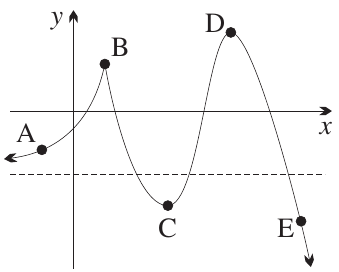
Let's analyse the key features of this curve:
Local maxima: The curve has local maximum values at two locations. Point is a local maximum where the derivative is undefined (this could represent a sharp corner or cusp). Point is also a local maximum, occurring at a turning point where .
Global maximum: Among all the local maxima, point has the highest function value. Since the curve doesn't reach any higher value anywhere in its domain, point is the global maximum.
Local minimum: There is a local minimum at turning point . This point is lower than all points on the curve extending leftward past point .
Note
Why No Global Minimum Exists:
The curve continues infinitely downward to the right of point . No matter how low point might be, there are always points further right with even lower function values. This means no single point can claim to have the lowest value across the entire domain.
Global minimum: Importantly, there is no global minimum for this function. Why? Because the curve continues infinitely downward to the right of point . No matter how low point might be, there are always points further right with even lower function values.
Case 2: Restricted domain
Now consider a function defined on a closed interval, specifically from point to point on the -axis.
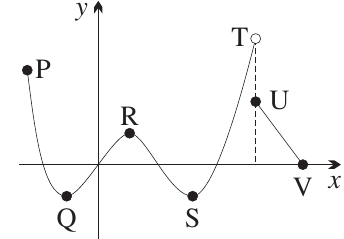
This case introduces additional complexity:
Local maxima: The curve has a local maximum at turning point where . Additionally, the left endpoint is also a local maximum because it is higher than nearby points on the curve.
Global maximum: Interestingly, despite having local maxima, this function has no global maximum. Point has been omitted from the curve (indicated by the open circle), meaning the function never actually reaches this highest value.
Local minima: There are local minima at two turning points, and , as well as at the right endpoint .
Important
Multiple Global Extrema:
Both points and have exactly equal function values, and these values are lower than all other points on the curve. Therefore, both points simultaneously qualify as global minima. This demonstrates that a function can have more than one global minimum (or maximum) if multiple points share the same extreme value.
Global minima: Both points and have exactly equal function values, and these values are lower than all other points on the curve. Therefore, both points simultaneously qualify as global minima. This demonstrates that a function can have more than one global minimum (or maximum) if multiple points share the same extreme value.
Key lesson: When working with restricted domains, always remember to evaluate the function at the endpoints, as these boundary points can be global extrema.
Finding global maximum and minimum
To systematically find the global maximum and minimum of a function, you need to identify and compare three types of critical points:
- Turning points: These are points where . The function changes from increasing to decreasing (local maximum) or from decreasing to increasing (local minimum) at these points.
- Boundaries of the domain: If the function is defined on a restricted domain, evaluate the function at all endpoints. For unrestricted domains, examine the behaviour as approaches positive or negative infinity.
- Discontinuities of : These occur at sharp corners, cusps, or where the derivative is undefined. The function might still be continuous at these points, but the derivative is not.
Important
Systematic Procedure:
Follow these steps to find global extrema:
- Find all turning points by solving
- Identify any points where is undefined
- Evaluate the function at all domain boundaries
- Calculate at each of these critical points
- Compare all the function values
- The highest value is the global maximum
- The lowest value is the global minimum
Remember: A global maximum or minimum might not exist if the function values extend infinitely in either direction, or if critical values are excluded from the domain.
Worked examples
Example
Worked Example 1: Quadratic function on a closed interval
Problem: Find the absolute maximum and minimum of over the domain .
Note: Since this function is a quadratic, we can solve it using parabola properties without needing calculus.
Solution:
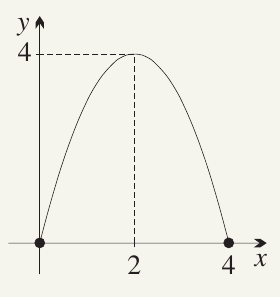
The function can be rewritten as . The coefficient of is negative, so this is a concave-down parabola (opening downward).
Step 1: Factor the function
Step 2: Find the x-intercepts
The -intercepts occur when :
Step 3: Find the axis of symmetry
For a parabola, the axis of symmetry lies exactly halfway between the two -intercepts:
Step 4: Calculate the vertex
Substituting into the function to find the -coordinate of the vertex:
So the vertex is at .
Step 5: Compare critical values
Since the parabola is concave-down, the vertex at is the highest point on the curve.
The domain is restricted to , so we must check the endpoints:
- At :
- At :
Comparing all critical values:
- Vertex:
- Left endpoint:
- Right endpoint:
Answer: The absolute maximum is 4 at x = 2, and the absolute minimum is 0 at both endpoints where x = 0 and x = 4.
Example
Worked Example 2: Cubic function on a closed interval
Problem: Find the global maximum and minimum of the function where .
Solution:
Using curve-sketching techniques, we can identify that this cubic function has turning points that have been previously analysed. The curve shows:
- A local maximum at
- A local minimum at
Step 1: Evaluate at the left boundary
At :
Step 2: Evaluate at the right boundary
At :
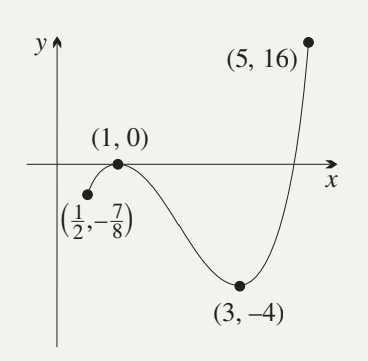
Step 3: Compare all critical values
- Left boundary:
- Local maximum:
- Local minimum:
- Right boundary:
Step 4: Identify global extrema
The highest value occurs at the right endpoint:
The lowest value occurs at the turning point:
Answer: The global maximum is 16 at x = 5, and the global minimum is -4 at x = 3.
Key Insight: This example demonstrates that global extrema don't always occur at turning points. The global maximum here is at a boundary point, not at a local maximum found using calculus.
Summary
Key Points to Remember:
-
Scope of comparison: Global extrema compare across the entire domain, while local extrema only compare within a small neighbourhood.
-
Three types of critical points to check: Always examine turning points (where ), domain boundaries or endpoints, and any discontinuities in .
-
Boundary points matter: On restricted domains, endpoints can be global maxima or minima even if they're not turning points.
-
Multiple global extrema are possible: Two or more points can share the same global maximum or minimum value if they have exactly equal function values.
-
Global extrema might not exist: If the function extends infinitely upward or downward, or if extreme values are excluded from the domain (open circles), global extrema may not exist.