Systematic Curve Sketching with the Derivative (HSC SSCE Mathematics Advanced): Revision Notes
📚Revision Notes
Systematic Curve Sketching with the Derivative
Introduction to systematic curve sketching
When sketching unfamiliar curves, we can use a systematic approach that combines earlier non-calculus methods with calculus techniques. Previously, we used a four-step approach focusing on domain, symmetry, intercepts and asymptotes. Now we extend this by adding derivative analysis to examine gradient, concavity, turning points and inflections.
Most functions don't require all seven steps shown below. Typically, you'll be guided on which methods are most relevant for a particular function.
Note
This systematic approach has limitations - for example, it only detects symmetry about the y-axis, and doesn't account for periodic behaviour in trigonometric functions.
The seven-step systematic method
This comprehensive approach combines non-calculus and calculus techniques:
Step 1: Domain
Determine where the function is defined.
Find all x-values for which exists. Always do this step first, as it affects all subsequent analysis. Look for:
- Values that make denominators zero
- Values that create negative numbers under even roots
- Values outside the domain of inverse trigonometric functions
Step 2: Symmetry
Test whether the function is even, odd, or neither.
- A function is even if for all x in the domain (symmetric about the y-axis)
- A function is odd if for all x in the domain (symmetric about the origin)
- Most functions are neither even nor odd
Understanding symmetry can reduce the work needed in later steps.
Step 3: Intercepts and sign
Part A: Find where the curve crosses the axes
- y-intercept: Substitute into the function
- x-intercepts (zeroes): Solve
Part B: Determine where the function is positive and negative
Create a table of test values. Select x-values in each interval created by the x-intercepts and discontinuities, then evaluate to determine the sign in each region.
This tells you which parts of the curve are above the x-axis (positive) and which are below (negative).
Step 4: Asymptotes
Part A: Vertical asymptotes
Check each discontinuity (where the function is undefined). If as x approaches the discontinuity from either side, there's a vertical asymptote at that x-value.
Part B: Horizontal asymptotes
Examine what happens to as:
- (right-hand behaviour)
- (left-hand behaviour)
If approaches a constant value L, then is a horizontal asymptote.
Step 5: The first derivative
Part A: Find critical points
Calculate , then find:
- Where (stationary points)
- Where is undefined (potential corners or cusps)
Part B: Analyse gradient throughout the domain
Create a table of slopes by testing values of in intervals between critical points:
- Where : function is increasing (/)
- Where : stationary point (—)
- Where : function is decreasing ()
This analysis reveals:
- Whether stationary points are maxima, minima, or horizontal inflections
- Intervals where the function rises or falls
Important
Common Mistake: Points where the derivative is undefined are NOT stationary points. Stationary points occur only where .
Step 6: The second derivative
Part A: Find potential inflection points
Calculate , then find:
- Where (possible inflection points)
- Where is undefined
Part B: Analyse concavity throughout the domain
Create a table of concavity by testing values of :
- Where : curve is concave up (∪)
- Where : possible inflection point
- Where : curve is concave down (∩)
An inflection point occurs where concavity changes (where changes sign).
Step 7: Any other features
Be aware that this systematic method doesn't capture all important features:
- Axes of symmetry that aren't the y-axis
- Periodic behaviour in trigonometric functions
- Other special characteristics specific to certain function types
Worked example: A curve with turning points and asymptotes
Example
Worked Example: Analysing a Rational Function with Asymptotes
Let's apply this systematic approach to a rational function that has multiple asymptotes and a turning point. This example demonstrates how calculus and non-calculus methods work together.
Consider the curve .
Part a: Domain
The function is undefined where the denominator equals zero.
Setting :
- or
Domain: all real numbers except and
In interval notation:
Part b: Sign analysis
The function never equals zero (the numerator is always 1), and has discontinuities at and .
We test values in each interval:
| * | * |
The asterisks (*) indicate discontinuities where the function is undefined.
Conclusion:
- (positive) when or
- (negative) when
Part c: Asymptotes
Vertical asymptotes:
At the discontinuities and , the function approaches infinity, so there are vertical asymptotes at these values.
Horizontal asymptote:
As : the denominator grows much faster than the numerator, so
As : similarly,
Therefore, the x-axis () is a horizontal asymptote.
Part d: Finding the derivative
To find , we use the chain rule.
Let
Then
Therefore:
By the chain rule:
Part e: First derivative analysis
The derivative has:
- Zero at (numerator equals zero)
- Discontinuities at and (denominator equals zero)
We test values in each interval:
| * | * | ||||||
| slope | / | * | / | — | \ | * | \ |
Where:
- / indicates increasing (positive gradient)
- — indicates stationary point (zero gradient)
- \ indicates decreasing (negative gradient)
-
- indicates discontinuity
Interpretation:
At :
Since the gradient changes from positive to zero to negative, there is a maximum turning point at .
The function is:
- Increasing for (except at where it's undefined)
- Decreasing for (except at where it's undefined)
Part f: Sketch and range
The complete sketch shows:
- Vertical asymptotes at (the y-axis) and (shown as dashed lines)
- Horizontal asymptote at (the x-axis)
- Maximum turning point at
- Function approaching as x approaches 0 from the left and as x approaches 4 from the right
- Function approaching as x approaches 0 from the right and as x approaches 4 from the left
From the graph, we can see the function takes all positive values above the horizontal asymptote, and all negative values at or below the maximum's y-coordinate.
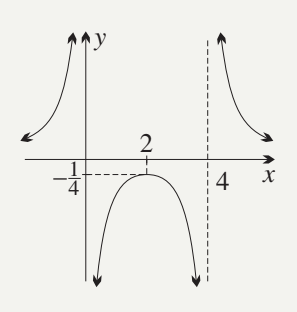
Range: or
In interval notation:
Exam tips
Note
Key Strategies for Success:
- Always start with the domain - this is crucial for identifying discontinuities and asymptotes
- Use tables systematically - they help organize your analysis and reduce errors
- Check the sign of the derivative carefully in each interval to correctly identify turning points
- Sketch asymptotes as dashed lines to distinguish them from the curve
- When finding the range, use your completed graph - the visual representation makes it clearer
- The denominator of a rational function being zero often indicates vertical asymptotes
Summary
Key Points to Remember:
- Seven systematic steps: Domain first (always), then symmetry, intercepts and sign, asymptotes, first derivative analysis, second derivative analysis, and finally check for other features
- Tables are essential: Use sign tables to find where functions are positive/negative, and slope tables to find where functions increase/decrease
- Critical points occur: Where (stationary points) or where is undefined
- Asymptotes appear: Vertically at discontinuities where the function approaches infinity, and horizontally where the function approaches a constant as
- Maximum or minimum? Check how the gradient changes: positive to zero to negative indicates a maximum; negative to zero to positive indicates a minimum
- This method has limitations: It doesn't capture all features like periodicity or non-y-axis symmetry, so always consider the specific function type you're working with