Combinations of Transformations (HSC SSCE Mathematics Advanced): Revision Notes
📚Revision Notes
Combinations of Transformations
Introduction
When working with graphs, we can apply multiple transformations one after the other. In this topic, we'll explore how different transformations interact and whether the order in which we apply them affects the final result.
Note
For this section, we'll treat reflections in the axes as dilations with factor . A rotation of about the origin is equivalent to two reflections. This simplifies our work to focus on four main types of transformations: two translations (horizontal and vertical) and two dilations (horizontal and vertical).
Understanding commuting transformations
Important
Two transformations are said to commute if they produce the same final result regardless of the order in which they are applied. This is an important concept because it tells us when we can rearrange the order of transformations without changing the outcome.
Summary of transformations
Before exploring combinations, let's review the four basic transformations and how they're applied:
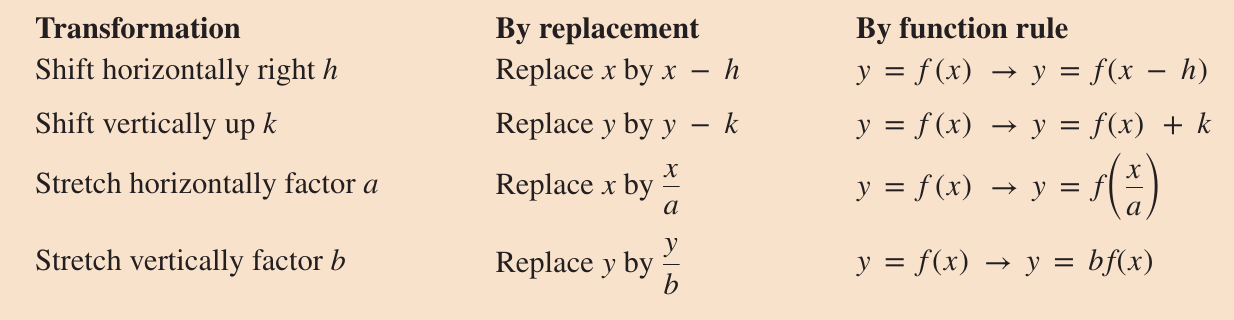
Each transformation can be expressed either by variable replacement or by function rule notation. Understanding both methods will help you work flexibly with transformations.
When transformations commute
Two translations always commute
When applying two translations (shifts) to a graph, the order doesn't matter. You'll always get the same result.
Example
Worked Example: Translations with parabola
Consider shifting the parabola right 3 units and down 1 unit.
Method 1: Shift right first, then down
- Shifting right 3:
- Then shifting down 1: , which gives
Method 2: Shift down first, then right
- Shifting down 1: , which gives
- Then shifting right 3:
Both methods produce the same equation:
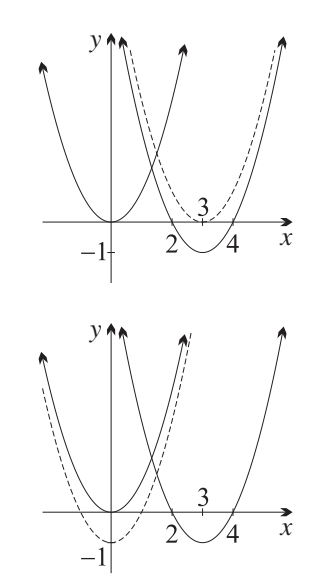
This demonstrates that horizontal and vertical translations can be applied in either order.
Two dilations always commute
Similarly, when applying two dilations (stretches) to a graph, the order of application doesn't affect the final result.
Example
Worked Example: Dilations with circle
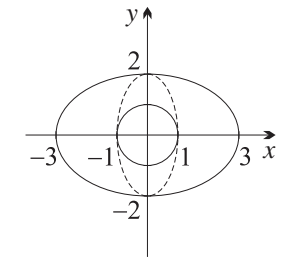
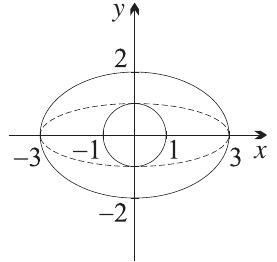
Consider stretching the circle vertically by factor 2 and horizontally by factor 3.
Method 1: Vertical stretch first, then horizontal
- Stretching vertically by factor 2: , which simplifies to
- Then stretching horizontally by factor 3: , which gives
Method 2: Horizontal stretch first, then vertical
- Stretching horizontally by factor 3:
- Then stretching vertically by factor 2:
Both methods produce the same equation:
Cross-direction transformations commute
A horizontal dilation and a vertical translation will always commute. Similarly, a vertical dilation and a horizontal translation will commute.
Example
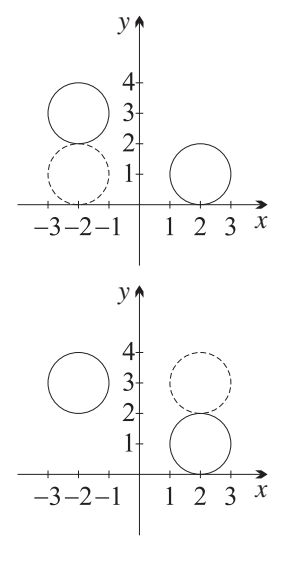
Worked Example: Cross-direction transformations with circle
Apply a reflection in the -axis (horizontal dilation with factor ), then shift up 2 units.
Method 1: Reflect first, then shift up
- Reflecting in the -axis: , which simplifies to
- Then shifting up 2: , giving
Method 2: Shift up first, then reflect
- Shifting up 2:
- Then reflecting in the -axis: , giving
Both methods produce:
Note
Summary of commuting transformations:
- Any two translations commute
- Any two dilations commute (including reflections)
- A translation and a dilation commute if one is vertical and the other horizontal
When transformations don't commute
Important
The critical case where order matters is when both transformations act in the same direction. Specifically:
- A vertical translation and a vertical dilation do not commute
- A horizontal translation and a horizontal dilation do not commute
Worked example: Horizontal transformations
Example
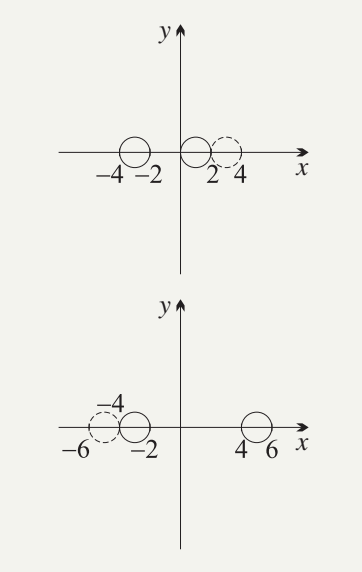
Worked Example: Non-commuting horizontal transformations
Problem: Apply a reflection in the -axis (horizontal dilation with factor ) and a translation left 2 units to the circle .
Part a: Reflect first, then translate left
Applying the reflection:
Then applying the translation left 2:
Part b: Translate left first, then reflect
Applying the translation left 2:
Then applying the reflection:
The final equations are different: versus
Example
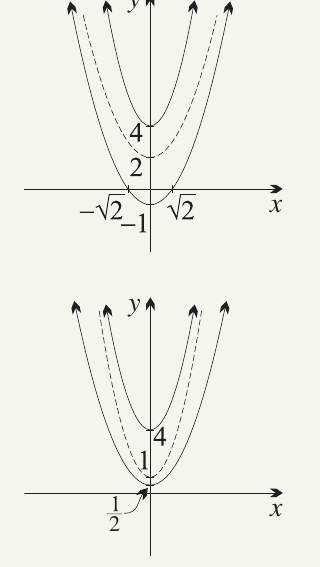
Worked Example: Non-commuting vertical transformations
Problem: Apply a vertical dilation with factor and a translation down 3 units to the parabola .
Part a: Dilate first, then translate down
Applying the dilation:
Then applying the translation down 3:
Part b: Translate down first, then dilate
Applying the translation down 3:
Then applying the dilation:
The final equations are different: versus
Important
Key rule for non-commuting transformations:
When a translation and a dilation both act in the same direction (both horizontal or both vertical), the order of application matters and produces different results.
Universal formula for combinations
For functions, there's a general formula that combines all four transformation types:
This formula applies the following transformations in sequence:
- Stretch horizontally with factor
- Shift left units
- Stretch vertically with factor
- Shift up units
Note
The vertical transformations (steps 3 and 4) can be done before the horizontal transformations (steps 1 and 2) because they commute.
Understanding the universal formula
Starting with :
- Stretching horizontally with factor gives:
- Shifting left gives:
- Stretching vertically with factor gives:
- Shifting up gives:
Alternative analysis:
You can also work backwards from the formula by progressive rewriting:
Starting with :
- Subtract :
- Divide by :
- Rewrite:
- Express as shifts:
Note
This formula is particularly useful for trigonometric functions and computer programs, but most problems are more easily solved using the standard transformation methods.
Remember!
Summary
Key Points to Remember:
-
Commuting transformations: Any two translations commute, any two dilations commute, and a horizontal transformation commutes with a vertical transformation
-
Non-commuting transformations: A translation and a dilation in the same direction (both horizontal or both vertical) do not commute—order matters!
-
Universal formula: combines all four transformations, but is trickier to use than applying transformations step by step
-
When order matters: Always check whether your transformations are in the same direction—if they are both horizontal or both vertical, the order of application will affect your final result
-
Practical approach: For most problems, apply transformations one at a time using the replacement method or function rule notation rather than trying to use the universal formula