Dilations (HSC SSCE Mathematics Advanced): Revision Notes
📚Revision Notes
Dilations
What is a dilation?
A dilation is a transformation that stretches or compresses a curve in one direction. For example, when you apply a dilation to a circle, it becomes an ellipse. Dilations are an important type of transformation, alongside translations and reflections. By combining these transformations, we can convert complex functions into simpler ones.
Stretching a graph vertically
Understanding vertical dilations
Let's compare two functions:
When we create a table of values for these functions, we notice something interesting:
Note
Every value in the second row is exactly three times the corresponding value in the first row. This means the graph of is obtained by stretching the graph of away from the -axis by a factor of 3.
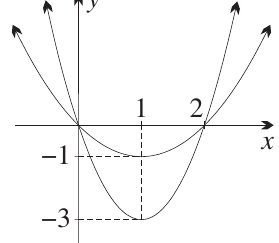
We can rewrite as . This shows that the stretching happens when we replace with .
The -axis is the axis of dilation. This means:
- Points on the -axis stay in place
- All other points triple their distance from the -axis
Important
Key box: Vertical dilations
To stretch a graph vertically by a factor of :
- Replace with
- Alternatively, if the graph is a function, the new function is
- The axis of dilation is the -axis (it doesn't move)
Stretching a graph horizontally
Understanding horizontal dilations
Similar to vertical stretching, we can stretch the graph of horizontally away from the -axis by a factor of 3. To do this, we replace with :
Let's compare the original and new functions using tables:
Original function:
New function:
Note
Notice that the -coordinates in both tables are identical, but we needed to triple the -coordinates to get the same -values.
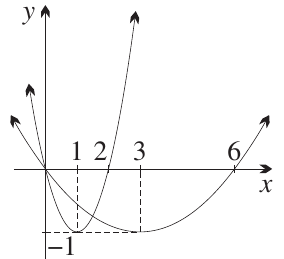
The -axis is the axis of dilation for horizontal dilations. This means:
- The point on the -axis doesn't move
- All other points triple their distance from the -axis
Important
Key box: Horizontal dilations
To stretch a graph horizontally by a factor of :
- Replace with
- Alternatively, if the graph is a function, the new function is
- The axis of dilation is the -axis (it doesn't move)
Example: Creating an ellipse from a circle
Example
Worked Example: Creating an Ellipse from a Circle
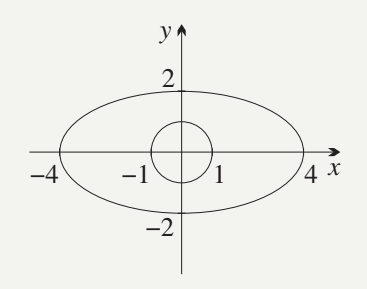
Question: Obtain the graph of from the graph of the circle .
Solution:
We can rewrite the equation as:
This is the unit circle :
- Stretched vertically by a factor of 2
- Stretched horizontally by a factor of 4
The resulting shape is an ellipse.
Note
Note about ellipses:
Any curve of the form is called an ellipse.
To create an ellipse from the unit circle :
- Stretch horizontally by a factor of
- Stretch vertically by a factor of
The ellipse will have:
- -intercepts at and
- -intercepts at and
Enlargements
When dilations don't preserve shape
Usually, dilating a figure changes its shape. The figure is no longer similar to the original.
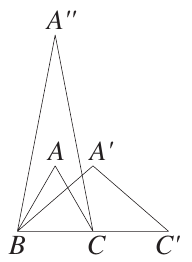
For example, consider an equilateral triangle with its base on the -axis:
- A horizontal dilation with factor 2 creates a squat (wide and short) isosceles triangle
- A vertical dilation with factor 3 creates a skinny (narrow and tall) isosceles triangle
Important
Neither of these triangles is similar to the original equilateral triangle. When you apply different dilation factors in horizontal and vertical directions, the shape changes and similarity is lost.
Creating similar figures with enlargements
However, if we apply two dilations with the same factor (one horizontal and one vertical), the result is similar to the original figure. This combined transformation is called an enlargement.
For instance, applying both a horizontal dilation with factor 2 and a vertical dilation with factor 2 to triangle produces triangle , which is also equilateral.
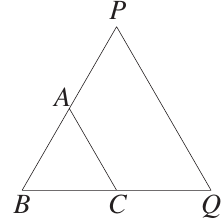
The factor 2 is called the enlargement factor or similarity factor.
Note
In the coordinate plane, the centre of an enlargement is normally the origin.
Important
Key box: Enlargements
An enlargement creates a figure that is similar to the original. This means:
- Matching angles are equal
- The ratios of matching lengths are equal
To create an enlargement:
- Apply a horizontal dilation with factor
- Apply a vertical dilation with the same factor
- The order doesn't matter
To apply an enlargement with factor :
- Replace with AND with
- Alternatively, for a function, use
Example: Enlarging a circle
Example
Worked Example: Enlarging a Circle
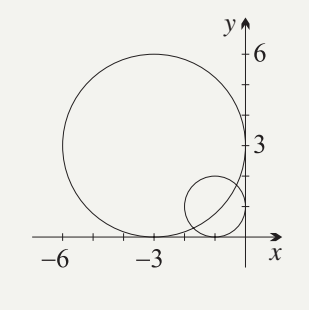
Question: Apply an enlargement with centre the origin and factor 3 to the circle . Write down the new function and sketch both curves.
Solution:
To enlarge by factor 3, we replace with and with :
Multiply both sides by :
This is a circle with:
- Centre at (three times further from the origin than the original centre at )
- Radius 3 (three times the original radius of 1)
The enlargement preserves the circular shape while scaling both the position and size by factor 3.
Stretching with a fractional or negative factor
Fractional factors create compressions
When the dilation factor is between 0 and 1, the graph is compressed (squashed) rather than stretched.
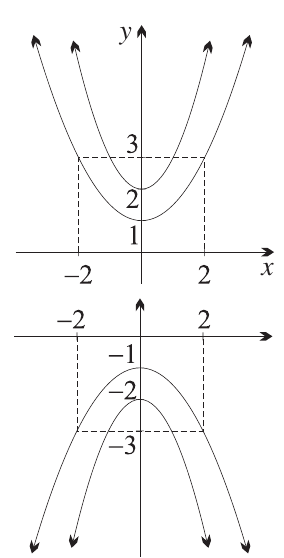
For example, applying a vertical dilation with factor to the parabola gives:
Which simplifies to:
This parabola is compressed (flatter) compared to the original.
Negative factors include reflections
When the dilation factor is negative, the transformation combines:
- A dilation with the positive value of the factor
- A reflection
For example, applying vertical dilations with factors and to produces:
With factor :
Note
This is the reflection of the original parabola in the -axis.
With factor :
This is the reflection in the -axis of the compressed parabola.
Important
Key box: Dilations with fractional or negative factors
- If the dilation factor is between 0 and 1, the graph is compressed
- If the dilation factor is negative, the dilation combines:
- A dilation with the positive version of the factor
- A reflection
- The order doesn't matter
Special cases:
- A reflection is a dilation with factor
- A rotation of 180° about the origin is an enlargement with factor , also called a reflection in the origin
Example: Multiple dilations of a parabola
Example
Worked Example: Multiple Dilations of a Parabola
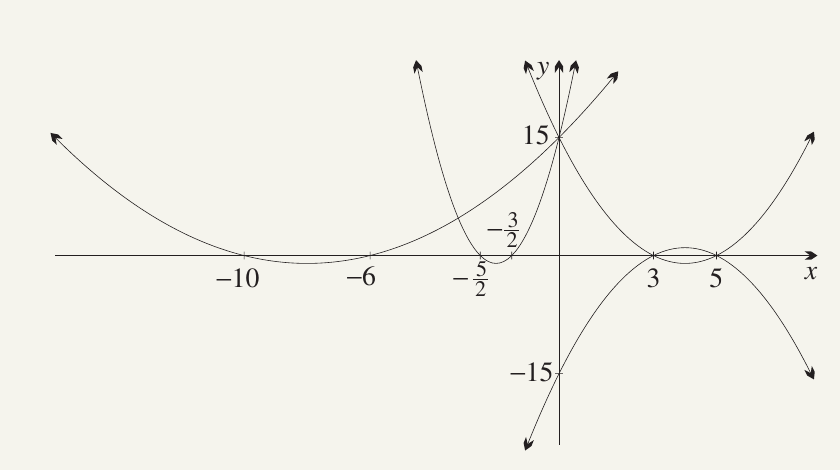
Question: Write down the new functions when each dilation is applied to the parabola . Sketch all four curves on one set of axes.
a) A horizontal dilation with factor
b) A horizontal dilation with factor
c) A vertical dilation with factor
Solution:
a) Horizontal dilation with factor
Replace with :
b) Horizontal dilation with factor
Replace with :
c) Vertical dilation with factor
Replace with :
Remember!
Summary
Key Points to Remember:
-
Vertical dilations multiply -values: replace with or use . The -axis is the axis of dilation.
-
Horizontal dilations multiply -values: replace with or use . The -axis is the axis of dilation.
-
Enlargements use the same factor in both directions and create similar figures: replace both with and with .
-
Fractional factors (between 0 and 1) compress the graph.
-
Negative factors combine dilation with reflection. A factor of gives a pure reflection.