Review of Translations and Reflections (HSC SSCE Mathematics Advanced): Revision Notes
📚Revision Notes
Review of Translations and Reflections
Introduction
This topic revisits fundamental graph transformations that you learned previously. Understanding how to shift and flip graphs is essential preparation for more advanced transformations like dilations. These skills allow you to take a known graph and create new equations by moving or reflecting it in predictable ways.
Transformations preserve the basic shape of a graph whilst changing its position or orientation on the coordinate plane. Mastering these techniques will help you sketch complex functions quickly and understand how equations relate to their graphs.
Note
Why These Skills Matter
Graph transformations are fundamental to understanding functions in mathematics. Rather than memorising hundreds of different graph shapes, you can learn to transform a few basic graphs to create many others. This skill is essential for calculus, physics, and engineering applications.
Two methods for transformations
When transforming graphs, you can use two different approaches depending on whether you're working with a function or a more general relation.
The replacement method works for any relation, whether it's a function or not. This method involves substituting variables directly in the original equation. For example, to shift a graph horizontally, you replace with a modified expression throughout the entire equation.
The function rule method can only be used when working with functions (where each -value corresponds to exactly one -value). This method is often more intuitive because it applies transformations directly to the function notation .
Important
Choosing the Right Method
Both methods produce the same result when applied correctly to functions. However, when dealing with circles, ellipses, or other relations that aren't functions, you must use the replacement method. The function rule method simply won't work for these cases.
Summary of transformation rules
The table below shows the five main transformations you need to understand, with both methods shown for each:
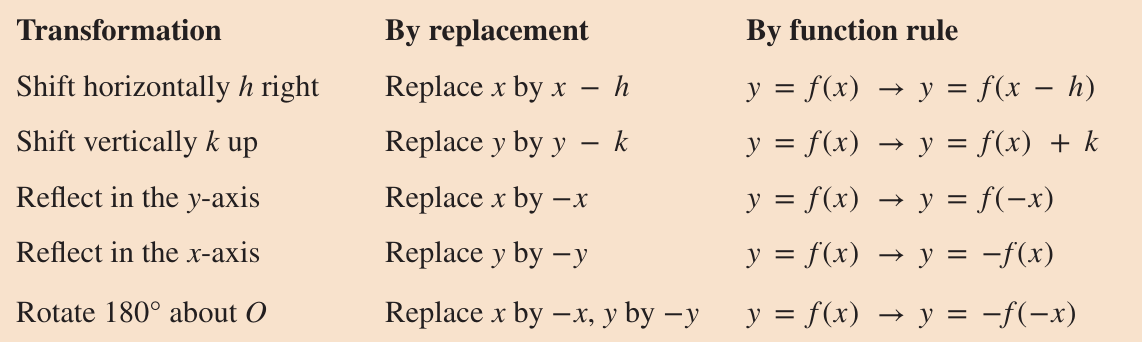
Let's break down what each transformation means:
Horizontal shifts: To move a graph units to the right, replace every with in the equation. Notice this seems backwards - moving right requires subtracting! Using function notation, this becomes . To shift left, use or .
Vertical shifts: To move a graph units upward, replace every with in the equation. Alternatively, add to the function: . This one is more intuitive - adding moves the graph up. To shift down, subtract from the function.
Reflection in the y-axis: This flips the graph across the vertical axis. Replace every with , giving . Points that were on the right side of the y-axis move to the left, and vice versa.
Reflection in the x-axis: This flips the graph across the horizontal axis. Replace every with , or write . Points above the x-axis move below it, and vice versa.
Rotation 180° about the origin: This transformation turns the graph upside down around the origin point . Replace both with and with , giving .
Note
Memory Aid: Inside vs Outside
A helpful way to remember these rules: Changes inside the function parentheses affect horizontal position, whilst changes outside the function affect vertical position. For example, shifts horizontally, but shifts vertically.
Understanding horizontal shifts (the tricky one!)
Many students find horizontal shifts counterintuitive at first. Here's why they work the way they do:
When we write , we're saying "use the function value that was at and place it at position ." In other words, the function value that was 2 units to the left now appears at the current position. This shifts the entire graph 2 units to the right.
Think of it this way: to get the same output (-value) as before, we now need an input that's 2 units larger. This pushes the whole graph to the right.
Important
The Counterintuitive Rule
This is one of the most common sources of errors in transformations:
- shifts the graph right by units (minus means right!)
- shifts the graph left by units (plus means left!)
This seems backwards because we're thinking about what value of gives us the same output, not where that output ends up on the graph.
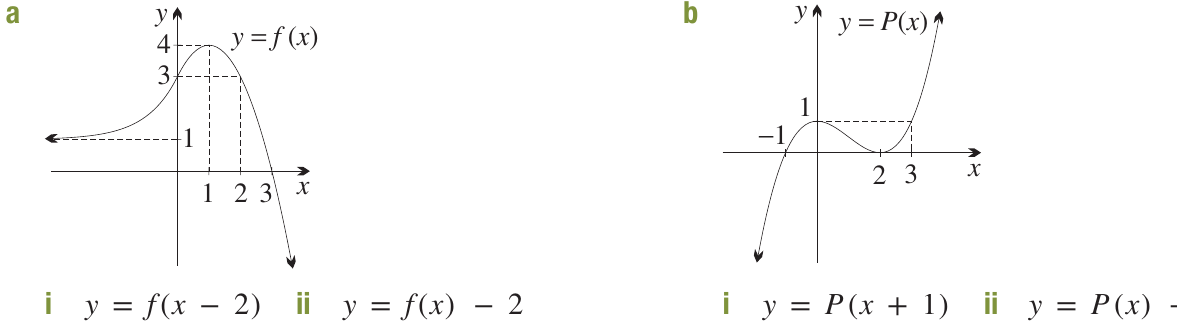
The graphs above illustrate the crucial difference between horizontal and vertical shifts. When you see , the graph moves right. When you see , the graph moves down. The key is remembering that changes inside the function (inside the brackets) affect horizontal position, whilst changes outside affect vertical position.
Worked example: transforming a circle
Let's apply transformations to the circle .
This circle has centre and radius (you can see this from the equation form).
Example
Worked Example: Circle Transformations
Starting with: (centre at , radius )
Step 1: Shifting left 3 units
We need to replace with in the equation:
Simplifying the term:
The new centre is at with the same radius of .
Step 2: Reflecting in the x-axis
We replace with throughout:
Simplifying (since squaring eliminates the negative):
The new centre is at - notice how the -coordinate changed from to .
Step 3: Rotating 180° about the origin
We replace both with and with :
Expanding:
Which gives us:
The new centre is at - both coordinates have switched signs from the original centre .
Here's how all four circles look together:
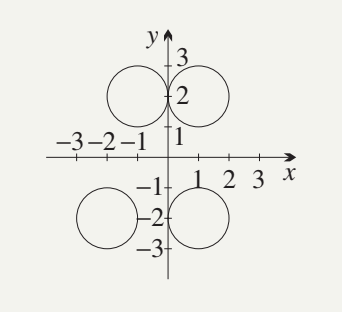
The original circle is in the fourth quadrant. After shifting left, it moves to the third quadrant. Reflecting in the x-axis moves it to the first quadrant. The 180° rotation places it in the second quadrant. Notice that all circles maintain the same radius of unit.
Worked example: transforming an exponential curve
Now let's apply transformations to the exponential function .
Example
Worked Example: Exponential Function Transformations
Starting with:
Transformation 1: Shifting down 1 unit
Using the function rule method, we subtract from the function:
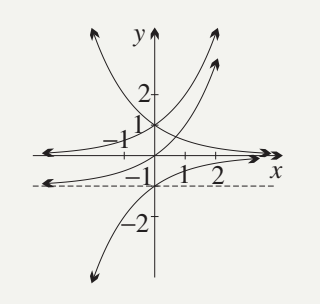
This moves every point on the curve down by unit. The horizontal asymptote, which was at , now becomes .
Transformation 2: Reflecting in the y-axis
We replace with :
This flips the curve so it decreases from left to right instead of increasing. The curve that was rising to the right now falls to the right.
Transformation 3: Rotating 180° about the origin
We replace both with and negate the entire function:
This combines the y-axis reflection with an x-axis reflection, turning the curve upside down and flipping it horizontally. The curve now decreases and approaches zero from below as increases.
All four curves can be sketched on the same axes to see how they relate to each other. The original curve passes through and rises steeply to the right. Each transformation creates a distinct variation of this basic exponential shape.
Key points and exam tips
Understanding the replacement method: The replacement method is your reliable tool for all situations. When you see "shift right 3 units", think "replace with ." When you see "shift up 2 units", think "replace with ."
Note
Watch for Sign Changes
Be extremely careful with signs when applying reflections. A common mistake is forgetting to apply the negative sign consistently throughout the equation. When reflecting in the x-axis, every term must be replaced with , and when simplifying, remember that but is different!
Circle transformations preserve radius: When you shift or reflect a circle, its size stays the same - only the centre moves. This makes circles excellent for practising transformations because you can check your work by verifying the radius hasn't changed.
Important
Combining Transformations
Sometimes you'll need to apply multiple transformations in sequence. Always work systematically: apply one transformation completely before starting the next. The order matters! Shifting then reflecting gives a different result than reflecting then shifting.
Checking your work: After transforming an equation, you can check your answer by selecting a few points on the original graph, applying the transformation to those points, and verifying they satisfy your new equation.
Function notation advantages: When working with functions, the function rule method (using notation) is often clearer because it shows the transformation more explicitly. For instance, immediately tells you the graph has shifted right 2 and up 3.
Summary
Key Points to Remember:
-
Two methods exist: Replacement works for any relation; function rule only works for functions.
-
Horizontal shifts are counterintuitive: Moving right by units requires replacing with , not .
-
Inside changes affect horizontal, outside changes affect vertical: Changes to (inside the function) move the graph horizontally, whilst changes to (outside the function) move it vertically.
-
Reflections use negative signs: x-axis reflection uses or ; y-axis reflection uses or .
-
180° rotation combines both reflections: Replace with and with simultaneously, giving .
-
Radius is preserved: Circle transformations never change the radius, only the centre position.
-
Check your work: Apply transformations to test points to verify your new equation is correct.