The Sign of a Function (HSC SSCE Mathematics Advanced): Revision Notes
📚Revision Notes
The Sign of a Function
Understanding the sign of a function
When we sketch a curve or solve inequations, we need to know where the function is above the -axis (positive) and where it is below the -axis (negative). The sign of a function tells us exactly this information.
For any function , we can classify every value in its domain as one of three types:
- Positive: where (the curve is above the -axis)
- Negative: where (the curve is below the -axis)
- Zero: where (the curve crosses or touches the -axis)
Note
Understanding the sign of a function is essential for solving inequations and analyzing function behavior. Any problem involving "greater than" or "less than" can be transformed into a question about where a function is positive or negative.
This becomes especially important when solving inequations. Any inequation can be rearranged so all terms are on one side. For example:
can be rewritten as:
This means solving an inequation is the same as finding where a function is positive, negative, or zero.
Bracket interval notation
What is bracket interval notation?
Bracket interval notation is an alternative way to write intervals. Instead of using inequalities like , we can write . This notation is more concise and particularly useful when working with unions of intervals.
Important
The key rule is:
- Square bracket [ or ] means the endpoint is included (like or )
- Round bracket ( or ) means the endpoint is not included (like or )
Think of it this way: a square bracket looks like a solid wall that holds the endpoint in, while a round bracket curves away from the endpoint, excluding it.
Types of intervals
Here are the main types of intervals written in both notations:
| Diagram | Using inequalities | Using brackets |
|---|---|---|
| Solid dots at and | ||
| Open dots at and | ||
| Solid dot at , open dot at | ||
| Solid dot at , arrow right | ||
| Arrow left, open dot at |
Closed intervals
A closed interval like contains both its endpoints. For example, includes , , and all numbers in between.
Open intervals
An open interval like does not contain either endpoint. For example, includes all numbers between and , but not or themselves.
Mixed intervals
Intervals like or contain one endpoint but not the other.
Unbounded intervals
When an interval extends forever in one direction, we use the infinity symbol :
- means all numbers greater than or equal to
- means all numbers greater than
- means all numbers less than or equal to
- means all numbers less than
Note
The symbol (infinity) is not a number—it's a concept indicating that an interval continues without bound. This is why we always use a round bracket with or : infinity itself can never be included as an endpoint.
Special cases
- The notation represents all real numbers
- The notation represents the single point (called a degenerate interval)
Important
Common Confusion Alert!
Be careful: the notation could mean either an open interval OR a point in the coordinate plane, depending on context. Always check the context to determine which interpretation is correct.
The union of intervals
Sometimes the solution to an inequation consists of multiple separate intervals. We use the union symbol to combine them.
For example, consider the function . This is a parabola that crosses the -axis at and .
The inequation has solution:
In bracket notation, this is written as:
Here are more examples showing the connection between "or" and the union symbol:
| Diagram | Using inequalities | Using brackets |
|---|---|---|
| Solid intervals and | or | |
| Mixed dots at points | or | |
| Left ray and open interval | or |
Note
The word "or" in mathematics corresponds directly to the union symbol in set notation. When you see "or" between two conditions, you can translate it to in bracket notation.
Where can a function change sign?
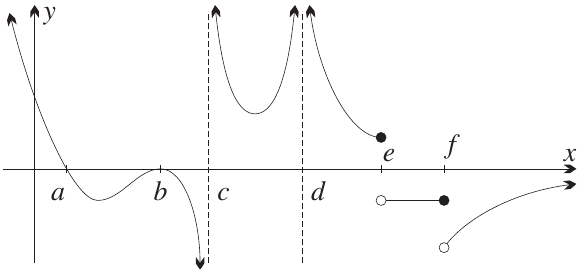
Understanding where a function can change from positive to negative (or vice versa) is crucial for solving inequations.
Zeroes
A zero of a function is a value where . On a graph, this is where the curve crosses or touches the -axis. A function may change sign at a zero.
Discontinuities
A discontinuity is a point where the function has a break or gap. Informally, if you can't draw the curve through a point without lifting your pen, that point is a discontinuity. A function may also change sign at a discontinuity.
The key principle
Important
Fundamental Principle of Sign Changes:
A function can only change sign at zeroes or discontinuities.
Between any two consecutive zeroes and discontinuities, the function must maintain the same sign. This is because if a function is continuous on an interval and never equals zero in that interval, it cannot cross the -axis, so it must stay entirely above or entirely below the axis.
In the graph above, notice:
- The function has zeroes at and
- It has discontinuities at , , , and
- The function changes sign at zero and at discontinuities and
- It does NOT change sign at zero or at discontinuities and
Note
Just because a function has a zero or discontinuity doesn't mean it must change sign there—but these are the only places where a sign change is possible. This is why identifying all zeroes and discontinuities is the first step in analyzing function sign.
Using a table of signs
A table of signs is a systematic method to determine where a function is positive and where it is negative.
How to create a table of signs
Step 1: Find all zeroes by solving
Step 2: Find all discontinuities (usually where a denominator equals zero)
Step 3: Choose test values between consecutive zeroes and discontinuities
Step 4: Calculate at each test value
Step 5: Record the sign (positive or negative) in each interval
The table structure
A table of signs has three rows:
- Row 1: -values (the test points)
- Row 2: -values (the function values at those points)
- Row 3: sign ( for positive, for negative, for zero, for discontinuity)
Note
The sign remains constant between consecutive critical points (zeroes and discontinuities), so one test value per interval is sufficient. You don't need to test multiple points in the same interval.
Worked example: Polynomial inequation
Example
Worked Example: Polynomial Inequation
Consider the function
Step 1: Find the zeroes
Setting :
So , , or
Step 2: Check for discontinuities
This is a polynomial, so there are no discontinuities.
Step 3: Create the table of signs
We need test values in the intervals: , , , and
Good choices are:
| sign |
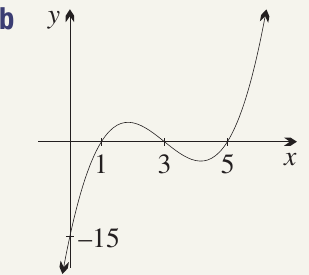
From the table:
- is positive for or , written as
- is negative for or , written as
Solving the inequation :
We need where the function is negative or zero, so:
In bracket notation:
Worked example: Polynomial with repeated factor
Example
Worked Example: Polynomial with Repeated Factor
Solve
Step 1: Rearrange with all terms on the left
Step 2: Factor the expression
Step 3: Find zeroes
The zeroes are and (with being a repeated zero)
Step 4: Create the table of signs
| sign |
Step 5: Sketch and solve
The function is negative or zero when or
In bracket notation:
Note: At the repeated zero , the function touches the -axis but doesn't cross it, so the sign doesn't change.
Important
Understanding Repeated Zeroes:
When a zero appears with an even power (like ), the function will touch the -axis but not cross it. The sign stays the same on both sides. When a zero appears with an odd power, the function crosses the -axis and changes sign.
Worked example: Rational function with discontinuity
Example
Worked Example: Rational Function with Discontinuity
Examine the sign of
Step 1: Find zeroes
The numerator is zero when , so
Step 2: Find discontinuities
The denominator is zero when , so there's a discontinuity at
Step 3: Create the table of signs
We need test values in the intervals: , , and
| sign |
The asterisk () indicates the function is undefined at .
From the table:
- is positive for or
- is negative for
This rational function has both a vertical asymptote (at ) and a horizontal asymptote, which you'll study in the next section.
Note
For rational functions, always check both the numerator (for zeroes) and the denominator (for discontinuities). The discontinuities are often where vertical asymptotes occur.
Worked example: Always positive function
Example
Worked Example: Always Positive Function
Examine the sign of
Analysis:
The numerator is , which is never zero, so there are no zeroes.
The denominator is . Since for all real , we have for all real . So there are no discontinuities.
Conclusion: The function is always positive.
We can verify this with a single test value:
| sign |
Since there are no zeroes or discontinuities where the sign could change, and we've found the function is positive at one point, it must be positive everywhere.
Note
When a function has no zeroes or discontinuities, it maintains the same sign everywhere in its domain. In such cases, you only need to test a single value to determine the sign for all real numbers.
Remember!
Summary
Key Points to Remember:
-
Bracket interval notation uses square brackets [ ] for included endpoints and round brackets ( ) for excluded endpoints. It provides a concise way to write intervals.
-
A function can only change sign at zeroes or discontinuities. Between these critical points, the sign remains constant.
-
A table of signs is created by choosing test values between zeroes and discontinuities. This systematic method reveals where the function is positive, negative, or zero.
-
To solve an inequation, rearrange it so all terms are on one side, then use a table of signs to find where the function has the required sign.
-
For polynomial inequations, you only need to consider zeroes. For rational functions, you must also consider discontinuities (where the denominator is zero).
-
The word "or" in mathematics corresponds to the union symbol when combining intervals.