Vertical and Horizontal Asymptotes (HSC SSCE Mathematics Advanced): Revision Notes
📚Revision Notes
Vertical and Horizontal Asymptotes
When sketching unknown functions, we follow several important steps. After factoring, we:
- Identify the domain
- Test whether the function has even or odd symmetry, or neither
- Identify the zeroes and discontinuities and create a table of signs
- Identify the curve's vertical and horizontal asymptotes
This note focuses on the fourth step: identifying asymptotes and describing how the curve behaves near them.
What are asymptotes?
Asymptotes commonly appear in functions involving algebraic fractions, such as:
or or
In these functions, the denominator becomes very small when is near certain values. For example, the denominator is very small when is near for the first function, or near or for the second function, or near for the third function. In all three functions, the denominator becomes very large when is very large.
Note
Asymptotes occur naturally when working with algebraic fractions. They appear in two situations:
- When the denominator approaches zero (creating vertical asymptotes)
- When x becomes very large in magnitude (potentially creating horizontal asymptotes)
Understanding asymptotes relies on two key principles about reciprocals:
Important
Principle 1: Size relationships
- The reciprocal of a very small number is a very large number
- The reciprocal of a very large number is a very small number
Principle 2: Sign relationships
- The reciprocal of a positive number is positive
- The reciprocal of a negative number is negative
The rectangular hyperbola
These principles are clearly demonstrated by the rectangular hyperbola , which has both a vertical and a horizontal asymptote.
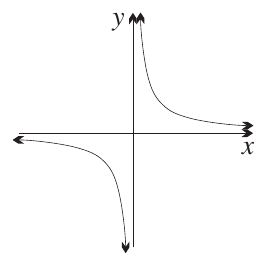
Horizontal behaviour: When is a very large number (positive or negative), is a very small number with the same sign. This means the curve approaches the -axis on both the left and right sides. We write this as:
"As , , and as , "
Vertical behaviour: When is a very small number (positive or negative), is a very large number with the same sign. This means the curve flies off to or to near . We write this as:
"As , , and as , "
Note
The notation means "as approaches from the left", and means "as approaches from the right". This precise notation helps us describe the curve's behavior on each side of the asymptote.
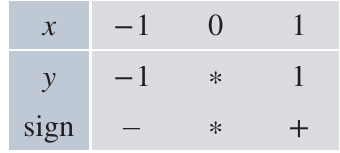
In more complex situations, we use a table of signs to check the sign and distinguish between and .
Testing for vertical asymptotes
When finding vertical asymptotes, always factor the function first as far as possible.
Important
Key rule for vertical asymptotes:
If the denominator has a zero at , and the numerator is not zero at , then the vertical line is an asymptote.
To determine whether or , construct a table of signs. Once you've identified the vertical asymptote, you can describe the curve's behaviour near it using the notation and .
Example: Finding vertical asymptotes
Let's examine the function .
Example
Worked Example: Finding Vertical Asymptote for
Finding the vertical asymptote:
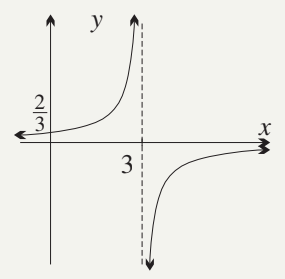
When , the denominator equals zero but the numerator does not. Therefore, x = 3 is a vertical asymptote.
Constructing a table of signs:
There are no zeroes of the function, but there is a discontinuity at .
| sign |
From the table of signs:
- As ,
- As ,
The horizontal asymptote:
The -axis is a horizontal asymptote because as , , and as , .
The sketch:
Example: Function with two vertical asymptotes
Consider the function .
Example
Worked Example: Function with Two Vertical Asymptotes
Testing for symmetry:
Therefore, the function is even (it has symmetry about the -axis).
Finding vertical asymptotes:
Factoring:
When or , the denominator equals zero but the numerator does not. Therefore, x = 2 and x = -2 are both vertical asymptotes.
Constructing a table of signs:
There are no zeroes, and there are discontinuities at and .
| sign |
From the table of signs:
- As , , and as ,
- As , , and as ,
The horizontal asymptote:
The -axis is a horizontal asymptote: as , , and as , .
Horizontal asymptotes and behaviour for large
For simple functions like those above, identifying the -axis as a horizontal asymptote is straightforward. However, for more complex functions such as:
or
finding horizontal asymptotes requires a systematic approach. These functions are called rational functions because they are the ratio of two polynomials.
Method for finding horizontal asymptotes
Important
Method for Finding Horizontal Asymptotes:
Step 1: Divide both the numerator and denominator by the highest power of x in the denominator.
Step 2: Use the fact that as and as .
Step 3: If tends to a definite limit as or as , then the horizontal line is a horizontal asymptote on the right or on the left.
Example: Rational function with horizontal asymptote
Examine the function .
Example
Worked Example: Finding Horizontal Asymptote for
Finding the horizontal asymptote:
Divide both numerator and denominator by :
As :
As :
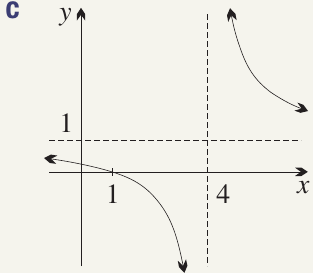
Therefore, y = 1 is a horizontal asymptote.
Finding the vertical asymptote:
When , the denominator equals zero but the numerator does not. Therefore, x = 4 is a vertical asymptote.
Table of signs:
We need to check around the zero at and the discontinuity at .
| sign |
From the table:
- As ,
- As ,
The sketch:
Example: Different types of behaviour
Examine the behaviour of these functions as and as .
Example
Worked Example: Analyzing Different Asymptotic Behaviors
a)
Divide numerator and denominator by :
As :
As :
The -axis y = 0 is a horizontal asymptote.
b)
Divide numerator and denominator by :
As :
As :
There are no horizontal asymptotes.
c)
Divide numerator and denominator by :
As :
As :
Therefore, y = 4/3 is a horizontal asymptote.
d)
As :
As :
Therefore, y = 3 is a horizontal asymptote on the left only.
Note
Notice how the degree of the numerator compared to the denominator determines asymptotic behavior:
- When the numerator has lower degree, the -axis is a horizontal asymptote (example a)
- When the numerator has higher degree, there are no horizontal asymptotes (example b)
- When numerator and denominator have equal degree, there's a horizontal asymptote at the ratio of leading coefficients (example c)
Remember!
Summary
Key Points to Remember:
-
Vertical asymptotes occur where the denominator equals zero but the numerator does not. Always factor the function first.
-
Use tables of signs to determine whether the function approaches or near vertical asymptotes.
-
For horizontal asymptotes, divide the numerator and denominator by the highest power of x in the denominator, then examine what happens as .
-
Reciprocal principles: Small denominators create large fractions, and large denominators create small fractions. The sign of the reciprocal matches the sign of the original number.
-
Limit notation like (approaching from the right) and (approaching from the left) precisely describes behaviour near asymptotes.