The Definite Integral and Its Properties (HSC SSCE Mathematics Advanced): Revision Notes
📚Revision Notes
The Definite Integral and Its Properties
Introduction
This note extends the theory of definite integrals to functions that take negative values. We'll explore key properties of definite integrals, including how to handle regions below the x-axis, and several important rules that simplify integration calculations.
Signed areas under the curve
When calculating a definite integral, we need to consider whether the function sits above or below the -axis. This gives us the concept of signed areas.
When a function has negative values, its graph lies below the -axis. The very thin rectangles in our area approximation have negative heights, which means areas below the -axis contribute negative values to the integral.
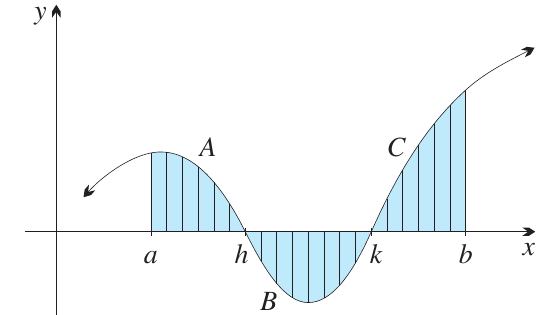
In the diagram above, where :
- Region is above the -axis, so it contributes a positive value
- Region is below the -axis (where is negative), so it contributes a negative value
- Region is above the -axis, so it contributes a positive value
Therefore:
Note
Key principle: The definite integral as the sum of signed areas
Let be continuous in the closed interval , where .
- For regions where the curve is above the -axis, attach a positive sign to the area
- For regions where the curve is below the -axis, attach a negative sign to the area
- These areas with signs attached are called signed areas under the curve
- The definite integral equals the sum of these signed areas in the interval
Example
Worked Example: Evaluating integrals with signed areas
Consider the function .
a) Evaluate
b) Evaluate
c) Evaluate
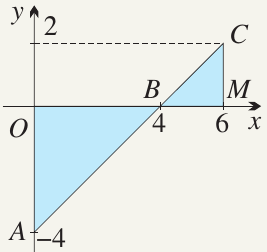
Interpretation:
- Triangle has area square units and lies below the -axis, so the integral in part a is
- Triangle has area square units and lies above the -axis, so the integral in part b is
- The integral in part c represents area of minus area of , giving
Properties of odd and even functions
The symmetry of odd and even functions creates useful shortcuts when integrating over symmetric intervals.
Odd functions
An odd function has point symmetry about the origin. For example, is odd.
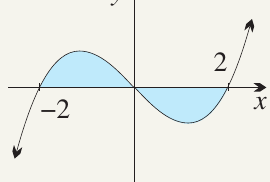
When we integrate an odd function from to , the areas above and below the -axis have equal magnitude but opposite signs. They cancel each other out completely.
Note
Property: Integration of odd functions
If is odd, then:
This is because the positive and negative areas cancel exactly.
Even functions
An even function has line symmetry in the y-axis. For example, is even.
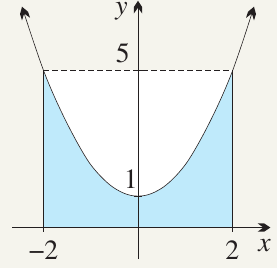
When we integrate an even function from to , the areas on both sides of the -axis are identical. Therefore, we can calculate the integral from to and double it.
Note
Property: Integration of even functions
If is even, then:
This allows you to calculate half the region and double it.
Example
Worked Example: Using symmetry
a) Evaluate
Since is an odd function:
We can verify this by direct calculation:
b) Evaluate
Since is an even function:
Important
Exam tip: Always check for odd or even symmetry before calculating—it can save significant time!
Dissection of the interval
When a region is divided into parts, the total area equals the sum of the individual areas. We can apply this principle to definite integrals by splitting the interval of integration.
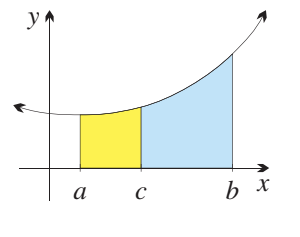
If is being integrated over the closed interval and the number lies within this interval, then we can break up the interval at any intermediate point.
Note
Property: Dissection of intervals
This property allows us to break complex integrals into simpler parts, particularly useful when a function changes character at certain points (for example, where it crosses the -axis).
Intervals of zero width
If we integrate a function over an interval from to (width zero), and the function is defined at , the region also has zero width.
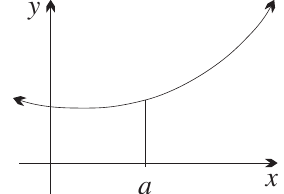
Note
Property: Zero-width intervals
This makes intuitive sense: there's no area to calculate when the interval has no width.
Reversing the interval
When we reverse the limits of integration (swapping the upper and lower bounds), the sign of the integral changes.
Note
Property: Reversing integration limits
This agrees with calculations using the fundamental theorem, because:
Example
Worked Example: Reversed limits
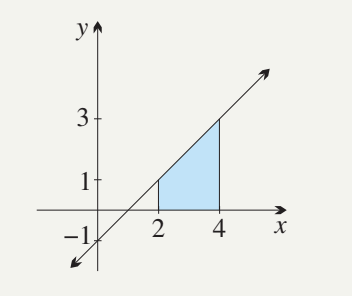
a) Evaluate
This is positive because the region lies above the -axis.
b) Evaluate
This is the opposite of part a, because the integral runs backwards from right to left, from to .
Sums of functions
When two functions are added together, their graphs stack vertically. The integral of the sum equals the sum of the individual integrals.
Note
Property: Integration of sums
Integration distributes over addition.
Example
Worked Example: Sum property
Show that the following two expressions are equal:
a)
b)
Both expressions give the same result, confirming the sum property.
Multiples of functions
When a function is multiplied by a constant, the region is stretched vertically by that constant factor. The constant can be factored outside the integral.
Note
Property: Constant multiples
This property allows you to pull constant factors outside the integral, simplifying calculations.
Example
Worked Example: Constant multiple
Show that these two expressions are equal:
a)
b)
Both methods produce the same answer, as expected.
Inequalities with definite integrals
If one curve always lies beneath another curve over an interval, then the area under the lower curve is less than the area under the higher curve.
Note
Property: Inequalities with integrals
If throughout the closed interval , then:
This property is essential for bounding integrals and proving inequalities.
Example
Worked Example: Inequality application
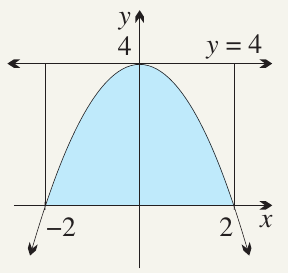
a) Sketch the graph of for
b) Explain why
Solution:
The parabola and the horizontal line are shown in the diagram.
Over the interval , we can see that:
Therefore, the region associated with the integral fits inside a square with side length .
The area of this square is square units, and the area cannot be negative, so:
Summary
Key Points to Remember:
-
Signed areas: Regions above the x-axis contribute positive values to the integral, while regions below the x-axis contribute negative values.
-
Odd and even functions:
- For odd functions integrated over symmetric intervals, (areas cancel)
- For even functions, (areas double)
-
Essential properties to memorise:
- Dissection:
- Reversing:
- Sum:
- Multiple:
-
Exam strategy: Always sketch the graph when dealing with signed areas or inequalities—visualisation helps prevent sign errors and provides geometric insight into the problem.