Average Velocity and Speed (HSC SSCE Mathematics Advanced): Revision Notes
📚Revision Notes
Average Velocity and Speed
Motion in one dimension
When studying the motion of an object along a straight line, we describe its position using displacement. Displacement is a single value, denoted by , that tells us where the object is located at any given time .
The entire motion can be described mathematically by expressing displacement as a function of time. This allows us to track the object's position throughout its journey.
Note
Important convention: Unless specifically stated otherwise, we only consider non-negative values of time. This means in our calculations.
Example: A ball thrown vertically upward
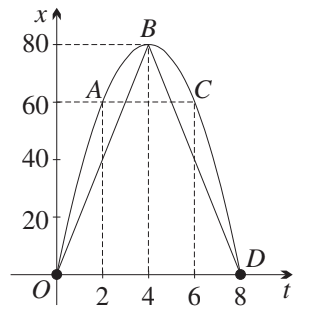
Consider a ball that is thrown straight up from ground level and lands back on the ground 8 seconds later. We can model this motion using the equation:
where represents the height in metres above the ground, and represents the time in seconds after the ball is thrown.
Important
Understanding the graph:
The graph shows displacement (height) on the vertical axis and time on the horizontal axis. It's crucial to remember that this graph does NOT show the actual path of the ball through space. Instead, it shows how the ball's height changes over time.
Key features of this motion:
- The ball starts at ground level when (point O)
- It reaches maximum height of 80 metres at seconds (point B, the vertex)
- It returns to ground level at seconds (point D)
- The domain is and the range is
Average velocity
Average velocity measures how quickly displacement changes over a time interval. It can be positive (moving in the positive direction), negative (moving in the negative direction), or zero (no net change in position).
The formula for average velocity is:
where is the displacement at time and is the displacement at time .
Graphical interpretation
On a displacement-time graph, the average velocity equals the gradient of the chord connecting the two points representing the start and end of the time interval.
Example from the ball's motion:
During the ball's ascent (from to ):
- Change in displacement = metres
- Change in time = seconds
- Average velocity = metres per second
This equals the gradient of chord OB on the graph.
During the ball's descent (from to ):
- Change in displacement = metres
- Change in time = seconds
- Average velocity = metres per second
The negative value indicates downward motion. This equals the gradient of chord BD.
Example
Worked Example 1: Finding position at specific times
Using the equation :
a) Find the height of the ball after 1 second.
When :
The ball is 35 metres above the ground after 1 second.
b) At what other time is the ball at this same height?
To find when the height is 35 metres, we solve :
or
The ball is at 35 metres height after 1 second (ascending) and again after 7 seconds (descending).
Example
Worked Example 2: Calculating average velocity for specific intervals
For the motion , we'll calculate average velocities during different time periods.
| 0 | 1 | 4 | 5 | |
|---|---|---|---|---|
| 0 | 35 | 80 | 75 |
a) Average velocity during the first second (from to ):
b) Average velocity during the fifth second (from to ):
The negative sign indicates the ball is moving downward during this interval.
Distance travelled vs displacement
It's essential to understand the difference between change in displacement and distance travelled.
Important
Key Differences:
Change in displacement:
- Can be positive, negative, or zero
- Only considers the difference between starting and ending positions
- Ignores the actual path taken
Distance travelled:
- Always positive or zero
- Takes into account the entire journey, including any returns
- Adds up all movement regardless of direction
Example: In our ball example, during the time from to :
- Change in displacement = metres
- Distance travelled = 80 metres (the ball moves down 80 metres)
For the complete 8-second flight:
- Change in displacement = metres (ball returns to starting position)
- Total distance travelled = metres (up 80m, then down 80m)
Average speed
Average speed measures how much distance is covered per unit of time. Unlike average velocity, average speed can never be negative.
Key difference from average velocity
For the complete flight of our ball (8 seconds):
Average velocity = m/s
Average speed = m/s
Note
Even though the ball returns to its starting point (giving zero average velocity), it travelled a total distance of 160 metres, resulting in a positive average speed.
Example
Worked Example 3: Comparing velocity and speed
For the ball motion :
| 0 | 2 | 7 | 8 | |
|---|---|---|---|---|
| 0 | 60 | 35 | 0 |
a) During the eighth second (from to ):
The ball moves from 35 metres down to 0 metres.
Average velocity = m/s
Distance travelled = 35 metres
Average speed = 35 m/s
Notice that while the velocity is negative (indicating downward motion), the speed is positive.
b) During the last six seconds (from to ):
The ball rises from 60 metres to 80 metres (travelling 20 metres up), then falls from 80 metres to 0 metres (travelling 80 metres down).
Average velocity = m/s
Distance travelled = metres
Average speed = m/s
Summary
Key Points to Remember:
-
Motion in one dimension is described by displacement as a function of time . Negative time values are excluded unless stated otherwise.
-
Average velocity equals the gradient of the chord on a displacement-time graph. It can be positive, negative, or zero, and is calculated using .
-
Distance travelled accounts for the entire journey including any returns, and can never be negative.
-
Average speed equals distance travelled divided by time taken, and can never be negative. It differs from average velocity when an object changes direction or returns to its starting position.
-
A key distinction: velocity has direction (can be negative), but speed does not (always positive or zero).