Applications of Differentiation (HSC SSCE Mathematics Advanced): Revision Notes
📚Revision Notes
Applications of Differentiation
Introduction
Differentiation techniques can be applied to exponential functions in much the same way as other functions. One of the most important applications is curve sketching. When working with exponential functions, you may need to evaluate certain limits, which would typically be provided in exam questions.
Note
When working with exponential functions in exams, limit values are typically provided in the question. You should focus on understanding how to use these limits rather than proving them rigorously.
The graphs of and
These two graphs form the foundation of exponential functions. Understanding their properties is essential for working with more complex exponential expressions.
Properties of
The function represents exponential growth. Key features include:
- The graph passes through the point
- As increases, increases rapidly without bound
- As decreases, approaches zero (but never reaches it)
- The -axis is a horizontal asymptote as
- The gradient at is
Sample values:
Properties of
The function represents exponential decay. Key features include:
- The graph passes through the point
- As increases, approaches zero
- As decreases, increases without bound
- The -axis is a horizontal asymptote as
- The gradient at is
Sample values:
Relationship between the two graphs
Because is replaced by in the second equation, the graphs of and are reflections of each other in the -axis.
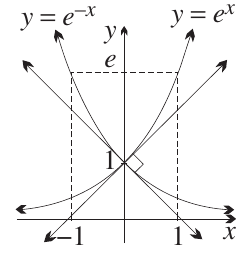
Important
The two curves intersect at . At this point, the gradient of is and the gradient of is . This means the tangent lines are perpendicular at their point of intersection.
Real-world applications
The exponential decay function is particularly important in applications. It describes many physical situations where a quantity "dies away exponentially", such as:
Note
Common Applications of Exponential Decay:
- The decay of sound from a plucked string
- Radioactive decay
- Cooling of hot objects
- Discharge of capacitors in electrical circuits
These applications all share the common feature of a quantity decreasing at a rate proportional to its current value.
Curve sketching with exponential functions
When sketching curves involving exponential functions, follow a systematic approach using these six steps:
Important
Six-Step Curve Sketching Method:
- Write down the domain
- Test whether the function is even, odd, or neither
- Find any zeroes and examine the sign of the function
- Examine behavior as and , noting any asymptotes
- Find stationary points and examine their nature
- Find points of inflection and examine concavity
Following these steps systematically ensures you don't miss any important features of the curve.
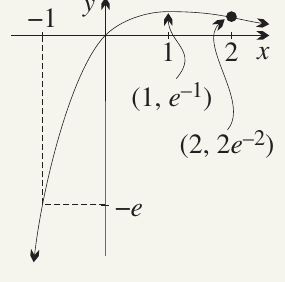
Worked example: Sketching
Let's apply these six steps to sketch the graph of .
Example
Worked Example: Sketching using the Six-Step Method
Step 1: Domain
The domain of is all real numbers.
Step 2: Even or odd function?
Testing :
This is neither nor , so the function is neither even nor odd.
Step 3: Zeroes and sign
The only zero occurs when .
From the table of signs:
| sign |
The function is positive for and negative for .
Step 4: Asymptotic behavior
As : (given), so the -axis is a horizontal asymptote on the right.
As :
Step 5: Stationary points
Using the product rule with and :
Therefore:
Setting :
Since can never be zero, we need , giving .
When :
So is the only stationary point.
Determining the nature of the stationary point:
Differentiating again using the product rule with and :
Therefore:
At :
Since , the point is a maximum turning point.
Step 6: Points of inflection
From , we find when .
When :
Testing concavity around :
| concavity | • |
There is a point of inflection at .
The curve is concave down for and concave up for .
The complete sketch:
Graph transformations
You can use transformations to sketch related functions without repeating the entire curve-sketching process.
Example
Worked Example: Sketching using Transformations
Starting from the graph of , we can obtain by replacing with .
Graphically, this transformation is a reflection in the -axis. The key features transform as follows:
- Maximum at becomes maximum at
- Inflection at becomes inflection at
- Behavior as becomes behavior as (and vice versa)
The reflected graph shows the same general shape but mirrored across the -axis.
Note
When using transformations, remember that replacing with creates a reflection in the -axis, while replacing with (or multiplying the entire function by ) creates a reflection in the -axis.
Understanding limits involving exponential functions
When working with products of polynomials and exponential functions, the limiting behavior can be puzzling.
The limit of as
Consider the product when is large:
- is a large number
- is a very small positive number
The product of a large number and a small number could theoretically be large, small, or anywhere in between.
Important
However, decreases much faster than increases. We say that dominates . The result is:
This concept of exponential dominance is crucial for understanding limiting behavior.
This is shown in the following table:
| approx |
The limit of as
Similarly, when is a large negative number:
- is a large negative number
- is a very small positive number
Again, the exponential function dominates, and:
This is shown in the following table:
| approx |
Note
Exam Tip:
In examination questions, limits such as these would normally be provided. You are not expected to prove them rigorously, but you should understand what they mean and how to use them in curve sketching.
Summary
Key Points to Remember:
- The graphs of and are reflections of each other in the -axis and intersect perpendicularly at .
- When curve sketching with exponential functions, follow the systematic six-step approach: domain, even/odd, zeroes and sign, asymptotes, stationary points, and inflection points.
- Use the product rule when differentiating products involving exponential functions.
- Exponential functions dominate polynomial functions in limits, meaning decreases faster than any polynomial increases.
- Graph transformations (like reflection in the -axis) can be used to sketch related functions efficiently.