Applications of Integration (HSC SSCE Mathematics Advanced): Revision Notes
📚Revision Notes
Applications of Integration
Introduction
Standard integration techniques for calculating areas can now be applied to functions involving the exponential function . This section demonstrates how to find areas under exponential curves and areas between exponential curves and other functions.
Finding the area between a curve and the x-axis
Always begin by drawing a sketch of the region. This is crucial because definite integrals assign a negative value to any area located below the x-axis (assuming the integral runs from left to right, not backwards). To find the actual area, you must take the absolute value of a negative integral result.
Important
Critical Concept: Sketching First
A sketch is essential before calculating any area. The definite integral will give a negative result for regions below the x-axis, so you must take the absolute value to find the actual area measurement.
Example
Worked Example: Area below the x-axis
Consider the function . We will find the area between this curve, the -axis, and the -axis.
Step 1: Sketch the curve
Start with the basic exponential curve and shift it down by units to obtain .
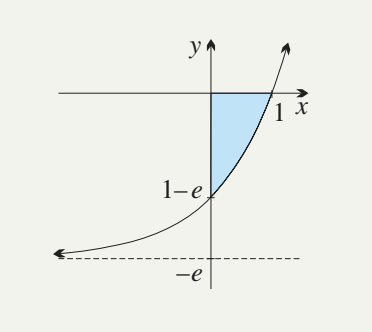
Step 2: Find the intercepts
To find the -intercept, substitute :
To find the -intercept, set :
Step 3: Identify the asymptote
The horizontal asymptote of is . After shifting down by units, the new horizontal asymptote is .
Step 4: Calculate the area
The region we want lies between and , below the -axis.
Note that is a constant, so .
The integral is negative because the region lies below the x-axis. Therefore, the required area is 1 square unit.
Note
Exam tip: Always check whether your region is above or below the -axis. If the integral gives a negative value, take the absolute value to find the actual area.
Finding areas between curves
When one curve lies entirely above another curve over a specific interval, you can find the area of the region between them using integration.
Formula for area between curves
Note
Area Between Two Curves
If a curve is always above in the interval , then:
The key principle is to subtract the lower function from the upper function, then integrate over the required interval.
Example
Worked Example: Area between exponential and polynomial curves
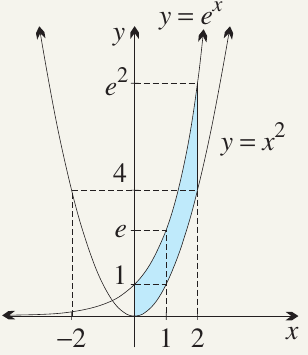
Find the area between the curves and from to .
Step 1: Sketch both curves
For , the exponential curve is always above the parabola . This is important because it determines which function to subtract from which.
Step 2: Apply the area formula
Since is above throughout the interval , we integrate:
Step 3: Integrate each term
Step 4: Evaluate at the limits
Important
Key point: Always ensure you identify which curve is on top before setting up your integral. A sketch is essential for this determination.
Remember!
Summary
Key Points to Remember:
- Always sketch the region before attempting to calculate an area using integration
- Definite integrals produce negative values for regions below the x-axis — take the absolute value to find the actual area
- For area between two curves, use the formula: where is the upper curve
- Remember that when integrating exponential functions
- Check your integration limits carefully — they should match the boundaries of the region you're finding