Differentiation of Logarithmic Functions (HSC SSCE Mathematics Advanced): Revision Notes
📚Revision Notes
Differentiation of Logarithmic Functions
Introduction to logarithmic differentiation
When working with calculus involving the exponential function , we also need to understand how to differentiate its inverse function, the natural logarithm (also written as ).
These two functions are intimately related through their inverse relationship. When you graph both curves on the same axes, they appear as reflections of each other across the diagonal line . This reflection property helps us understand many features of the logarithmic function.
Note
The inverse relationship between and means that and . This deep connection between the two functions is what allows us to derive the differentiation rule for logarithms using our knowledge of exponentials.
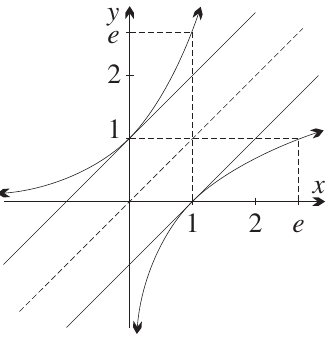
Key features of the natural logarithm function
Understanding the graph of is essential before we differentiate it. Here are its important characteristics:
The domain consists of all positive real numbers (), whilst the range includes all real numbers. This makes sense because you can only take the logarithm of positive numbers, but the result can be any real value.
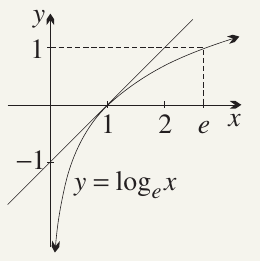
The function crosses the -axis at the point , meaning the -intercept is 1. At this point, the gradient of the tangent line equals 1. The -axis acts as a vertical asymptote, which means the curve approaches but never touches this line.
As approaches infinity, also approaches infinity (you can see this by looking at its reflection ). Throughout its entire domain, the logarithmic function is always increasing at a decreasing rate, meaning it rises continuously but the rate of increase gradually slows down.
Note
The restriction to positive values in the domain isn't arbitrary—it comes from the definition of logarithms. Since asks "what power must we raise to get ?", and any positive power of gives a positive result, we can only take logarithms of positive numbers.
Deriving the derivative of the logarithmic function
We can find the derivative of by using what we know about its inverse function . This elegant method relies on the relationship between a function and its inverse.
Let .
By the definition of logarithms, we can rewrite this as:
Now we differentiate both sides with respect to :
This works because the exponential function is its own derivative. Since (from our earlier equation), we can substitute:
To find , we take reciprocals of both sides:
This beautiful result shows that the derivative of the logarithmic function is simply the reciprocal function.
Important
The derivative of the logarithmic function is the reciprocal function:
This is one of the most fundamental derivatives in calculus and forms the basis for all logarithmic differentiation.
Using the derivative to confirm properties
We can use this derivative formula to verify properties of the logarithmic function that we already know from its graph.
Example
Finding the gradient at the -intercept:
Starting with , we differentiate to get:
The graph crosses the -axis at the point . Substituting into the derivative:
gradient at -intercept
This confirms what we observed from the graph.
Example
Proving the function is always increasing and concave down:
The domain of is . For all values in this domain:
Since the first derivative is always positive, the function is always increasing.
To check concavity, we differentiate again:
This second derivative is negative for all , which proves the function is always concave down (curves downward).
Basic differentiation with the standard form
Once we know the basic derivative, we can differentiate functions that combine logarithms with other terms using our standard differentiation rules.
Example
Differentiate
Solution:
We simply differentiate each term separately.
Example
Differentiate
Solution:
Again, treat each term independently, using the power rule for and our logarithm rule for .
Using the chain rule with logarithmic functions
When the argument of the logarithm is more complex than just , we need to apply the chain rule. Let's work through some examples to develop additional standard forms.
Example
Differentiate
Let
To use the chain rule, we set:
Then
We know that:
Applying the chain rule:
Example
Differentiate (general form)
This follows the same pattern. Let and .
Then:
Using the chain rule:
This is an important standard form worth memorising.
Example
Differentiate
Let and .
Then:
Using the chain rule:
Three standard forms for differentiating logarithmic functions
Based on our work above, we can summarise three essential standard forms that cover most logarithmic differentiation problems:
Important
Basic form:
Linear argument form:
General chain rule form:
The third form is the most general and will be particularly useful later when we study integration. You can either memorise it or apply the chain rule each time you encounter such a function.
Applying the standard forms
Let's see how these standard forms simplify our work with various logarithmic expressions.
Example
Differentiate
Using the second standard form with :
Example
Differentiate
Using the second standard form with :
Multiplying both numerator and denominator by :
Example
Differentiate
Using the third standard form, let , so :
Alternatively, we could write and , giving:
Using the product rule with logarithms
When a logarithmic function is multiplied by another function, we apply the product rule in the usual way.
Example
Differentiate using the product rule
Let and .
Then and .
Using the product rule :
We factored out to present the answer more elegantly.
Using the quotient rule with logarithms
When a logarithmic function appears in a quotient, we apply the quotient rule.
Example
Differentiate using the quotient rule
Let and .
Then and .
Using the quotient rule :
Notice how we simplified the numerator by combining the fractions.
Using log laws to simplify before differentiating
Often, applying logarithm laws before differentiating makes the problem much easier. This approach can help you avoid complicated applications of the chain rule, product rule, or quotient rule.
Important
Always consider using log laws first!
Before attempting differentiation with the chain rule, product rule, or quotient rule, check whether applying logarithm laws can simplify the expression. This strategy often transforms a difficult problem into a straightforward one.
Example
Differentiate
Rather than using the chain rule, we can first apply the log law for products:
Then use the log law for powers:
Now differentiation is straightforward:
Note that is just a constant, so its derivative is zero.
Example
Differentiate
Using the log law for powers:
Now we can differentiate using the second standard form:
This is much simpler than trying to use the chain rule on the fifth power.
Example
Differentiate
Using the log law for quotients (log of a quotient equals the difference of logs):
Now we differentiate each term:
The negative sign in the second term comes from the chain rule applied to .
Note
When differentiating , remember that the derivative of is , which is why we get that then simplifies to when we account for the subtraction.
Summary
Key Points to Remember:
-
The derivative of the natural logarithm is the reciprocal function:
-
For linear arguments, use:
-
For general composite functions, apply: or
-
Always check if log laws can simplify the expression before differentiating. Converting products to sums, quotients to differences, and bringing powers out front often makes differentiation much easier.
-
The logarithmic function is always increasing (positive derivative) and always concave down (negative second derivative) for all .