Review of Exponential Functions Base e (HSC SSCE Mathematics Advanced): Revision Notes
📚Revision Notes
Review of Exponential Functions Base e
Introduction
This section reviews exponential functions with base from Year 11, with two new topics added:
- Dilations of exponential functions
- Exponential and logarithmic equations reducible to quadratics (covered in Section 5F)
The exponential function has special properties that make it fundamental in mathematics and science. This note focuses on understanding , its transformations, and applications to tangent and normal lines.
The number e and the function y = e^x
What is e?
The number e is an irrational number, approximately equal to 2.7183. It is defined as the unique base for which the exponential function is its own derivative. This means:
In other words, at every point on the curve , the gradient of the tangent line equals the y-coordinate.
Important
The Fundamental Property: "Gradient Equals Height"
This property is what makes special among all exponential functions. At any point on the curve, the slope of the tangent line is exactly equal to the y-coordinate .
This is the defining characteristic of the natural exponential function.
The number plays a similar role in exponential functions as plays in trigonometric functions - it's a fundamental constant that appears throughout mathematics.
Key properties of y = e^x
The exponential function has several important characteristics:
Note
Derivative property:
- The function is its own derivative:
- At the y-intercept (where ), the gradient is exactly 1
- At each point, gradient equals height
Domain and range:
- Domain: All real numbers ()
- Range: (the function is always positive)
Asymptote:
- The line y = 0 (the x-axis) is a horizontal asymptote
- As , the function approaches 0 but never reaches it
Other properties:
- The function is one-to-one, meaning its inverse relation is also a function
- The y-intercept is at (0, 1) because
- The second derivative is also :
- The function is always concave up and increasing at an increasing rate
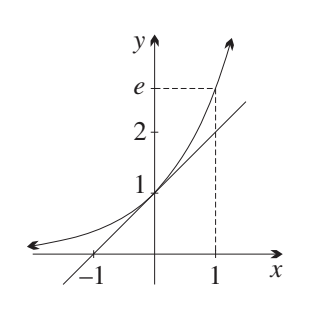
A sketch of shows an exponential curve passing through and , rising steeply as increases and approaching the x-axis as decreases.
Inverse function identities
The natural logarithm (also written as ) is the inverse function of . Two important identities connect these functions:
Note
Key Inverse Function Relationships:
These identities are useful when simplifying expressions and solving equations.
Using the calculator
Note
Calculator Keys for Exponential and Logarithmic Functions:
On your calculator:
- The button ln represents (natural logarithm)
- The button log represents (common logarithm)
- The function is usually accessed using shift followed by ln, or a similar key sequence
Transformations of y = e^x
We can create new exponential functions by applying transformations to the basic function . The main transformations are reflections and translations.
Reflection in the y-axis: y = e^-x
The function is obtained by reflecting in the y-axis.
Properties of y = e^-x:
- Reflects the original curve horizontally
- y-intercept: (same as )
- Horizontal asymptote:
- Range:
- This function represents exponential decay rather than growth
Note
A reflection in the y-axis can also be thought of as a horizontal dilation with factor .
Vertical translation: y = e^x + k
Adding a constant to shifts the entire graph vertically.
For y = e^x + 3:
- Shift the graph of up by 3 units
- y-intercept: because
- Horizontal asymptote: y = 3 (shifted up from )
- Range:
Horizontal translation: y = e^(x-h)
Replacing with shifts the graph horizontally.
For y = e^(x-2):
- Shift the graph of right by 2 units
- y-intercept: because when ,
- Horizontal asymptote: (unchanged)
- Range:
Note
Connection Between Shifts and Dilations:
The function can be rewritten as , which means it's also a vertical dilation of with factor .
This shows that horizontal shifts of exponential functions can sometimes be expressed as vertical dilations!
Dilations of y = e^x
Dilations were introduced in Section 2G and involve stretching or compressing the graph either horizontally or vertically. With exponential functions, dilations have an interesting property: some can be expressed as shifts in the other direction.
Horizontal dilation: y = e^(ax)
Replacing with creates a horizontal dilation with factor .
For y = e^(3x):
- Dilate horizontally with factor
- This compresses the graph horizontally (makes it steeper)
- The y-intercept remains at
- When , (the curve reaches height sooner)
Vertical dilation: y = ae^x
Multiplying by a constant creates a vertical dilation with factor .
For y = 3e^x:
- Dilate vertically with factor 3
- This stretches the graph vertically
- y-intercept: because
- When , (three times higher than the original curve)
Note
Another Connection: Vertical Dilation as Horizontal Shift
The function can be rewritten as:
This means it can also be viewed as a horizontal shift left by units.
Key insight about dilations
Important
Special Property of Exponential Function Dilations:
Some dilations of exponential functions can be expressed in two ways:
- is a horizontal dilation and cannot be rewritten as a simple shift
- is both a vertical dilation with factor AND a horizontal shift left by
This special property arises from the index law:
Tangents and normals to the exponential function
The derivative property makes finding tangent and normal lines straightforward. Let's work through a complete example.
Example
Worked Example: Tangent and Normal to y = 2e^x at x = 1
Question: Let be the point on the curve where .
a) Find the equations of the tangent and normal at point
b) Show that the tangent passes through the origin, and find where the normal meets the x-axis (point )
c) Find the area of triangle
Solution:
Part (a): Finding point A and the gradient
First, find the y-coordinate of point by substituting :
So A = (1, 2e).
Next, find the gradient by differentiating:
At point where :
This confirms the "gradient equals height" property since the gradient is , which equals the y-coordinate.
Finding the tangent equation:
Using point-gradient form with and point :
Tangent equation: y = 2ex
Finding the normal equation:
The normal is perpendicular to the tangent, so its gradient is (negative reciprocal).
Using point-gradient form:
Multiply both sides by :
Normal equation: x + 2ey = 4e² + 1
Part (b): Intercepts
Tangent through origin:
The tangent equation is . When , we have , so the tangent passes through the origin . Its y-intercept is zero.
Normal x-intercept:
To find where the normal meets the x-axis (point ), set in the normal equation:
So B = (4e² + 1, 0).
Part (c): Area of triangle AOB
Triangle has:
- Base along the x-axis from to : length
- Height perpendicular to the base: height (the y-coordinate of )
Using the triangle area formula:
Area = e(4e² + 1) square units
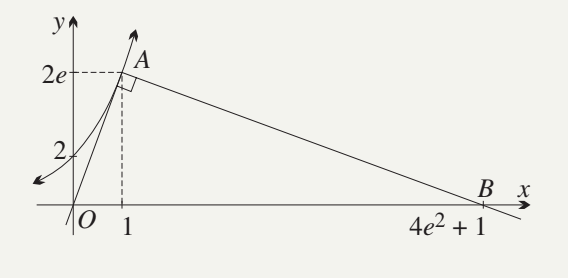
This example demonstrates how the derivative property of simplifies calculations involving tangent and normal lines.
Remember!
Summary
Key Points to Remember:
-
The defining property: The exponential function is its own derivative: . At every point, gradient equals height.
-
Key transformations: Reflecting in the y-axis gives (exponential decay). Vertical shifts change the asymptote from to . Horizontal shifts can also be expressed as vertical dilations.
-
Dilations and shifts: Some vertical dilations of can be rewritten as horizontal shifts. For example, is both a vertical stretch and a horizontal shift.
-
Inverse function: The natural logarithm is the inverse of . Remember: and .
-
Tangent and normal lines: Use the derivative to find the gradient of the tangent. The normal's gradient is the negative reciprocal. Both can be found using point-gradient form: .