Differentiating the Trigonometric Functions (HSC SSCE Mathematics Advanced): Revision Notes
📚Revision Notes
Differentiating the Trigonometric Functions
Introduction
Building on the fundamental limit from earlier work, we can now establish the derivatives of the three main trigonometric functions: , , and . These derivatives form essential standard results that you need to know by heart. The proofs are quite advanced, but using these formulas to differentiate more complex trigonometric functions is straightforward once you master the basic patterns.
Note
While the mathematical proofs of these derivative formulas are quite sophisticated, you don't need to memorize the proofs. However, you absolutely must memorize the three standard derivative formulas themselves, as they form the foundation for all trigonometric differentiation.
Standard derivatives of trigonometric functions
Here are the three fundamental derivative formulas for trigonometric functions. These must be memorised:
Important
Standard derivatives:
Critical requirement: These formulas only work when is measured in radians, not degrees. This is one of the key reasons why radians are the standard unit for angles in calculus.
Notice that the derivative of sine is cosine, but the derivative of cosine introduces a negative sign. The derivative of tangent involves secant squared, which may seem unusual at first but follows from the quotient rule applied to .
Graphical understanding of the derivative of sin x
Before diving into calculations, it helps to understand visually why the derivative of is .
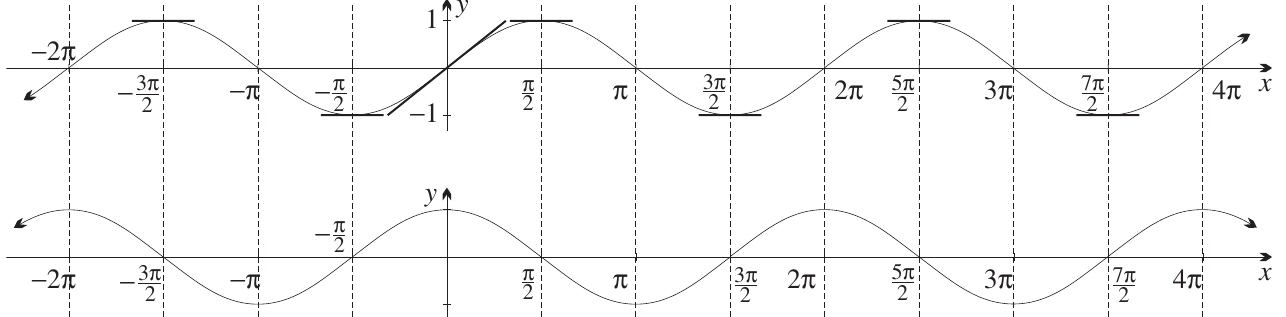
Consider the graph of . If we sketch its derivative by examining where the gradient is zero, maximum, or minimum:
- At , the sine curve has its steepest positive gradient
- At , the curve reaches a maximum, so the gradient is zero
- At , the gradient is steepest in the negative direction
- At , the curve reaches a minimum, so the gradient is zero again
When we plot these gradient values, we get a wave that looks exactly like the cosine function. Furthermore, we know from limits that the gradient of at the origin equals exactly , which matches the maximum value of at .
Note
This graphical approach doesn't constitute a rigorous proof, but it provides strong visual evidence for the relationship between sine and its derivative. It's an excellent way to build intuition about why makes sense.
Working with the standard forms
Now let's see how to apply these standard derivatives in practice.
Example
Worked Example: Basic differentiation
Differentiate these functions and find the gradient when :
a)
Applying the standard derivatives:
When :
This tells us that at , the function has a horizontal tangent.
b)
Differentiating:
When :
Example
Worked Example: Finding the tangent line
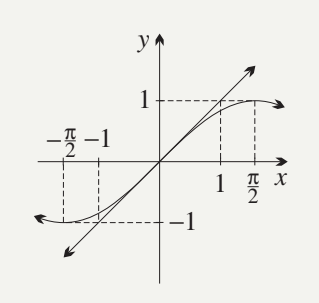
If , find and determine the equation of the tangent to at the origin.
Step 1: Note that , so the curve passes through the origin.
Step 2: Differentiate:
Step 3: Evaluate at :
Step 4: This means the tangent line at the origin has gradient 1. Using the point-gradient form:
This simple result confirms that radian measure is the natural choice for calculus. The tangent to the sine curve at the origin has the beautifully simple equation .
Using the chain rule to generate more standard forms
When the angle in a trigonometric function is not simply , but a linear expression like , we need to use the chain rule. This creates a predictable pattern.
Example
Worked Example: Chain rule with linear functions
a) Differentiate
Let , so
Then and
By the chain rule:
b) Differentiate
Let , so
Then and
By the chain rule:
c) Differentiate
Let , so
Then and
By the chain rule:
This last result generalises to give us extended standard forms.
Standard derivatives of functions of ax + b
When the angle is a linear function , we can use these extended formulas:
Important
Extended standard forms:
The pattern is clear: differentiate as normal, but multiply by the coefficient of .
Example
Worked Example: Using extended standard forms
a) Differentiate
Here and :
b) Differentiate
Here and :
c) Differentiate
Here and :
Using the chain rule with more complex functions
For functions that don't fit the pattern, we apply the chain rule in its general form.
Example
Worked Example: Chain rule with powers and composite functions
a) Differentiate
Let , so
Then and
By the chain rule:
b) Differentiate
Let , so
Then and
By the chain rule:
Using the product rule with trigonometric functions
When a trigonometric function is multiplied by another function, use the product rule:
Example
Worked Example: Product rule application
Differentiate
Step 1: Let and
Step 2: Find the derivatives: and
Step 3: Apply the product rule:
Using the quotient rule with trigonometric functions
When one function is divided by another, use the quotient rule:
Example
Worked Example: Quotient rule application
Differentiate
Step 1: Let and
Step 2: Find the derivatives: and
Step 3: Apply the quotient rule:
Successive differentiation of sine and cosine
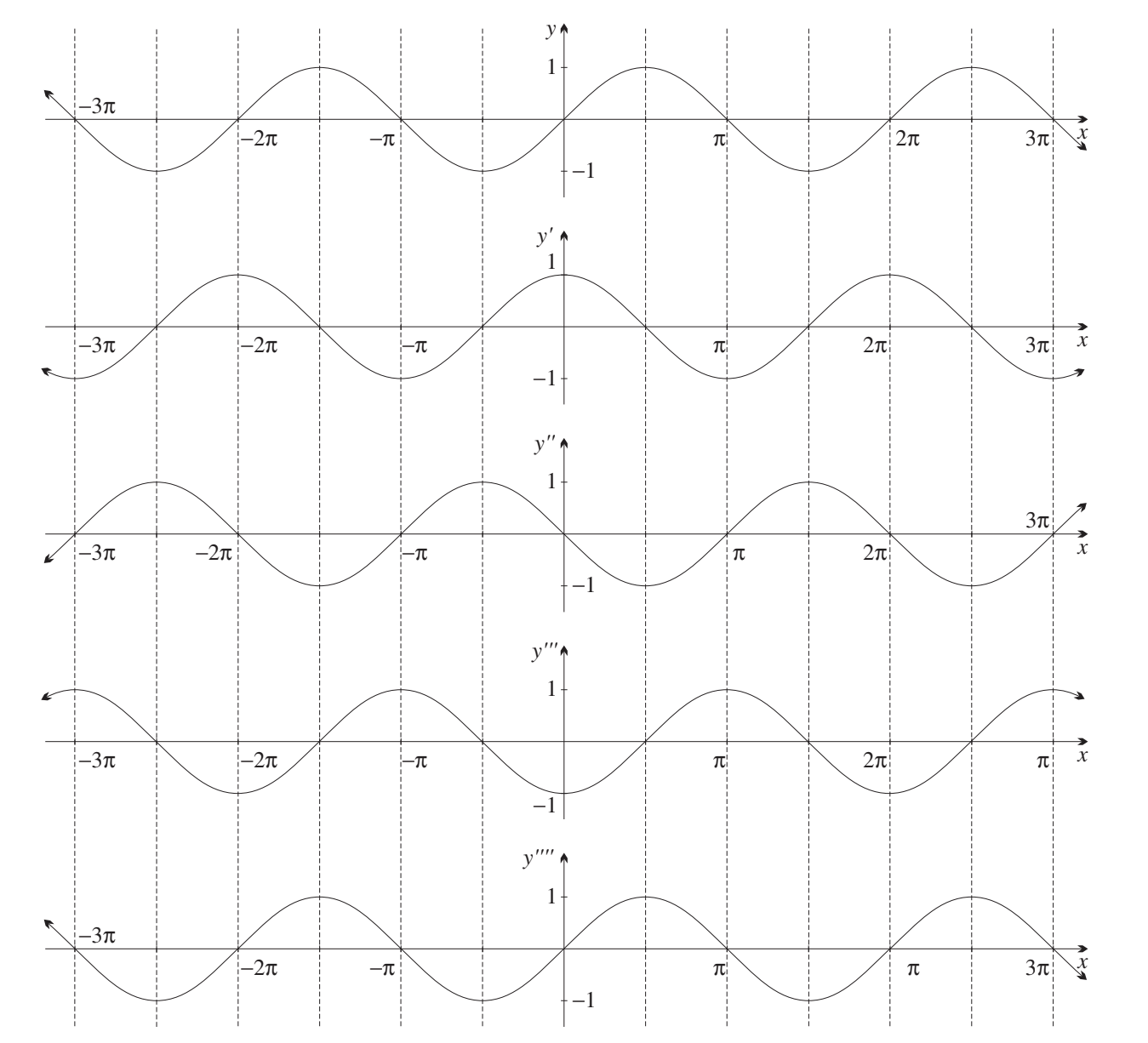
An interesting pattern emerges when we differentiate repeatedly:
Notice that after four differentiations, we return to the original function. This means differentiation is an order 4 operation on the sine function.
Note
The same pattern occurs with . Both functions satisfy:
- (the second derivative equals the negative of the original)
- (the fourth derivative equals the original)
This cyclical behavior is unique to sine and cosine among elementary functions, and it reflects their periodic nature.
Differentiation as phase shift
Each differentiation of sine or cosine shifts the wave to the left by , which is one quarter of the period . We say that differentiation advances the phase by .
Key relationships:
The second derivative shifts the wave by (half a period), which reflects the graph in the -axis:
Four differentiations shift the wave by (one full period), bringing it back to itself:
Connection between π and e
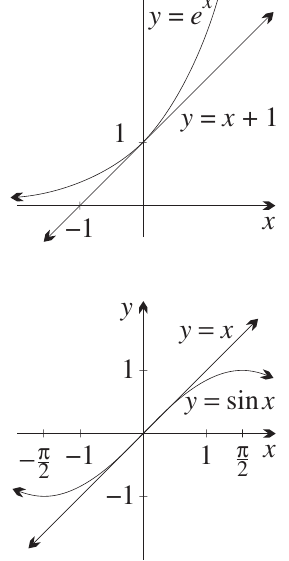
There are striking parallels between the number (used in radians) and the number (the natural exponential base).
Note
Interesting Parallels:
For exponential functions:
- The derivative of is exactly
- The tangent to at the -intercept has gradient exactly
For trigonometric functions with radian measure:
- The derivative of is exactly
- The tangent to at the origin has gradient exactly
Both and are irrational numbers. The number relates to the area of circles, while relates to areas under the rectangular hyperbola. These connections hint at deeper relationships between trigonometric and exponential functions.
Interestingly, there are now four functions whose fourth derivatives equal themselves: , , , and .
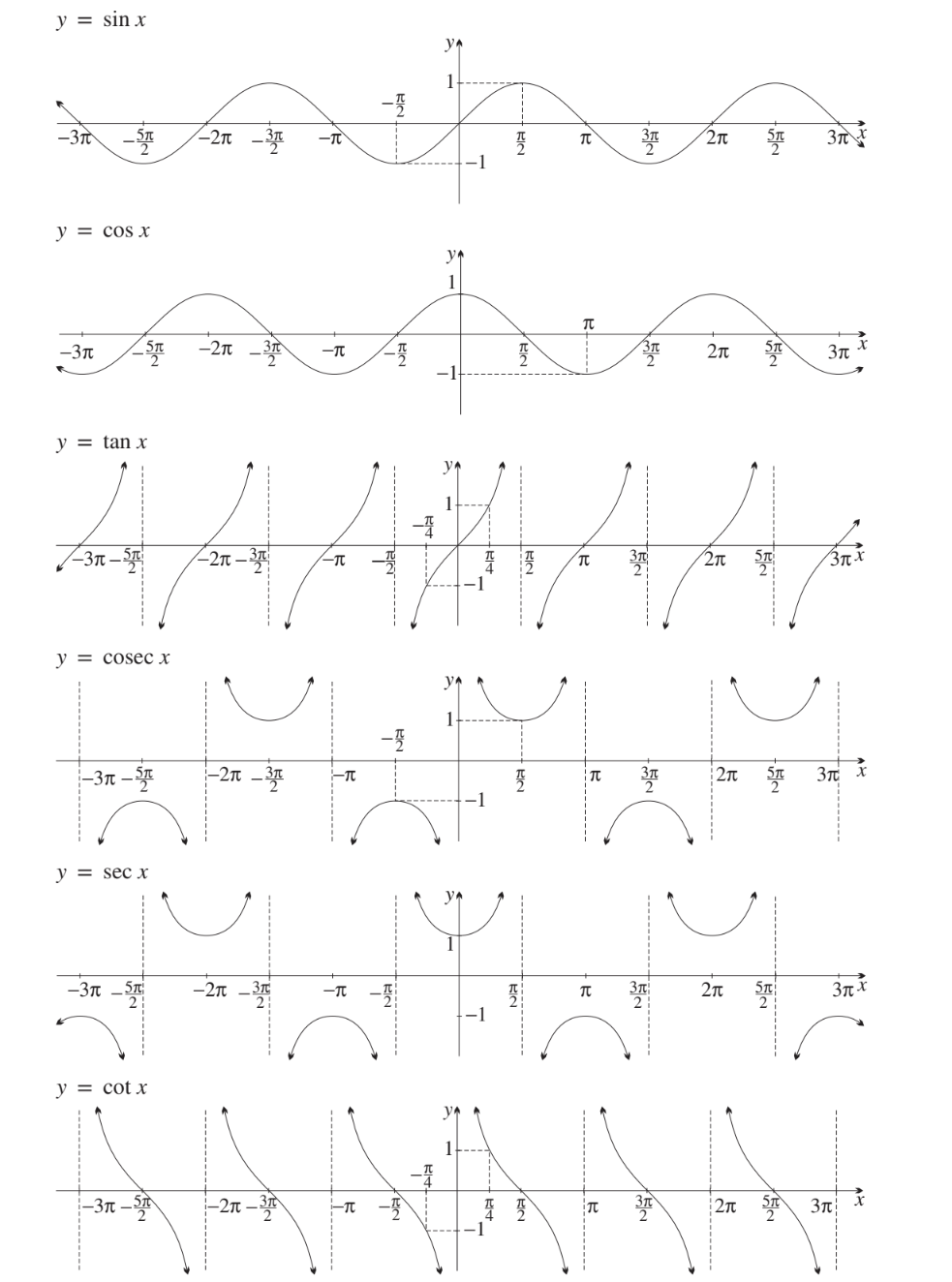
Graphs of the six trigonometric functions
It's helpful to visualise all six trigonometric functions. Here are their key properties:
Amplitude and period:
- and each have amplitude 1
- The other four functions do not have a defined amplitude
- , , , and each have period
- and have period
Summary
Key Points to Remember:
- Master the three standard derivatives: , ,
- For linear angles : Multiply the standard derivative by the coefficient
- Use the chain rule when the angle is a more complex function of
- Successive differentiation of sine and cosine returns to the original function after four steps
- Radian measure is essential for these formulas to work correctly