Integrating the Trigonometric Functions (HSC SSCE Mathematics Advanced): Revision Notes
📚Revision Notes
Integrating the Trigonometric Functions
In calculus, we can reverse the standard differentiation formulas to find integration formulas. This process allows us to integrate trigonometric functions using known patterns from differentiation.
Standard forms for integrating trigonometric functions
When we reverse the standard forms for differentiating , , and , we obtain three fundamental standard integrals. These are essential building blocks for integration.
Note
The key insight in integration of trigonometric functions is that we can work backwards from differentiation. Each differentiation rule gives us a corresponding integration formula, though we must be careful about signs and constants of integration.
Deriving the standard integrals
Example
Deriving the Cosine Integral
We know that
Working backwards from this differentiation result:
This is our first standard integral.
Example
Deriving the Sine Integral
We know that
Reversing this:
Multiplying both sides by :
Notice the negative sign that appears in the final result.
Example
Deriving the Secant Squared Integral
We know that
Reversing this:
The three standard trigonometric integrals
Important
Essential Formulas to Memorize
These formulas should be memorised carefully, paying particular attention to the negative sign in the second formula:
where is the constant of integration.
Important
Critical Restriction on Primitives
No calculation involving a primitive may cross an asymptote. This means when evaluating definite integrals, ensure the interval of integration does not include points where the function is undefined.
Worked example: Area under a sine curve
Example
Finding the Area Under the First Arch of y = sin x
Let's find the area of the first arch of the curve .
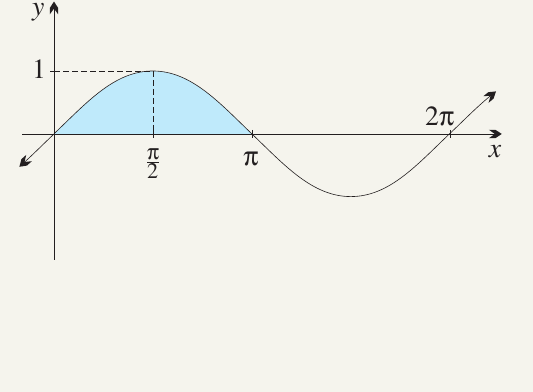
Because the region is entirely above the x-axis, we can calculate:
Note that and from the graph of .
Note
This simple answer confirms that radians are the correct units to use for calculus with trigonometric functions. Using degrees would produce much more complicated results.
Additional worked examples
Example
Evaluating Definite Integrals with Trigonometric Functions
a) Evaluate
The result is zero because the positive and negative areas cancel out.
b) Evaluate
c) Why is meaningless?
This integral is meaningless because it crosses the asymptote at , where (and therefore ) is undefined.
Integrating functions of the form
We can extend our standard integrals to handle composite functions where is replaced by . This gives us more powerful integration formulas.
Deriving the extended forms
Example
Deriving the Cosine Formula for ax + b
We know that
Reversing this:
Dividing by :
Notice we multiply by 1/a, the reciprocal of the coefficient.
Example
Deriving the Sine Formula for ax + b
We know that
Reversing this:
Dividing by :
Example
Deriving the Secant Squared Formula for ax + b
We know that
Reversing this:
Dividing by :
Standard integrals for functions of
Important
Extended Standard Formulas
These extended forms should also be memorised:
Key point: Notice that we multiply by 1/a, which is the reciprocal of the coefficient of .
Worked examples with composite functions
Example
Example 1: Evaluating
Here, the coefficient is , so we multiply by 1/3.
Example
Example 2: Evaluating
Since the coefficient of is , the reciprocal is 4:
Example
Example 3: Evaluating
Note: is in quadrant 3 with related angle , so .
The primitives of and
To find the primitives of and , we use their ratio definitions and apply logarithmic integration techniques.
Key formula for logarithmic integration
Note
The Logarithmic Integration Pattern
We need the standard form from the previous chapter:
or equivalently:
This formula is the key to integrating tan x and cot x.
Finding the primitive of
Example
Deriving the Integral of cot x
Using the ratio formula :
Let , then
This matches the pattern u'/u, so:
Important
Do not use this formula across a zero of sin x.
Finding the primitive of
Example
Deriving the Integral of tan x
Using the ratio formula :
We need to rewrite this to match the pattern :
Let , then
Therefore:
This can also be written as:
Important
Do not use this formula across a zero of cos x.
Finding a function whose derivative is known
When we know the derivative of a function and the value of the function at one specific point, we can determine the entire original function by finding the constant of integration.
Note
Method for Finding the Original Function
Step 1: Integrate the derivative to find the general form of the function (with an unknown constant ).
Step 2: Use the given point to substitute values and solve for C.
Step 3: Write the complete function with the determined value of .
Worked example 1
Example
Finding a Function from its Derivative and Initial Condition
The derivative of a function is , and the graph has -intercept . Find the original function and then find .
Step 1: Integrate the derivative
Taking the primitive:
Step 2: Use the initial condition
When , , so:
Step 3: Write the complete function
Finding the requested value:
When :
The answer is 4.
Worked example 2
Example
Finding and Evaluating a Function
Given that and :
a) Find the function
Taking the primitive:
Using the condition :
Therefore:
b) Find
Substituting :
Using the reverse chain rule
The chain rule from differentiation can be reversed to handle more complex integrals, particularly those involving powers of trigonometric functions.
The reverse chain rule formula
Note
Reverse Chain Rule Pattern
For powers of :
Or using notation:
This formula is particularly useful when integrating composite trigonometric expressions.
Method using differentiation first
Sometimes it's helpful to use the chain rule to differentiate first, then reverse the process to find the integral.
Example
Using Differentiation to Find an Integral
Use the chain rule to differentiate , then find
Part 1: Differentiation
Let
Let , then
By the chain rule:
Therefore:
Part 2: Finding the integral
From Part 1, we know:
Reversing this:
Dividing by :
Therefore:
Direct application of the reverse chain rule
We can also apply the reverse chain rule formula directly without differentiating first.
Example
Direct Application of the Reverse Chain Rule
Use the reverse chain rule to find
We need to identify the pattern .
Let , then
Rewriting the integral:
This matches our previous result.
Summary
Key Points to Remember:
-
The three standard trigonometric integrals are: , , and . Pay special attention to the negative sign in the sine integral.
-
For composite functions , multiply by 1/a (the reciprocal of the coefficient): , and similarly for sine and secant squared.
-
Never evaluate a definite integral across an asymptote, as this makes the integral meaningless.
-
To integrate and , use their ratio definitions and logarithmic integration: and .
-
When finding a function from its derivative and an initial condition, first integrate to get the general form with constant , then substitute the given point to find the specific value of .
-
The reverse chain rule is powerful for integrating composite functions, especially powers of trigonometric functions. The pattern is: