The Behaviour of sin x Near the Origin (HSC SSCE Mathematics Advanced): Revision Notes
📚Revision Notes
The Behaviour of sin x Near the Origin
Introduction
This topic establishes a key limit that forms the foundation for finding the derivative of . This limit demonstrates that the curve has gradient 1 when it passes through the origin. In geometric terms, this shows that the line is the tangent to at the origin.
Understanding this behaviour provides the geometric basis for differentiating the trigonometric functions.
A fundamental inequality
To begin, we use a geometric approach to establish an important relationship between , and for angles near the origin.
Important
The inequality for sin x and tan x near the origin
For all acute angles :
For :
Geometric proof
Part A: Acute angles
Let be an acute angle.
Draw a circle with centre and any radius . Create a sector that subtends the angle at the centre . Let the tangent at point meet the radius at point (the radius may need to be extended). Join the chord .
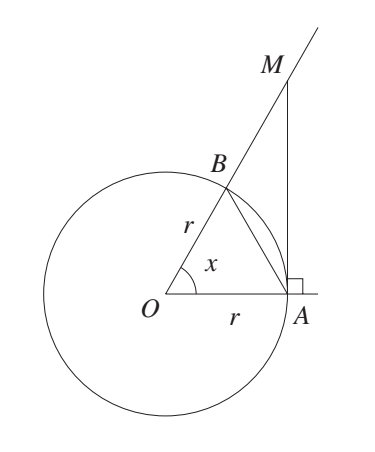
In triangle :
Therefore:
The diagram shows that:
Note
We use the standard area formulae to compare these regions:
- Area of triangle:
- Area of sector:
- Area of triangle with tangent:
Using the area formulae for triangles and sectors:
Dividing through by :
Part B: Negative angles
Because , and are all odd functions, the inequality reverses for negative angles:
The main theorem
The inequality established above allows us to prove two fundamental limits that are essential for calculus with trigonometric functions.
Important
Two fundamental limits
Proof of the fundamental limits
When is acute, we know that:
Dividing through by :
As , , so:
But is an even function, so:
Combining these two limits:
Finally:
The behaviour of sin x and tan x near the origin
The line is a tangent to both and at the origin.
When , the derivatives of both and are exactly .
Note
What the graph shows:
The following graph illustrates what we have proven about the behaviour of these functions near the origin:
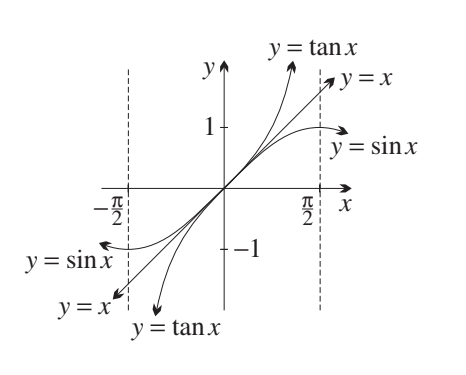
- The line is a common tangent at the origin to both and
- On both sides of the origin, curves away from the tangent towards the -axis
- On both sides of the origin, curves away from the tangent in the opposite direction
Approximations to the trigonometric functions for small angles
For 'small' angles (positive or negative), the limits above provide good approximations for the three trigonometric functions. The angle must be expressed in radians for these approximations to work.
Note
Small-angle approximations
Suppose that is a 'small' angle (written in radians). Then:
Example
Worked Example 1: Simple approximations
Question: Use the small-angle approximations to give approximate values of:
a)
b)
c)
Solution:
The 'small angle' of is radians. Hence, using the approximations above:
a)
b)
c)
Example
Worked Example 2: Tower height problem
Question: Approximately how high is a tower that subtends an angle of when it is km away?
Solution:
Convert km to metres.
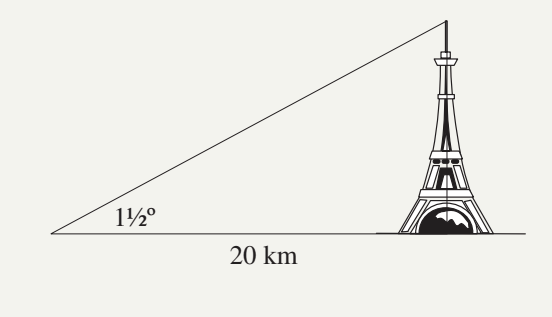
Then from the diagram, using simple trigonometry:
But the 'small' angle expressed in radians is :
Hence, approximately:
Example
Worked Example 3: Sun diameter problem
Question: The sun subtends an angle of at the Earth, which is km away. What is the sun's approximate diameter?
Note: This problem can be solved similarly to the previous example, but like many small-angle problems, it can also be done by approximating the diameter to an arc of the circle.
Solution:
First, convert the angle to radians:
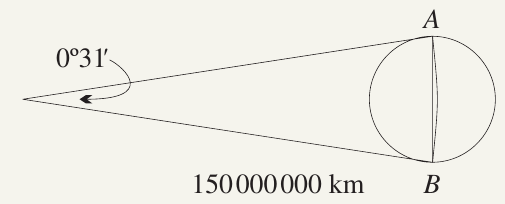
Because the diameter is approximately equal to the arc length :
Summary
Key Points to Remember:
- For all acute angles : (for negative angles near zero, the inequality reverses)
- The fundamental limits are: and
- At the origin, the line is tangent to both and , with both functions having derivative 1 at
- For small angles in radians: , , and
- These approximations only work when the angle is expressed in radians, not degrees