Gross Pay, Net Pay, and Deductions (HSC SSCE Mathematics Standard): Revision Notes
📚Revision Notes
Gross Pay, Net Pay, and Deductions
Understanding your pay
When you start working, it's important to understand the difference between what your employer pays you and what you actually take home. These amounts are rarely the same because of various deductions.
Note
Understanding the difference between gross pay and net pay is essential for managing your personal finances and budgeting effectively. This knowledge helps you understand exactly how much money you'll have available to spend or save each pay period.
What is gross pay?
Gross pay is your total earnings before any money is taken out. This includes:
- Your regular wages or salary
- Allowances
- Overtime pay
- Commissions
- Bonuses
Think of gross pay as the "big number" - it's the full amount you've earned before any deductions are applied.
What is net pay?
Net pay (also called take-home pay) is the amount of money you actually receive in your bank account after all deductions have been subtracted from your gross pay. This is what you can spend or save.
Important
Your net pay is always less than your gross pay because of deductions. The difference between these two amounts represents all the money taken out for taxes, retirement savings, and other purposes.
Common deductions from your pay
A deduction is money that is regularly taken from your wage or salary. Here are the most common types:
Income tax
A compulsory charge collected by the government to fund public services and operations. The amount depends on how much you earn - higher earners typically pay a higher percentage.
Note
Exam tip: On pay slips, income tax is often shown as PAYG tax (Pay As You Go tax). This means the tax is deducted from each pay, rather than being paid in a lump sum at the end of the year.
Superannuation
An investment fund for your retirement. Australian employers must contribute at least 9% of your wages to a superannuation fund. This money is saved for when you retire and cannot be accessed until you reach retirement age.
Note
Superannuation is sometimes called "super" for short. While your employer must contribute at least 9%, you can also choose to make additional voluntary contributions to increase your retirement savings.
Health insurance
Private insurance that covers medical and dental expenses. This is optional but many people choose to have it for better healthcare access and to avoid paying the Medicare levy surcharge.
Union fees
Payment for membership in a trade union. Unions represent workers' rights and interests. This is optional depending on whether you join a union.
Other deductions
Your pay slip might also show:
- Social club fees
- HECS repayments (for university students repaying their study loans)
- Other post-tax deductions
The net pay formula
To calculate your net pay, use this simple formula:
Where deductions is the total of all amounts taken from your pay.
Important
Remember: You must add up all deductions first before subtracting them from the gross pay. A common mistake is forgetting to include all deduction types in your calculation.
Worked example: Calculating net pay
Example
Worked Example: Calculating Net Pay
Laura is a nurse who receives a gross weekly wage of $2345. She has the following deductions taken from her pay:
- Income tax: $861
- Health fund payments: $48.25
- Superannuation: $67.95
What is Laura's net pay?

Solution
Step 1: Identify what we need to find
- We need to calculate Laura's net pay
Step 2: Write the formula
Step 3: Calculate total deductions
First, add up all the deductions:
Step 4: Substitute the values into the formula
Step 5: Calculate the answer
Therefore, Laura's net pay is $1367.80.
Reading a pay slip
Pay slips contain important information about your earnings and deductions. Learning to read them correctly is an essential life skill that helps you verify you're being paid correctly and track your finances.
Worked example: Understanding pay slip information
Example
Worked Example: Reading a Pay Slip
Oscar received the following pay slip. What amount is shown for:
- a) Gross pay?
- b) Net pay?
- c) Superannuation?
- d) PAYG tax?
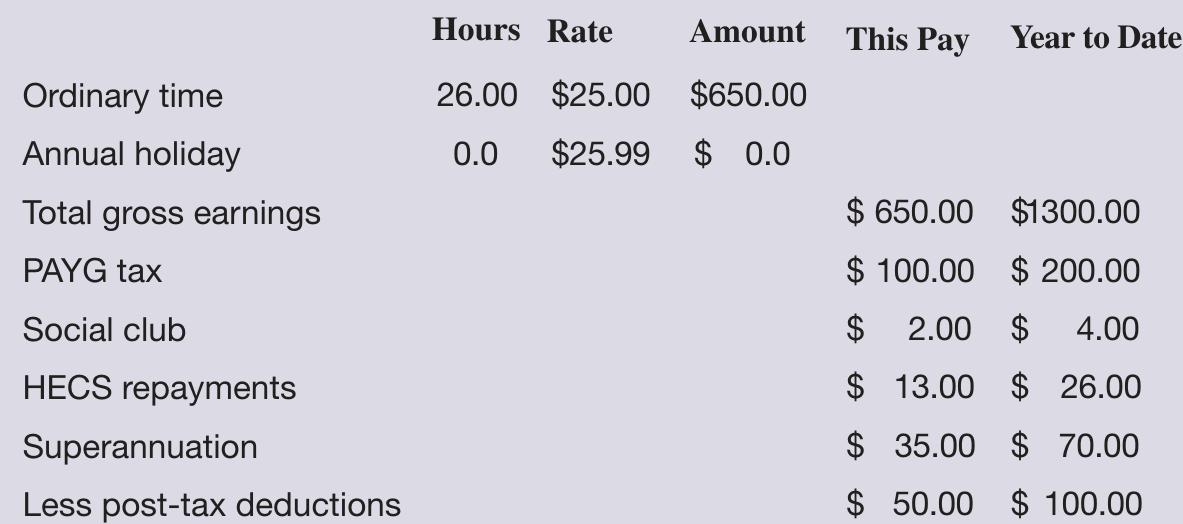
Solution
a) Gross pay: Look for "Total gross earnings" in the "This Pay" column.
- Oscar's gross pay is $650.00
b) Net pay: Find "Net pay" in the "This Pay" column.
- Oscar's net pay is $450.00
c) Superannuation: Locate "Superannuation" in the "This Pay" column.
- The superannuation deduction is $35.00
d) PAYG tax: Find "PAYG tax" in the "This Pay" column.
- The PAYG tax deducted is $100.00
Understanding pay slip columns
Most pay slips have two important columns:
- This Pay - Shows amounts for the current pay period
- Year to Date - Shows cumulative totals for the financial year
Note
Exam tip: Always check which column you're reading from. Questions usually ask about "this pay" rather than year-to-date figures. Reading from the wrong column is a common mistake that can cost you marks.
Key information on a pay slip
A typical pay slip includes:
Earnings section:
- Hours worked
- Rate of pay per hour
- Total gross earnings
Deductions section:
- All amounts taken from your gross pay
- Each deduction listed separately
Net pay:
- Your final take-home amount
- Usually shows as "Direct credit to account"
Note
Pay slips are important documents that you should keep for your records. They serve as proof of income and can be needed for loan applications, rental applications, or tax purposes.
Summary
Key Points to Remember:
- Gross pay is your total earnings before any deductions - the "big number"
- Net pay is your actual take-home pay after deductions - what arrives in your bank account
- The formula is: Net pay = Gross pay − Deductions
- Common deductions include income tax, superannuation, health insurance, and union fees
- Australian employers must contribute at least 9% superannuation
- Always check the "This Pay" column when reading pay slip information
- Your net pay is always less than your gross pay because of deductions