Changing the Subject of the Formula (HSC SSCE Mathematics Standard): Revision Notes
📚Revision Notes
Changing the Subject of the Formula
What is the subject of a formula?
When working with equations and formulas, the subject is the variable (pronumeral) that appears alone on the left-hand side of the equals sign, with no numbers attached to it. For example, in the formula , the variable is the subject because it stands by itself on the left side.
Understanding how to change the subject of a formula is an essential algebraic skill. Sometimes you need to rearrange a formula to make a different variable the subject, especially when you know the values of other variables and want to find a specific one. This process is also called making a variable the subject or rearranging a formula.
Note
Think of the subject as the "answer" variable—it's the one you're solving for. Just as in simple equations like , where is clearly the subject, more complex formulas follow the same principle.
Method for changing the subject
The key principle when changing the subject of a formula is to isolate the variable you want by moving all other terms to the opposite side of the equation. You achieve this by using opposite operations (also called inverse operations) to undo what has been done to your chosen variable.
The process involves three main steps:
1. Identify the opposite operation
Every mathematical operation has an opposite that "undoes" it:
- Addition is opposite to subtraction
- Multiplication is opposite to division
- Squaring (raising to power ) is opposite to taking the square root
- Raising to power is opposite to taking the th root
2. Add or subtract to both sides
When a term is added or subtracted in your equation, you remove it by adding or subtracting the same value from both sides. This maintains the balance of the equation, which is the fundamental rule in algebra—whatever you do to one side must be done to the other.
3. Multiply or divide both sides
When your variable is multiplied or divided by a number, you use the opposite operation on both sides of the equation. If it's multiplied by , divide both sides by . If it's divided by , multiply both sides by .
Important
The golden rule of rearranging equations: Whatever you do to one side, you must do to the other side. This maintains the balance and equality of the equation. Think of it like a set of scales—to keep them balanced, any change on one side must be matched on the other.
The goal is to systematically undo each operation that has been applied to your variable, working backwards through the order of operations, until the variable stands alone on one side of the equation.
Worked examples
Example
Worked Example 1: Linear equation with addition and multiplication
Consider a formula for calculating the total cost of a child's birthday party:
where is the total cost in dollars and is the number of children attending.

Let's make the subject of this equation. This would allow us to calculate how many children can attend for a given budget.
Solution:
We need to isolate by removing the operations applied to it. Currently, is multiplied by 40 and then 75 is added.
Step 1: Start with the original formula.
Step 2: Remove the added by subtracting 75 from both sides.
Step 3: Rearrange to put the subject on the left-hand side (this is conventional but not mathematically necessary).
Step 4: Remove the multiplication by by dividing both sides by 40.
Step 5: Simplify to get the final answer.
Now the formula is rearranged with as the subject. If you know the total cost , you can substitute it into this formula to find how many children can attend.
Example
Worked Example 2: Quadratic equation with powers
Pythagoras' theorem describes the relationship between the sides of a right-angled triangle:
where , , and are the lengths of the sides, with being the hypotenuse (longest side).
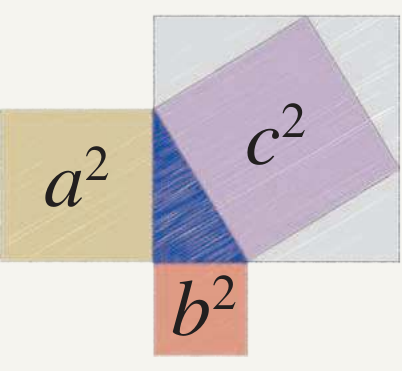
Part a: Make the subject of the formula.
Solution:
Step 1: Write the formula.
Step 2: Remove by subtracting it from both sides.
Step 3: Rearrange with the subject on the left.
Step 4: Remove the square by taking the square root of both sides.
The formula is now rearranged to find the length of side .
Part b: Find the length of given and . Give your answer correct to one decimal place.
Solution:
Step 5: Substitute the values into the rearranged formula.
Step 6: Evaluate the expression.
Step 7: Round to one decimal place.
Therefore, the length of side is approximately 4.9 units.
Example
Worked Example 3: Exponential equation with powers and roots
The compound interest formula calculates the final amount in an investment:
where is the final amount, is the principal (initial amount), is the interest rate (as a decimal), and is the number of time periods.
Let's make the subject of this formula. This would allow us to calculate what interest rate is needed to reach a target amount.
Solution:
Step 1: Write the formula.
Step 2: Remove the multiplication by by dividing both sides by .
Step 3: Remove the power of by taking the th root of both sides.
Step 4: Remove the added by subtracting 1 from both sides.
Step 5: Rearrange with the subject on the left-hand side.
The formula now has as the subject, allowing you to find the required interest rate for a given investment scenario.
Exam tips
When working on changing the subject of a formula in exams, keep these practical strategies in mind to avoid common mistakes and work more efficiently:
Note
- Always perform the same operation to both sides of the equation to maintain balance
- Work through operations in reverse order—undo the last operation first
- Check your rearranged formula by substituting simple values
- Remember that taking a square root gives the positive value in most practical contexts
- Write each step clearly on a new line to avoid errors
Remember!
These key concepts form the foundation of successfully changing the subject of any formula:
Summary
Key Points to Remember:
- The subject of a formula is the variable that appears alone on the left-hand side with no numbers attached
- Use opposite operations to isolate your chosen variable: addition ↔ subtraction, multiplication ↔ division, squaring ↔ square root
- Whatever operation you perform on one side of the equation, you must perform on the other side to maintain balance
- Work systematically through the operations applied to your variable, undoing them one at a time
- For complex formulas with powers or roots, remember that the opposite of raising to power is taking the th root