Measurement Errors (HSC SSCE Mathematics Standard): Revision Notes
📚Revision Notes
Measurement Errors
Introduction to measurement uncertainty
When we take measurements using any instrument, there will always be some degree of error and uncertainty. Even when using very sensitive instruments, repeating the same measurement will often give slightly different results each time.
There are several sources of measurement errors that can affect our readings:
- Reading errors: Mistakes made when interpreting the scale on an instrument
- Parallax error: Errors caused by viewing the measurement from an angle rather than straight on
- Calibration error: Inaccuracies in the instrument itself
Note
The accuracy of any measurement can be improved by taking multiple measurements of the same quantity using the same instrument. This helps us identify and reduce random errors.
Understanding precision
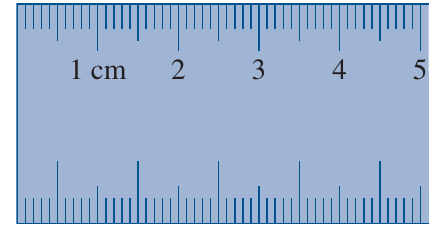
When we use a measuring instrument like a ruler or thermometer, the precision refers to the smallest division or unit that we can read on that instrument. This is also called the limit of reading.
For example, if you have a 30 cm ruler that is marked in millimetres, the smallest unit you can measure is 1 mm. Therefore, this ruler has a precision of 1 mm.
Important
The precision of an instrument limits how accurately we can measure. No matter how carefully we try to read a measurement, our accuracy is restricted to plus or minus half of the precision, written as .
Example: If you measure something as 10 mm on a ruler with 1 mm precision, the actual measurement could be anywhere in the range mm.
Absolute error and bounds
Every measurement we make is an approximation and contains some error. The absolute error represents the difference between the actual value and the measured value shown by the instrument.
Important
The maximum value for an absolute error is always half of the precision:
This is the single most important rule to remember when calculating measurement errors!
This absolute error creates a range of possible values for our measurement, defined by an upper bound and a lower bound.
| Term | Definition | Formula |
|---|---|---|
| Precision | Smallest unit on measuring instrument or limit of reading | N/A |
| Absolute error | Measured value minus actual value | |
| Upper bound | Maximum possible value of the measurement | Measurement Absolute error |
| Lower bound | Minimum possible value of the measurement | Measurement Absolute error |
Example
Calculating Bounds: 10 mm Measurement
Using a measurement of 10 mm with precision 1 mm:
Step 1: Calculate the absolute error
- Absolute error mm
Step 2: Calculate the upper bound
- Upper bound mm
Step 3: Calculate the lower bound
- Lower bound mm
Conclusion: The true value lies somewhere between 9.5 mm and 10.5 mm.
Relative error
While the absolute error tells us the size of the error in the same units as the measurement, the relative error gives us an indication of how significant this error is compared to the size of what we're measuring.
Note
A 0.5 mm error might be very significant when measuring something small (like a 2 mm insect), but quite insignificant when measuring something large (like a 50 metre swimming pool). This is why relative error is useful!
The relative error is calculated by dividing the absolute error by the actual measurement:
Example: For our measurement of 10 mm with absolute error of 0.5 mm:
This tells us the error is 0.05 (or 5 hundredths) of the measurement size.
Percentage error
The percentage error is simply the relative error expressed as a percentage. This makes it easier to interpret and compare errors across different measurements.
To find the percentage error, we multiply the relative error by 100%:
Example: Continuing with our 10 mm measurement:
This means our measurement has an error of plus or minus 5%.
Note
Exam tip: Percentage error is often easier to interpret than absolute or relative error, and is commonly used in scientific work to compare the precision of different measurements.
Worked example: Finding measurement errors
Example
Complete Worked Example: Ruler Measurement
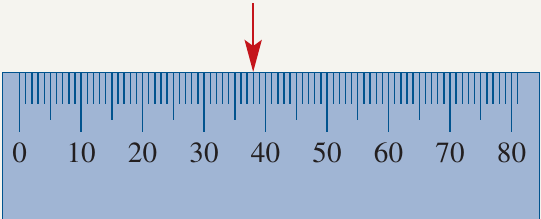
A ruler is marked in millimetres.
Questions:
- a) What is the length indicated by the arrow on this ruler?
- b) What is the precision or limit of reading?
- c) What is the upper and lower bound for each measurement?
- d) Find the relative error. Answer correct to three decimal places.
- e) Find the percentage error. Answer correct to one decimal place.
Solution:
a) Finding the measurement
The arrow is pointing to the 38 mm mark on the ruler.
Length
b) Finding the precision
The precision is the smallest unit marked on the ruler. Looking at the ruler, we can see it is marked in millimetres.
Precision
c) Finding the upper and lower bounds
First, calculate half the precision:
The lower bound is found by subtracting the absolute error from the measurement:
The upper bound is found by adding the absolute error to the measurement:
d) Finding the relative error
Using the formula for relative error:
e) Finding the percentage error
Using the formula for percentage error:
Remember!
Summary
Key Points to Remember:
-
Precision is the smallest unit on your measuring instrument and determines the limit of your reading accuracy
-
Absolute error is always of the precision, regardless of what you're measuring
-
Upper bound = Measurement + Absolute error; Lower bound = Measurement - Absolute error
-
Relative error shows how significant the error is compared to the measurement size:
-
Percentage error is relative error expressed as a percentage: multiply relative error by 100%