Capacity (HSC SSCE Mathematics Standard): Revision Notes
📚Revision Notes
Capacity
What is capacity?
Capacity refers to how much liquid a container can hold. It's important to understand that some objects have both volume and capacity. For example, a soft drink can is a cylinder that has:
Note
Understanding Volume vs Capacity:
- Volume (as a solid shape): calculated using
- Capacity (as a container): the amount of liquid it can hold, such as mL
This distinction is important – volume measures the space the object occupies, while capacity measures how much liquid it can contain.
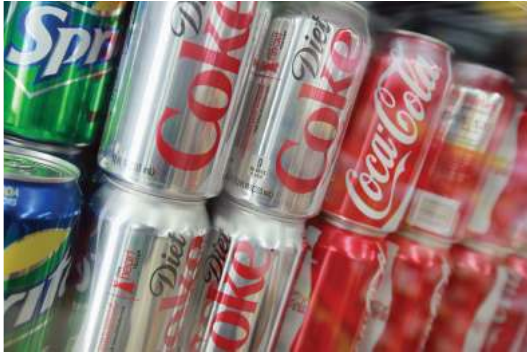
The base unit for measuring capacity is the litre (L). In everyday life and in various industries, we use different units depending on the size of the container or volume of liquid we're measuring.
Units of capacity
There are three commonly used units for measuring capacity:
- Megalitre (ML): Used for very large volumes, such as water storage in dams
- Kilolitre (kL): Used for large volumes, such as swimming pools
- Millilitre (mL): Used for small volumes, such as drinks or medicine
Note
Choosing the Right Unit:
The unit you choose depends on what you're measuring. Just as you wouldn't measure the distance between cities in millimetres, you wouldn't measure a swimming pool's capacity in millilitres. Using appropriate units makes measurements more practical and easier to understand.
Conversions between capacity units
Understanding how to convert between different capacity units is essential. Here are the key conversion factors:
Important
Essential Capacity Conversions:
Between capacity units:
- ML kL
- ML L
- kL L
- L mL
Between volume and capacity:
- cm³ mL
- cm³ L
- cm³ L
- m³ cm³
- m³ mL
- m³ L
- m³ kL
These conversions are the foundation for all capacity calculations!
These conversions are particularly useful when you need to calculate the capacity of a container after finding its volume in cubic units.
Converting volume to capacity
When working with containers, you often need to convert from volume (measured in cubic centimetres or cubic metres) to capacity (measured in litres or millilitres). Understanding these relationships helps you move between measuring space and measuring liquid content.
Key conversion relationships
Note
For small volumes:
- cm³ equals exactly mL – this is the most important conversion to remember
- To convert cm³ to litres, multiply by
- Remember: cm³ makes litre
For large volumes:
- m³ equals exactly kL (or L)
- This works because m³ cm³, and mL L
Worked example: Finding capacity
Let's work through an example of finding the capacity of a rectangular container. This type of problem requires two steps: first calculating volume, then converting to capacity.
Example
Worked Example: Finding Container Capacity
Problem: A rectangular container measuring cm by cm by cm is filled with water.
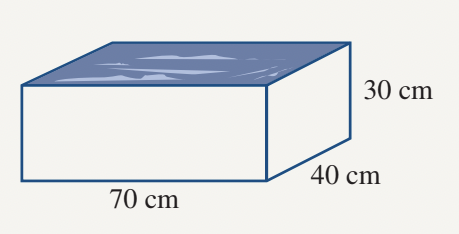
a) Find the volume of the container in cubic centimetres.
b) Find the capacity of the container in litres.
Solution
Part a) Finding the volume:
Use the volume formula for a right prism:
The base is a rectangle, so we use the area formula .
Substitute the dimensions:
Calculate:
Part b) Finding the capacity:
There are two methods to convert from cm³ to litres.
Method 1: Multiply by
Method 2: Convert to mL first, then to litres
Since cm³ mL:
Since mL L:
Both methods give the same answer: the container has a capacity of litres.
Summary
Key Points to Remember:
-
Capacity measures liquid content – it tells you how much liquid a container can hold, while volume measures the space occupied by a solid.
-
The litre is the base unit – all capacity measurements relate back to litres (L), with megolitres and kilolitres for larger volumes, and millilitres for smaller volumes.
-
Simple conversion for cubic centimetres – remember that cm³ mL, making conversions between small volumes and capacity straightforward.
-
Two-step approach – when finding capacity, first calculate the volume in cubic units, then convert to litres using the appropriate conversion factor.
-
Check your units – always ensure you're converting correctly by remembering that cm³ L and m³ L.