Surface Area of Pyramids and Cones (HSC SSCE Mathematics Standard): Revision Notes
📚Revision Notes
Surface Area of Pyramids and Cones
Surface area of a square pyramid
To work out the surface area of a pyramid, we add together the areas of all its faces. A square pyramid has a square base and four identical triangular faces that meet at a point called the apex.
Understanding slant height
Important
Critical Concept: Slant Height vs Perpendicular Height
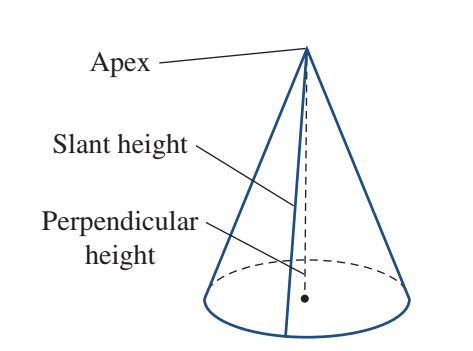
The slant height is a crucial measurement for calculating surface area. It is the distance from the apex down to the base edge, measured along a triangular face. This is different from the perpendicular height, which is the straight vertical distance from the apex down to the centre of the base.
These two measurements are NOT the same and cannot be used interchangeably in formulas!
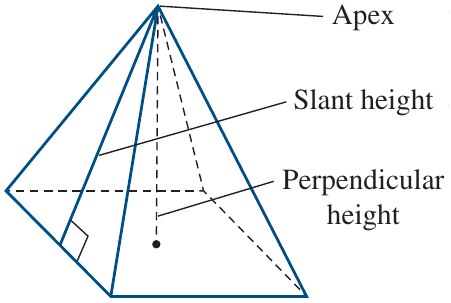
Think of it this way: if you were an ant walking on the surface of the pyramid from the apex to the base edge, you would travel the slant height distance. The perpendicular height would be the distance if you could drill straight through the inside of the pyramid.
Formula for surface area of a square pyramid
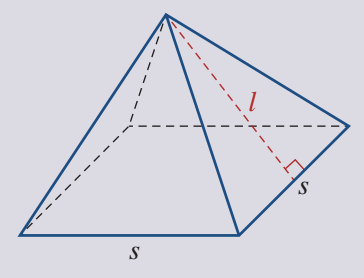
A square pyramid consists of:
- One square base with area (where is the side length)
- Four identical triangular faces, each with area (where is the slant height)
The total surface area formula is:
Where:
- is the side length of the square base
- is the slant height of each triangular face
Note
The formula can be read as: "square base area + four triangular faces". The represents the combined area of all four triangular faces, since each triangle has base and height (the slant height).
Worked example: Square pyramid
Example
Worked Example: Finding Surface Area of a Square Pyramid
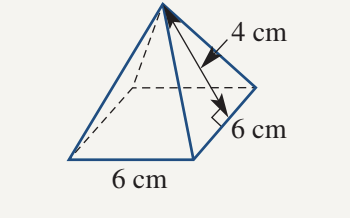
Question: A square pyramid has a base with side length cm and a slant height of cm. Find the surface area of this square pyramid.
Solution:
To solve this problem, we'll work through it step by step:
Drawing the net helps us visualise all the surfaces. The net shows the square base surrounded by four triangular faces.
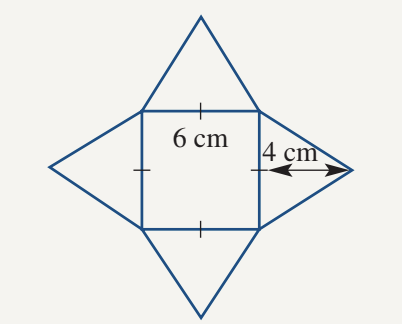
Using the surface area formula:
Substituting and :
Exam tip: Always check that your answer is in square units (cm², m², etc.) for area questions.
Surface area of a cone
A cone is made up of two distinct surfaces: a flat circular base and a curved surface that extends from the base edge up to the apex. The radius of the circular base is , and the slant height along the curved surface is .
Formula for surface area of a cone
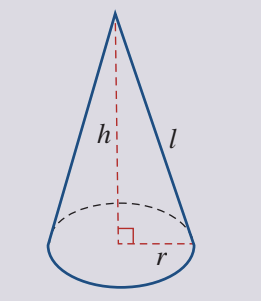
The surface area combines:
- The circular base with area
- The curved surface with area
The complete formula is:
Where:
- is the radius of the circular base
- is the slant height of the curved surface
- is the perpendicular height (used when we need to calculate )
Note
Understanding the Two Terms
Notice the formula has two terms:
- represents the flat circular base
- represents the curved surface that wraps around to the apex
Both parts are essential for calculating the complete surface area of a cone.
Finding the slant height using Pythagoras' theorem
Often, you'll be given the perpendicular height and radius but not the slant height. When this happens, we can use Pythagoras' theorem because the radius, perpendicular height, and slant height form a right-angled triangle inside the cone.
The relationship is:
Where:
- is the slant height
- is the perpendicular height
- is the radius
Important
When to Use Pythagoras' Theorem
If a question gives you the perpendicular height and radius but NOT the slant height, this is your signal to use Pythagoras' theorem first. Always draw the right triangle inside the cone to help identify which measurements you have and which you need to find.
Worked example: Cone with perpendicular height
Example
Worked Example: Finding Slant Height and Surface Area of a Cone
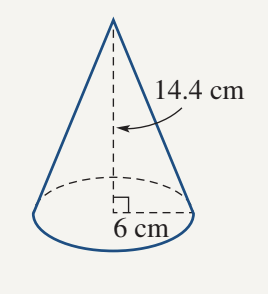
Question: A cone has a radius of cm and a perpendicular height of cm.
a) Find the slant height of the cone. Answer correct to one decimal place.
b) Find the surface area of the cone. Answer correct to the nearest square centimetre.
Solution:
Part a) Finding the slant height:
First, we visualise the right-angled triangle formed by the radius, perpendicular height, and slant height inside the cone.
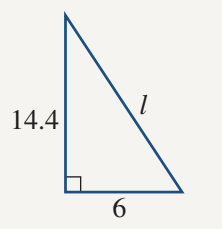
Using Pythagoras' theorem:
Part b) Finding the surface area:
Now we can use the surface area formula with the slant height we just calculated:
Remember!
Summary
Key Points to Remember:
-
Surface area of a square pyramid: Add the square base area to the total area of four triangular faces using the formula
-
Slant height vs perpendicular height: The slant height is the distance along the surface of the shape, while the perpendicular height is the straight vertical distance from apex to base
-
Surface area of a cone: Combine the circular base and curved surface using
-
Use Pythagoras when needed: If you're given perpendicular height and radius but not slant height, use to find the slant height first
-
Units matter: Always express surface area in square units (cm², m², etc.) and include units in your final answer