Surface Area of Right Prisms (HSC SSCE Mathematics Standard): Revision Notes
📚Revision Notes
Surface Area of Right Prisms
Introduction
When working with three-dimensional shapes like prisms, we often need to find the total area of all the outer surfaces. This is called the surface area. To calculate surface area accurately, it helps to visualise all the faces of the solid shape.
A useful tool for this is a net. A net is a flat, two-dimensional pattern that shows all the surfaces of a solid spread out. When you fold a net along its edges, it forms the three-dimensional solid. Think of it like unfolding a cardboard box and laying it flat - this gives you the net of the box.
Note
Nets are particularly helpful because they allow you to see all faces of a prism at once, making it much easier to ensure you haven't missed any surfaces in your calculation. Some faces may be hidden from view in a 3D drawing, but they're clearly visible in a net.
The surface area of a solid is the sum of the areas of all its faces. For right prisms, this means adding up the areas of all the polygons that form the outer surfaces. Often, some faces will have the same area (for example, opposite faces of a rectangular prism), which makes our calculations simpler.
Method for finding surface area
Follow these steps to find the surface area of any right prism:
Important
Systematic 5-Step Procedure:
Step 1: Identify all the surfaces of the solid. If needed, sketch the net to see all faces clearly.
Step 2: Create a formula for the surface area based on the faces you identified in the net.
Step 3: Substitute the given measurements into your surface area formula.
Step 4: Calculate the surface area using a calculator if necessary.
Step 5: Write your final answer with the correct units (such as cm² or mm²) and to the appropriate level of accuracy.
This systematic approach ensures you account for every face and avoid common calculation errors.
Worked examples
Example 1: Rectangular prism
Let's find the surface area of a rectangular prism with dimensions .
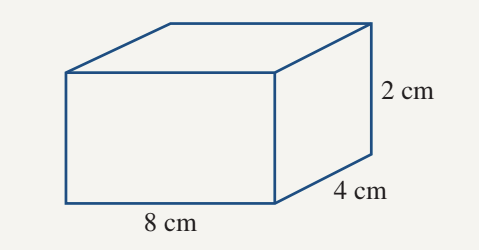
Example
Worked Example: Finding Surface Area of a Rectangular Prism
Solution:
First, we draw the net of this rectangular prism to see all six faces:
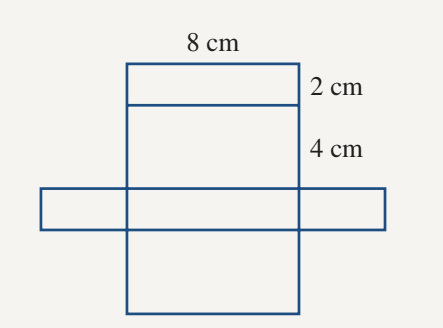
Looking at the net, we can see the prism has six rectangular faces. There are three pairs of identical faces:
- Two faces measuring
- Two faces measuring
- Two faces measuring
Now we write the surface area formula. Let = length, = breadth, and = height:
Substituting our values where , , and :
Therefore, the surface area of this rectangular prism is 112 cm².
Example 2: Triangular prism
Let's find the surface area of a triangular prism where the triangular face has a base of and height of , and the prism has a length of with two other edges each measuring .
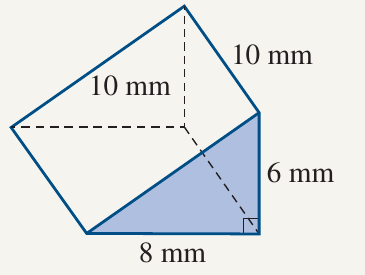
Example
Worked Example: Finding Surface Area of a Triangular Prism
Solution:
A triangular prism has five faces in total:
- Two triangular faces (at each end)
- Three rectangular faces (forming the sides)
First, we calculate the area of one triangular face using the formula:
where is the base and is the height.
Substituting and :
Now we can write the complete surface area formula by adding all five faces:
Breaking this down:
- accounts for both triangular faces
- is one rectangular face
- is the second rectangular face
- is the third rectangular face
Calculating:
Therefore, the surface area of this triangular prism is 288 mm².
Note
Notice how we calculated the triangular face area first, then used that result in the complete surface area formula. This step-by-step approach helps prevent calculation errors and keeps your working organized.
Example 3: Trapezoidal prism
Let's find the surface area of a trapezoidal prism with parallel sides of and , perpendicular height of , slant edges of and , and length .
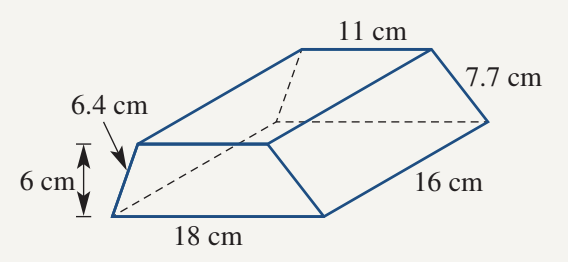
Example
Worked Example: Finding Surface Area of a Trapezoidal Prism
Solution:
A trapezoidal prism has six faces:
- Two trapezoidal faces (at each end)
- Four rectangular faces (forming the sides)
First, we calculate the area of one trapezoidal face using the formula:
where and are the parallel sides and is the perpendicular height.
Substituting , , and :
Now we write the surface area formula including all six faces:
Breaking this down:
- accounts for both trapezoidal faces
- is the rectangular face along the top edge
- is one slanted rectangular face
- is the rectangular face along the bottom edge
- is the other slanted rectangular face
Calculating:
Therefore, the surface area of this trapezoidal prism is 863.6 cm².
Important
Common Mistake to Avoid:
When working with trapezoidal or triangular prisms, students often forget to include all the rectangular side faces. Always count the number of edges on the cross-sectional shape - this tells you how many rectangular faces your prism has!
Key formulas
Note
Essential Area Formulas for Prism Faces:
For your reference, here are the area formulas for common shapes that form the faces of prisms:
Rectangle: (length times breadth)
Triangle: (half of base times height)
Trapezoid: (half the sum of parallel sides times height)
Keep these formulas handy when calculating surface areas of different types of prisms.
Remember!
Summary
Key Points to Remember:
-
Draw the net first - Sketching the net helps you identify all faces and avoid missing any in your calculation. It's especially helpful for more complex prisms.
-
Identify matching faces - Many prisms have pairs of identical faces (like opposite sides of a rectangular prism). You can save time by calculating one face and multiplying by 2.
-
Use the correct formula - Make sure you're using the right area formula for the cross-sectional shape (triangle, trapezoid, etc.) of your prism.
-
Always include units - Surface area is measured in square units (cm², mm², m²). Don't forget to include these in your final answer.
-
Add all faces together - Surface area means the total area of every face. Double-check that you've included all faces in your calculation, not just the visible ones.