Trapezoidal Rule (HSC SSCE Mathematics Standard): Revision Notes
📚Revision Notes
Trapezoidal Rule
What is the trapezoidal rule?
The trapezoidal rule is a mathematical technique used to estimate the area of shapes with irregular boundaries. It's based on the same principle as calculating the area of a trapezium, but uses different variable names to make it more practical for real-world applications.
Note
The trapezoidal rule is especially valuable in practical situations where you need to find areas of land or irregular shapes that can't be measured as perfect geometric figures. It provides a quick and reasonably accurate approximation.
Connection to trapezium area
The trapezoidal rule comes directly from the trapezium area formula. Both formulas work in exactly the same way - they find the area by taking the average of two parallel sides and multiplying by the perpendicular distance between them.
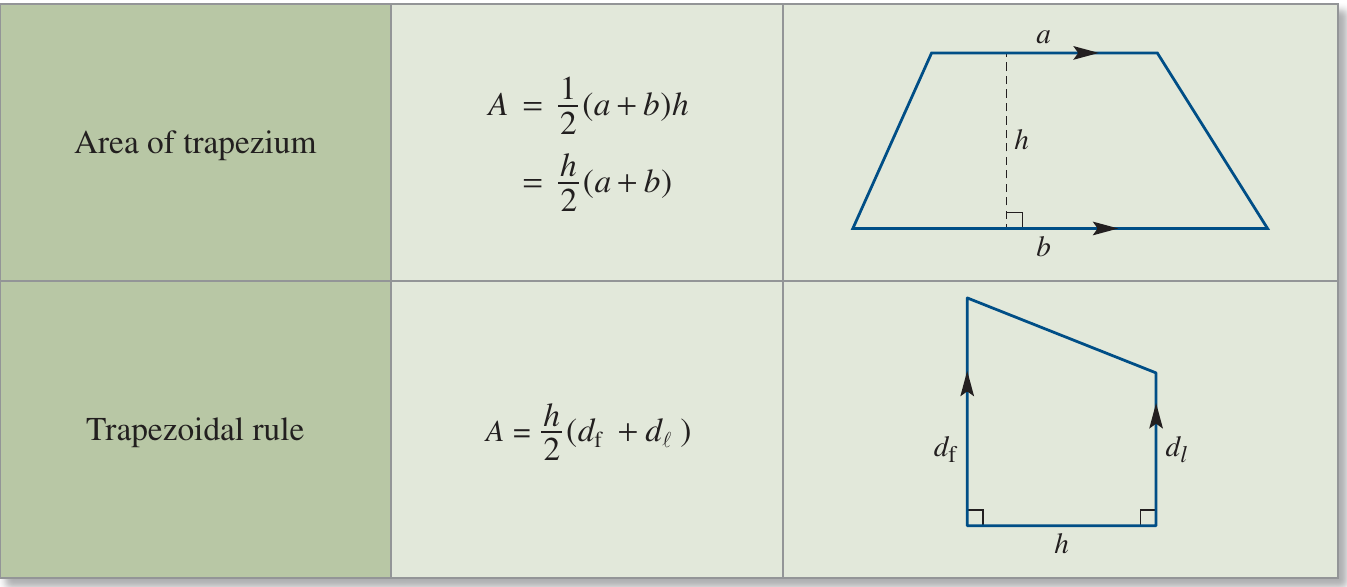
The standard trapezium formula is:
The trapezoidal rule formula is:
Note
Notice how the structure of both formulas is identical - the only difference is in the variable names used. This makes the trapezoidal rule easier to apply in practical surveying and measurement situations.
Understanding the variables
Each variable in the trapezoidal rule has a specific meaning:
- represents the area of the shape being estimated
- is the height or perpendicular width between the parallel sides
- is the distance along the first parallel side
- is the distance along the last parallel side
Important
The subscripts 'f' and 'l' help you remember which measurements to use - 'f' for first and 'l' for last. This notation system prevents confusion when working with multiple measurements in complex shapes.
When to use the trapezoidal rule
The trapezoidal rule is particularly useful for estimating areas of shapes that have one or more irregular boundaries. Common applications include:
- Land plots bordered by natural features like lakes or rivers
- Irregular agricultural fields
- Any shape where one side cannot be measured as a straight line
The rule works by treating the irregular shape as if it were a trapezium, giving an approximate area that's close to the true value.
Note
While the trapezoidal rule gives an approximation rather than an exact answer, it's often the most practical method available for real-world measurements. The approximation is generally accurate enough for most practical purposes, especially when the irregular boundary is relatively smooth.
Worked example: Single application
Let's look at how to apply the trapezoidal rule once to estimate an area.
Example
Worked Example: Single Application
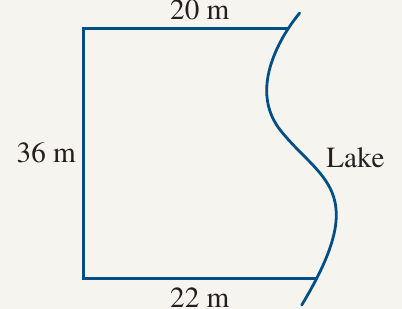
A block of land has a lake forming one of its boundaries as shown. Find the approximate area of the land to the nearest square metre.
Solution:
Write the trapezoidal rule formula:
Identify the values from the diagram:
Substitute these values into the formula:
Calculate the result:
The estimated area of the land block is 756 square metres.
Improving accuracy with two applications
When you apply the trapezoidal rule more than once to the same shape, you get a better estimate of the true area. This technique involves:
- Dividing the irregular shape into two or more sections
- Applying the trapezoidal rule to each section separately
- Adding the results together to get the total area
Important
Why does this work better?
By breaking the shape into smaller sections, you reduce the effect of the irregular boundary on each calculation. Each smaller section more closely resembles a true trapezium, leading to a more accurate overall estimate. This is one of the most effective ways to improve the accuracy of your area calculations.
Worked example: Two applications
Let's see how to apply the rule twice for improved accuracy.
Example
Worked Example: Two Applications
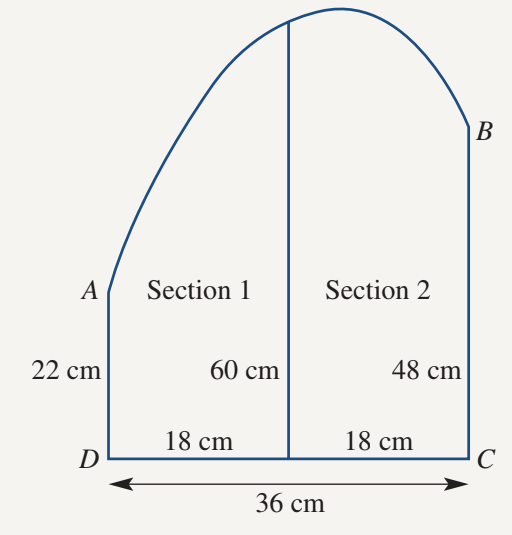
Use the trapezoidal rule twice to estimate the area of shape ABCD to the nearest square centimetre.
Solution:
Divide the shape into two sections. Looking at the diagram, we can split it at the 60 cm measurement, creating Section 1 on the left and Section 2 on the right.
For Section 1:
For Section 2:
Apply the trapezoidal rule to both sections:
Substitute the values:
Calculate each section:
The estimated area of shape ABCD is 1710 square centimetres.
Exam tips
Important
Essential Tips for Exam Success:
- Always check which measurements represent , , and in the diagram before starting your calculations
- Remember that is always perpendicular to the parallel sides - this is a common source of errors
- When using two applications, make sure the of the first section equals the of the second section at the point where they meet
- Round your final answer appropriately according to the question requirements
- Include correct units in your final answer - marks are often lost for missing units
Summary
Summary
Key Points to Remember:
- The trapezoidal rule formula is , where is the perpendicular distance between parallel sides, is the first parallel distance, and is the last parallel distance
- The rule is used to estimate areas of shapes with irregular boundaries by treating them as trapeziums
- Applying the rule multiple times to different sections of a shape gives a more accurate estimate than a single application
- The trapezoidal rule is based on the same mathematical principle as the trapezium area formula, just with different variable names
- Always substitute values carefully and double-check which measurement corresponds to each variable before calculating