Volume of Cylinders and Spheres (HSC SSCE Mathematics Standard): Revision Notes
📚Revision Notes
Volume of Cylinders and Spheres
Understanding cylinders
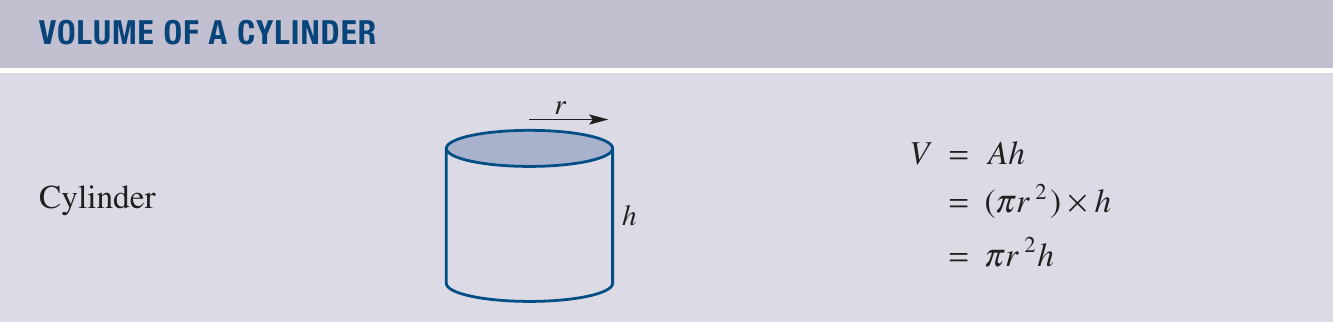
A cylinder is a three-dimensional shape that has two circular ends (called bases) connected by straight parallel sides. You can think of it as a can or a tube. The cylinder has a circular cross-section, which means if you slice through it horizontally, you always see a circle.
Note
The key measurements for a cylinder are:
- Radius : the distance from the centre to the edge of the circular base
- Height : the vertical distance between the two circular ends
The volume formula for cylinders
To find the volume of a cylinder, we need to calculate how much space it occupies. This is done by multiplying the area of the circular base by the height of the cylinder.
Since the base is a circle with area , we can write:
Substituting the circle area formula:
This simplifies to:
Note
This formula tells us that the volume of a cylinder is the product of , the square of the radius, and the height. It combines the familiar circle area formula with the height to give us a three-dimensional measurement.
Worked example: Finding the volume of a cylinder
Example
Worked Example: Basic Cylinder Volume
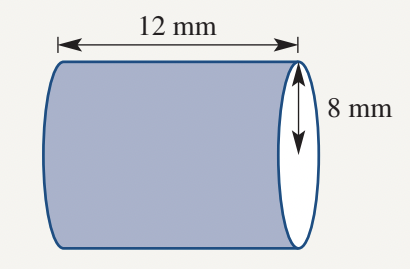
Question: A cylinder has a radius of mm and a height of mm. Find the volume of the cylinder, correct to two decimal places.
Solution:
- Begin with the volume formula for a cylinder:
- Replace and into the formula:
- Calculate the value:
- Round the answer to two decimal places and include the correct units:
Important
Exam tip: Always remember to cube the units when finding volume. If the measurements are in mm, the volume will be in mm³.
Worked example: Finding the volume of an annulus prism
An annulus is a ring shape - a circle with a circular hole in the middle. An annulus prism is this ring shape extended to create a three-dimensional object.
Example
Worked Example: DVD Annulus Prism
Question: The diameter of a DVD is cm, and the diameter of the hole in its centre is cm. Find its volume in cubic centimetres, correct to two decimal places, given that the DVD is cm thick.
Solution:
- First, find the area of the annulus (the ring shape) using the formula where is the outer radius and is the inner radius.
- The outer radius is cm
- The inner radius is cm
- Calculate the area:
- Now use the volume formula for a prism:
- Substitute and :
- Round to two decimal places:
Important
When you're given a diameter, always remember to divide by 2 to find the radius before using the formulas. This is one of the most common mistakes in volume calculations!
Understanding spheres and hemispheres
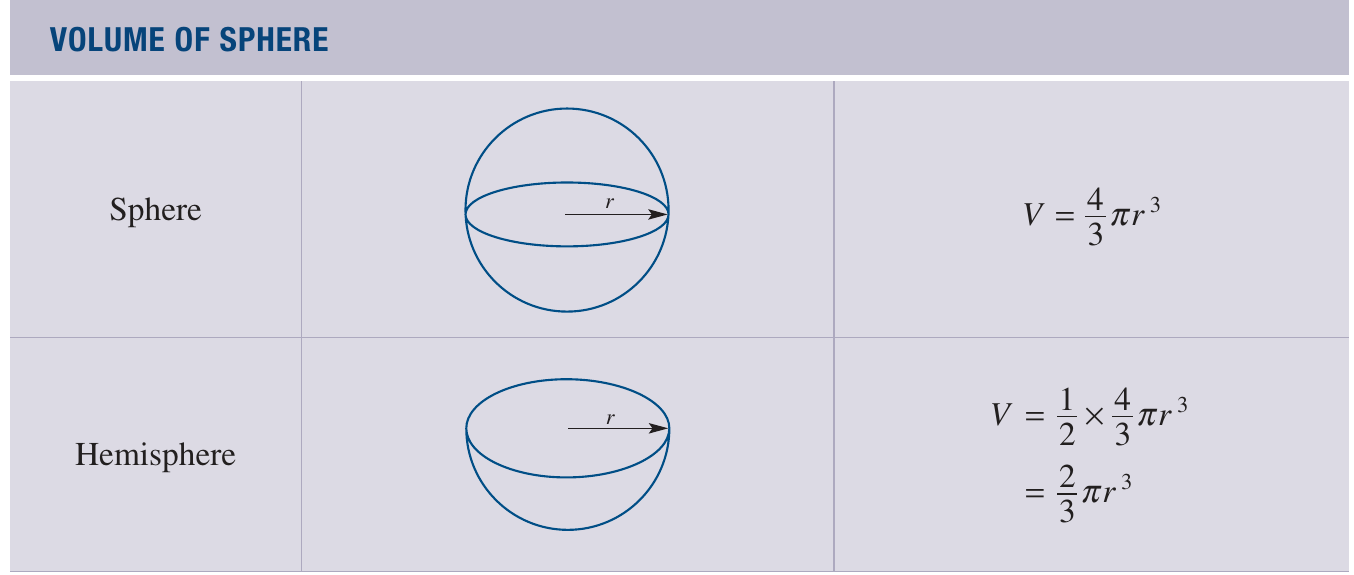
A sphere is a perfectly round three-dimensional object, like a ball. Every point on the surface of a sphere is the same distance from its centre. This distance is called the radius .
A hemisphere is exactly half of a sphere. You can imagine it as a ball cut in half through its centre.
Volume formulas for spheres and hemispheres
The volume of a sphere is calculated using the formula:
This means to find the volume, you cube the radius (multiply it by itself three times), multiply by , then multiply by .
Since a hemisphere is exactly half of a sphere, its volume is:
Note
Notice that half of equals . This makes the hemisphere formula easier to remember - you just need to change the numerator from 4 to 2!
Worked example: Finding the volume of a sphere
Example
Worked Example: Sphere Volume
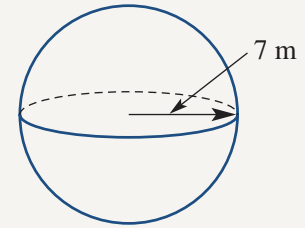
Question: Find the volume of a sphere with radius m. Answer correct to one decimal place.
Solution:
- Begin with the volume formula for a sphere:
- Substitute into the formula:
- Calculate the value:
- Round to one decimal place and include units:
Worked example: Finding the volume of a hemisphere
Example
Worked Example: Hemisphere Volume
Question: Find the volume of a hemisphere with diameter m. Answer correct to one decimal place.
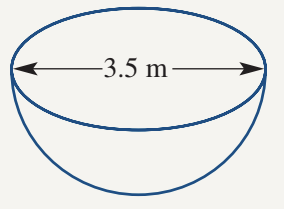
Solution:
- Begin with the volume formula for a hemisphere:
- Find the radius from the diameter. Since diameter m:
- Substitute into the formula:
- Calculate the value:
- Round to one decimal place and include units:
Important
Key point: When you're given a diameter for a sphere or hemisphere, always divide by 2 to find the radius before using the volume formula. Many calculation errors occur from forgetting this crucial step!
Remember!
Summary
Key Points to Remember:
- Cylinder volume: - multiply the circular base area by the height
- Sphere volume: - cube the radius and multiply by
- Hemisphere volume: - exactly half the volume of a sphere
- Always convert diameter to radius by dividing by before using the formulas
- Check your units carefully - volume is always measured in cubic units (mm³, cm³, m³)