Volume of Pyramids and Cones (HSC SSCE Mathematics Standard): Revision Notes
📚Revision Notes
Volume of Pyramids and Cones
Understanding pyramids and cones
When you compare a pyramid to a prism with the same base and height, something interesting happens. The pyramid takes up exactly one-third of the space that the prism occupies. This same relationship applies to cones and cylinders.
Note
This one-third relationship is crucial because it helps us calculate the volume of pyramids and cones. If you know how to find the volume of a prism or cylinder, you can find the volume of the corresponding pyramid or cone by simply dividing by three.
The general formula for the volume of any pyramid is:
where:
- = volume (in cubic units)
- = area of the base
- = perpendicular height from base to apex
For a cone, we use the same formula structure, where the base is a circle.
Volume formulas
The key to finding the volume of pyramids and cones is identifying the shape of the base. Once you know the base shape, you can work out its area and apply the one-third rule.
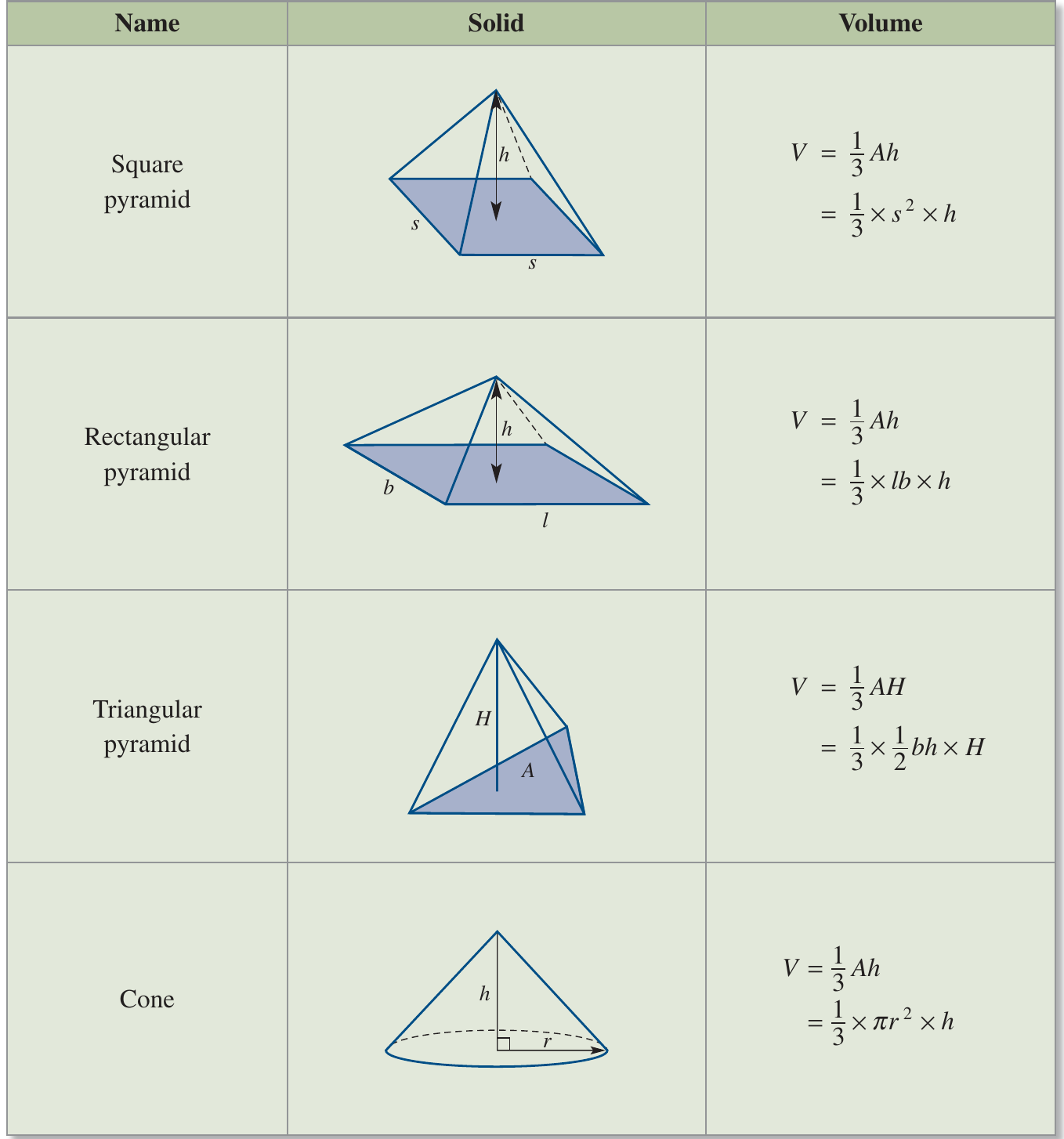
Here are the specific formulas for different types:
Square pyramid
When the base is a square with side length :
The base area is (square of the side length), which you multiply by the height and then divide by 3.
Rectangular pyramid
When the base is a rectangle with length and breadth :
The base area is , which you multiply by the height and then divide by 3.
Triangular pyramid
When the base is a triangle with base and height , and the pyramid has height :
Important
Here you need to be careful with the two different heights. The small is the height of the triangular base, while the capital is the height of the pyramid itself.
Cone
When the base is a circle with radius :
The base area is (the area of a circle), which you multiply by the height and then divide by 3.
Note
Exam tip: Always write down the formula first, then substitute your values, and finally calculate the answer. This makes your working clear and helps you avoid mistakes.
Calculating volume: worked examples
Example
Worked Example 1: Finding the volume of a square pyramid
Let's find the volume of a square pyramid with a height of m and a square base with sides of m. We'll round our answer to the nearest cubic metre.
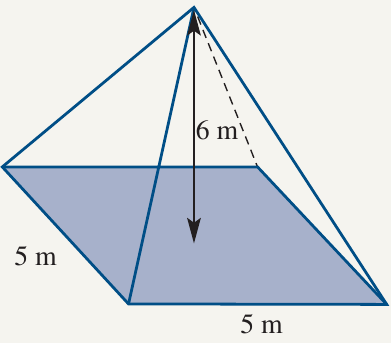
Solution:
Step 1: Start with the general volume formula for a pyramid:
Step 2: The base is a square, so the base area is:
Step 3: Substitute the measurements into the formula:
Step 4: Calculate the result:
Answer: The volume of the pyramid is 50 m³
In this example, the answer came out as a whole number, so no rounding was needed. However, always check whether the question asks for a specific number of decimal places or significant figures.
Example
Worked Example 2: Finding the volume of a cone
Find the volume of a cone with radius m and height m. Give your answer correct to three significant figures.
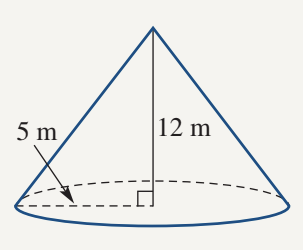
Solution:
Step 1: Start with the volume formula for a cone:
Step 2: The base is a circle, so the base area is:
Step 3: Substitute the values for radius and height into the formula:
Step 4: Calculate the result:
Step 5: Round to three significant figures:
Answer: The volume of the cone is 314 m³
When a question asks for a specific number of significant figures or decimal places, make sure you write down the full calculator answer first, then round it. This shows the examiner that you know how to round correctly.
Summary
Key Points to Remember:
-
The one-third rule: Pyramids and cones always have a volume equal to one-third of the corresponding prism or cylinder with the same base and height.
-
General formula: The volume of any pyramid or cone is , where is the base area and is the perpendicular height.
-
Know your base shapes: Identify whether the base is a square (), rectangle (), triangle (), or circle () to find the correct area formula.
-
Show all working: Always write the formula, substitute the values, and then calculate. This helps you check your work and earn method marks in exams.
-
Units matter: Volume is always measured in cubic units (m³, cm³, etc.). Don't forget to include units in your final answer.