Blood Types (HSC SSCE Mathematics Standard): Revision Notes
📚Revision Notes
Blood Types
What are blood types?
Blood types are identified using a combination of letters and the Rh factor. Each person's blood type consists of:
- A letter designation: A, B, AB, or O
- An Rh factor: either positive (+) or negative (−)
This creates eight possible blood type combinations: O+, O−, A+, A−, B+, B−, AB+, and AB−.
Blood type frequencies in Australia
Blood types are not distributed equally across the population. Research from the Australian Red Cross Blood Service has identified the percentage of each blood type in the Australian population:
| Blood Type | Percentage of Population |
|---|---|
| O+ | 40% |
| O− | 9% |
| A+ | 31% |
| A− | 7% |
| B+ | 8% |
| B− | 2% |
| AB+ | 2% |
| AB− | 1% |
The most common blood type is O+ at 40% of the population, whilst AB− is the rarest at only 1%.
Note
Notice an important pattern: positive blood types are always more common than their negative counterparts. For example, O+ (40%) is much more common than O− (9%), and A+ (31%) is more common than A− (7%). This pattern holds true for all blood type letter combinations.
Why blood types matter
Blood is essential for human survival, and understanding blood type distribution is crucial for medical services. Blood donors save lives for many people requiring transfusions. Most donated blood is used to treat patients with cancer and other serious illnesses.
Important
The demand for different blood types varies based on their frequency in the population. Since O+ is the most common blood type, it is needed in the largest quantities. However, rarer blood types like AB− are critical for patients with matching blood types who cannot receive other types safely.
Calculating numbers of people with specific blood types
To find how many people in a population have a particular blood type, you need:
- The percentage of that blood type in the population
- The total population number
Important
Calculation Method:
Number of people = Percentage (as decimal) × Population
To convert a percentage to a decimal, divide by 100. For example, 8% becomes 0.08.
Worked example: calculating blood types in the NSW population
Example
Worked Example: NSW Blood Type Calculations
Let's use the NSW population data to calculate how many people have specific blood types.
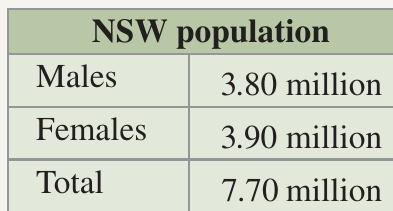
Question a: How many males in NSW have blood type B+?
- From the blood type data, B+ represents 8% of the population
- The male population of NSW is 3.80 million
- Calculate: of million
Therefore, approximately 304,000 males in NSW have blood type B+.
Question b: How many females in NSW have blood type O−?
- From the blood type data, O− represents 9% of the population
- The female population of NSW is 3.90 million
- Calculate: of million
Therefore, approximately 351,000 females in NSW have blood type O−.
Question c: How many people in NSW have blood type A+?
- From the blood type data, A+ represents 31% of the population
- The total population of NSW is 7.70 million
- Calculate: of million
Therefore, approximately 2,387,000 people in NSW have blood type A+.
Remember!
Summary
Key Points to Remember:
- Blood types combine a letter (A, B, AB, or O) with an Rh factor (positive or negative) to create eight possible types
- O+ is the most common blood type in Australia (40%), whilst AB− is the rarest (1%)
- Positive blood types are always more common than their negative counterparts
- To calculate how many people have a specific blood type, multiply the blood type percentage (as a decimal) by the population number
- Understanding blood type distribution is essential for medical services and blood donation programmes
- Always convert percentages to decimals before multiplying (divide by 100)