Time Zones (HSC SSCE Mathematics Standard): Revision Notes
📚Revision Notes
Time Zones
Understanding time zones
Time zones are geographical areas of the Earth where everyone uses the same standard time. The planet is divided into 24 time zones, numbered from to , which are roughly based on lines of longitude running north to south.
Each time zone number tells you how many hours to add or subtract from Coordinated Universal Time (UTC). UTC is the international time standard, based on the time at the prime meridian (the line of longitude). UTC is also known as Greenwich Mean Time (GMT), named after Greenwich in London where the prime meridian passes through.
Note
UTC and GMT are essentially the same for most practical purposes. Both represent the time at longitude, which serves as the reference point for all other time zones around the world.
The International Date Line is an imaginary line running through the Pacific Ocean at approximately longitude. It runs from the North Pole to the South Pole and marks where one calendar day changes to the next.
How time zones work
Understanding whether to add or subtract hours depends on the time zone number:
- Positive time zone numbers (such as , , ): These zones are ahead of UTC. When converting from UTC to these zones, you add the hours.
- Negative time zone numbers (such as , , ): These zones are behind UTC. When converting from UTC to these zones, you subtract the hours.
Important
Key Rule for Time Zone Conversions:
- Positive time zone number → ahead of UTC → Add the time
- Negative time zone number → behind UTC → Subtract the time
This rule is essential for solving all time zone problems correctly!
Remember that everywhere within the same time zone has the same time. This makes coordination and communication easier within regions.
Australian time zones
Australia spans three different time zones. From east to west, these are:
- Eastern Standard Time (EST): UTC hours
- Central Standard Time (CST): UTC hours
- Western Standard Time (WST): UTC hours
Notice that Central Standard Time uses a half-hour offset (), which is less common than whole-hour offsets.
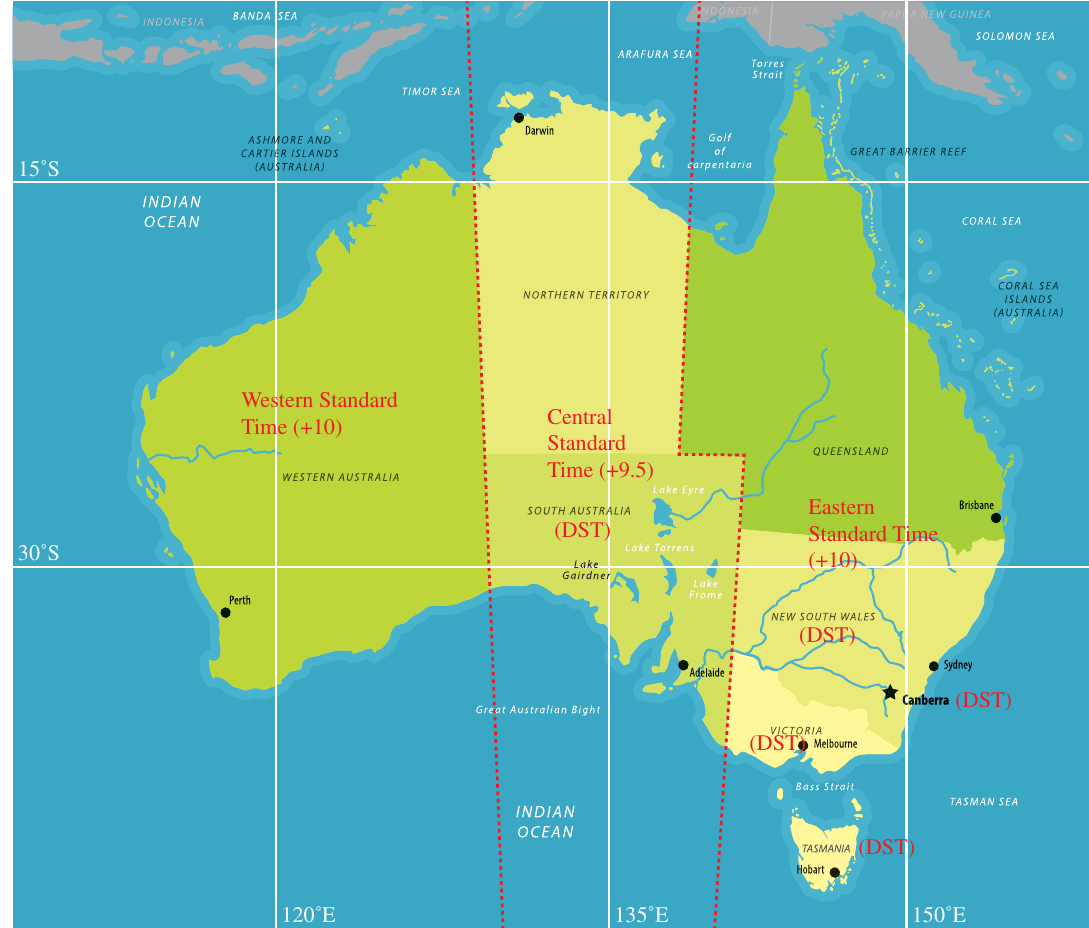
The map above shows how Australia is divided into these three time zones. The red dotted lines mark the boundaries between zones. Major cities in each zone include:
- Eastern zone (): Sydney, Melbourne, Brisbane, Hobart, Canberra
- Central zone (): Adelaide, Darwin, Alice Springs
- Western zone (): Perth
Note
The Eastern zone has the highest UTC offset at hours, meaning it's the furthest ahead of UTC. This means when you travel west across Australia, you need to turn your clock back.
Daylight saving time
Daylight saving time (DST) involves moving clocks forward by one hour during the warmer months. This practice allows people to take advantage of longer daylight hours in summer.
Important
States that observe daylight saving:
- New South Wales
- Victoria
- South Australia
- Tasmania
- Australian Capital Territory
States that do NOT observe daylight saving:
- Queensland
- Northern Territory
- Western Australia
When daylight saving operates
In Australia, daylight saving follows this schedule:
- Start date: First Sunday in October (clocks move forward hour)
- End date: First Sunday in April (clocks move back hour)
Note
An easy way to remember: "October On, April Off" – clocks go forward in October and back in April.
Calculating with daylight saving
When daylight saving time is operating in a location, you need to add one extra hour to your time calculation. This is in addition to any time zone differences.
Working with time zones
Let's look at how to solve problems involving time zones and daylight saving time.
Example
Worked Example: Basic Time Zone Conversion
Problem: Hobart is in the Eastern Standard Time zone (UTC ) and Greenwich is at UTC (time zone ). What is the time in:
a) Hobart if it is : p.m. in Greenwich?
b) Greenwich if it is : a.m. in Hobart?
Solution:
Part a:
Hobart is in EST () and is hours ahead of UTC at Greenwich.
Since Hobart is ahead, we add the time:
Part b:
Greenwich is at UTC and is hours behind Hobart (which is in EST ).
Since Greenwich is behind, we subtract the time:
Example
Worked Example: Time Zone Conversion with Daylight Saving
Problem: Jack in Sydney wants to phone his mother in Perth. Sydney is in UTC () and Perth is in UTC (). Daylight saving time is currently operating in Sydney. When should Jack ring to reach his mother at : p.m. in Perth?
Solution:
Step 1: Calculate the basic time difference
Sydney is in UTC () and Perth is in UTC ().
Sydney is hours ahead of Perth.
If it's : p.m. in Perth, we add hours for Sydney:
Step 2: Account for daylight saving
Sydney is observing daylight saving, so we add one more hour:
Answer: Jack should ring when it is : p.m. in Sydney.
International time zones reference
The table below shows the standard time zones around the world and major cities in each zone. This table does not account for daylight saving time, which may affect actual local times during certain periods.
| Time zone | Major places |
|---|---|
| Eniwetok | |
| Midway Island, Samoa | |
| Cook Is, Honolulu, Tahiti | |
| Alaska | |
| Anchorage, Los Angeles, San Francisco, Seattle, Vancouver | |
| Alberta, Denver, Edmonton, Phoenix, Salt Lake City, Santa Fe | |
| Chicago, Dallas, El Paso, Guatemala, New Orleans, Mexico City | |
| Boston, Kingston, Lima, Miami, Montreal, New York, Quebec | |
| Caracas, Labrador, La Paz, Santiago | |
| Brasilia, Buenos Aires, Georgetown, Montevideo, Rio de Janeiro | |
| Mid-Atlantic | |
| Azores, Cape Verde Is | |
| Belfast, Dublin, Edinburgh, Iceland, Lisbon, London, Morocco | |
| Amsterdam, Berlin, Madrid, Prague, Paris, Rome, Vienna | |
| Athens, Cairo, Cape Town, Greece, Harare, Helsinki, Istanbul | |
| Baghdad, Beirut, Kuwait, Moscow, Nairobi, Tehran | |
| Abu Dhabi, Baku, Kabul, Kazan, Muscat, Tehran, Volgograd | |
| Colombo, Islamabad, Kolkata, Madras, New Delhi | |
| Dhaka, Kathmandu, Colombo, Sri Lanka | |
| Bangkok, Hanoi, Jakarta, Phnom Penh | |
| Beijing, Hong Kong, Kuala Lumpur, Manila, Perth, Singapore | |
| Osaka, Seoul, Sapporo, Seoul, Tokyo | |
| Adelaide, Darwin, Alice Springs, Broken Hill | |
| Brisbane, Canberra, Hobart, Melbourne, Port Moresby, Sydney | |
| Lord Howe Is | |
| Magadan, New Caledonia, Solomon Is, Vanuatu | |
| Auckland, Christchurch, Fiji, Marshall Is, Wellington, Suva |
Note
Exam tip: When working with international time zones, always check whether daylight saving is operating in either location, as this will affect your final answer by one hour.
Remember!
Summary
Key Points to Remember:
-
Time zones divide the Earth into regions, each with a standard time offset from UTC (ranging from to hours).
-
For positive time zones (ahead of UTC), add the hours. For negative time zones (behind UTC), subtract the hours.
-
Australia has three time zones: Eastern (), Central (), and Western ().
-
Daylight saving time adds one extra hour and operates from the first Sunday in October to the first Sunday in April in NSW, Victoria, SA, Tasmania, and the ACT.
-
When solving time zone problems, always work through the basic time zone difference first, then add one hour if daylight saving is operating.